
Last updated: July 2026 · Written by the team at Badminton House
Quick Answer: Choose the Right Block for Your Badminton Season
Build your badminton season plan around the block matching your immediate need: develop capacity before important fixtures, compete without adding technical projects, or reduce load and rebuild after the competition period clearly exposes a weakness.
Base block
Technique plus highest conditioning volume.
Competition block
Match play and patterns; maintain only.
Recovery or rebuild block
Lower load; fix the exposed weakness.
If club nights, league ties and open tournaments all blur into one long stretch of “play more and hope,” your training has no place to absorb fatigue or make a real technical change. A useful badminton season plan gives each part of the year a clear job: build capacity and tolerate short-term messiness, sharpen dependable patterns for competition, then repair what matches exposed. That matters because a half-rebuilt shot is especially vulnerable under pressure, while repeating hard match play year-round leaves little room to improve it. This guide turns that logic into three practical blocks for a club player’s calendar—not as a guaranteed performance shortcut, but as a better way to decide what to train now and what to postpone.
In This Guide
The 3-Block Badminton Season Plan at a Glance
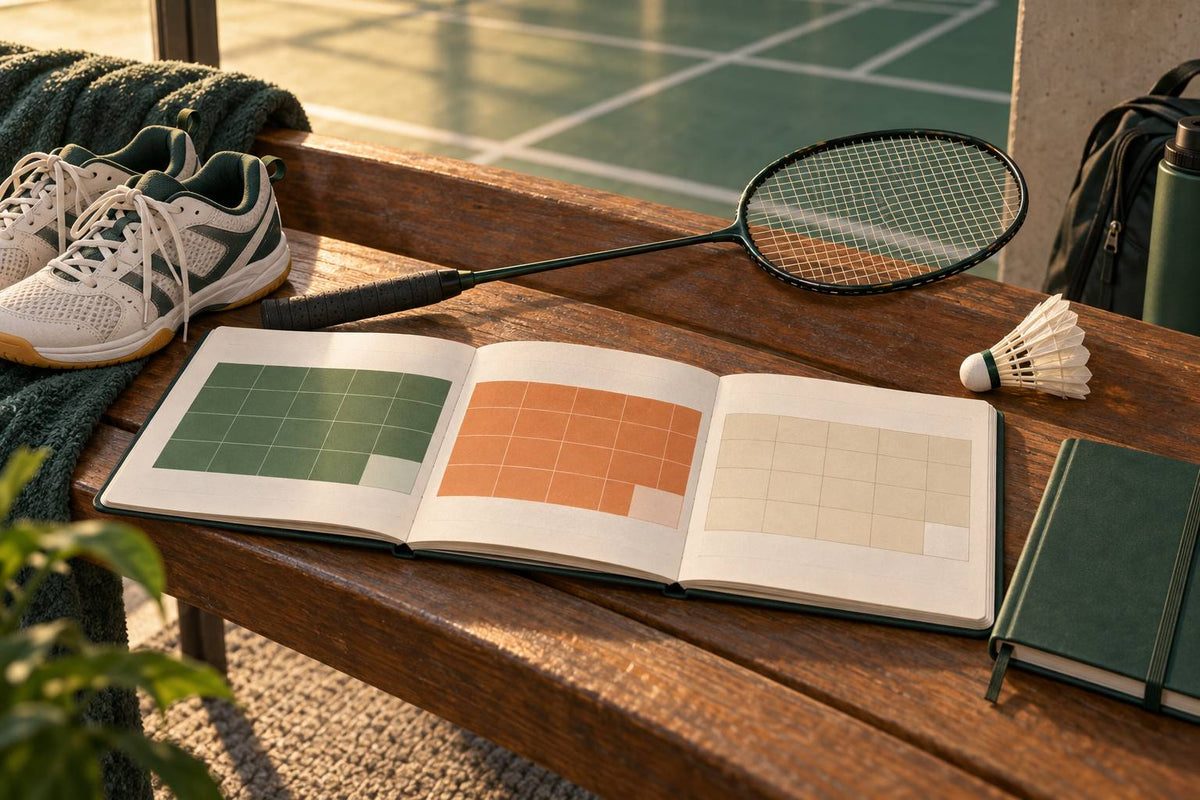
Divide your season into three focused blocks of 6–10 weeks, each ending with a lighter week. The blocks organize training decisions; they do not guarantee better results. Their value is making one priority clear instead of trying to improve everything at once.
| Block | Focus | Session mix | Matches | Do not |
|---|---|---|---|---|
| Base | Technique and conditioning volume | Repetition-heavy practice and footwork | Low | Judge changes by short-term results |
| Competition | Patterns and performance | Conditioned games and match play | High | Start technical projects |
| Recovery/rebuild | Reduce load and fix exposed weaknesses | Technical reps and easier play | Low | Carry competition load forward |
A lighter week cuts hard-effort volume while keeping brief efforts crisp. Put new technical work furthest from competition: under pressure, a half-rebuilt shot is often less dependable than the old pattern.
A Worked 26-Week Calendar for League and Open Tournaments
This illustrative calendar treats league fixtures as recurring performance dates while placing three opens far enough apart to recover, practise and sharpen between them.

| Weeks | Block | Example emphasis |
|---|---|---|
| 1–8 | Base | Technical change, six-direction shadow footwork and short rally-style intervals. Highest conditioning volume; Week 8 is lighter. |
| 9–18 | Competition | League in Weeks 9, 12 and 15; opens in Weeks 10, 14 and 17. Use multi-shuttle work, conditioned games and one reduced-frequency maintenance dose. Week 18 is lighter. |
| 19–26 | Rebuild | Reduced load, bodyweight work and technical reps aimed at exposed weaknesses. Week 26 is lighter. |
Use the badminton weekly training plan to arrange sessions inside each week; see the badminton gym program for strength-planning detail beyond this season-level calendar.
Run One Honest Post-Competition Audit
After the competition block, chart every rally from three to five matches. For each point, record four things:
- Ending shot: smash, net shot, drive, clear or another stroke.
- Outcome: winner, forced error or unforced error.
- Rally state: whether you were attacking or defending.
- Score phase: early, middle or late in the game.
Look for repetition, not the most memorable miss. Unforced errors and rally-ending smashes, net shots, drives and clears are useful signals; defensive situations also deserve attention because they can reduce winners and increase errors. A pattern such as repeated defensive-clear errors late in games is more actionable than “improve consistency.” Make that pattern a rebuild-block target: first stabilize the clear under controlled feeding, then test it from defensive positions and under score pressure. If you have footage, use this 15-minute match-video analysis template to collect the evidence consistently.
What to Do When the Season Gets Interrupted
When work, study, illness or another disruption takes over, switch to maintenance mode rather than abandoning the plan. Lower total volume, but retain brief, sharp on-court efforts where possible. Once regular training resumes, do not compress all the missed conditioning, footwork and matches into one catch-up week.
Rebuild gradually from week to week. Increases above 15% have been associated with greater injury risk, while acute-versus-chronic load can help show whether the current week has jumped far above recent training. Treat both as direction-of-travel heuristics, not hard safety thresholds: workload-ratio cut-offs remain contested and cannot predict an individual injury.
A break does not erase everything. Maximal strength is often largely retained for about 28 days, although strength endurance declines sooner. Cardiorespiratory fitness may take roughly as long to rebuild as the interruption lasted, so let the calendar move back instead of forcing your old workload immediately.
Which Block Should You Choose?
Start with the block that matches your competitive calendar and current training need—not simply the first block on the page.
| Choice | Choose this if… |
|---|---|
| Base block | Competition is furthest away, conditioning volume can be high, and you can accept temporarily worse play while changing technique. |
| Competition block | League or tournament matches are underway. Prioritize patterns, conditioned games and match play; maintain conditioning and postpone new technical projects. |
| Recovery or rebuild block | Competition has ended and your audit identified repeated losing patterns. Reduce load, then rebuild the technical issue that matters most. |
If fixtures overlap two choices, protect match readiness: use the competition block and defer the rebuild until pressure is farther away.
Get 10% off your first order
Join the Badminton House list and we’ll email you a 10% welcome code — plus training guides, technique advice, and badminton updates.
By subscribing, you agree to receive Badminton House emails and can unsubscribe anytime.
At Badminton House, we play badminton and understand that a useful season plan must fit real club nights, league fixtures, and life away from the court. If you want a second opinion on your plan or playing setup, contact us for practical advice.
Prepare for the mileage ahead with footwear suited to your season on court.
Explore the Shoes You’ll Put This Season’s Mileage Through

Leave a comment
This site is protected by hCaptcha and the hCaptcha Privacy Policy and Terms of Service apply.