
Last checked: August 2026 · Written by the player-led team at Badminton House
Quick answer
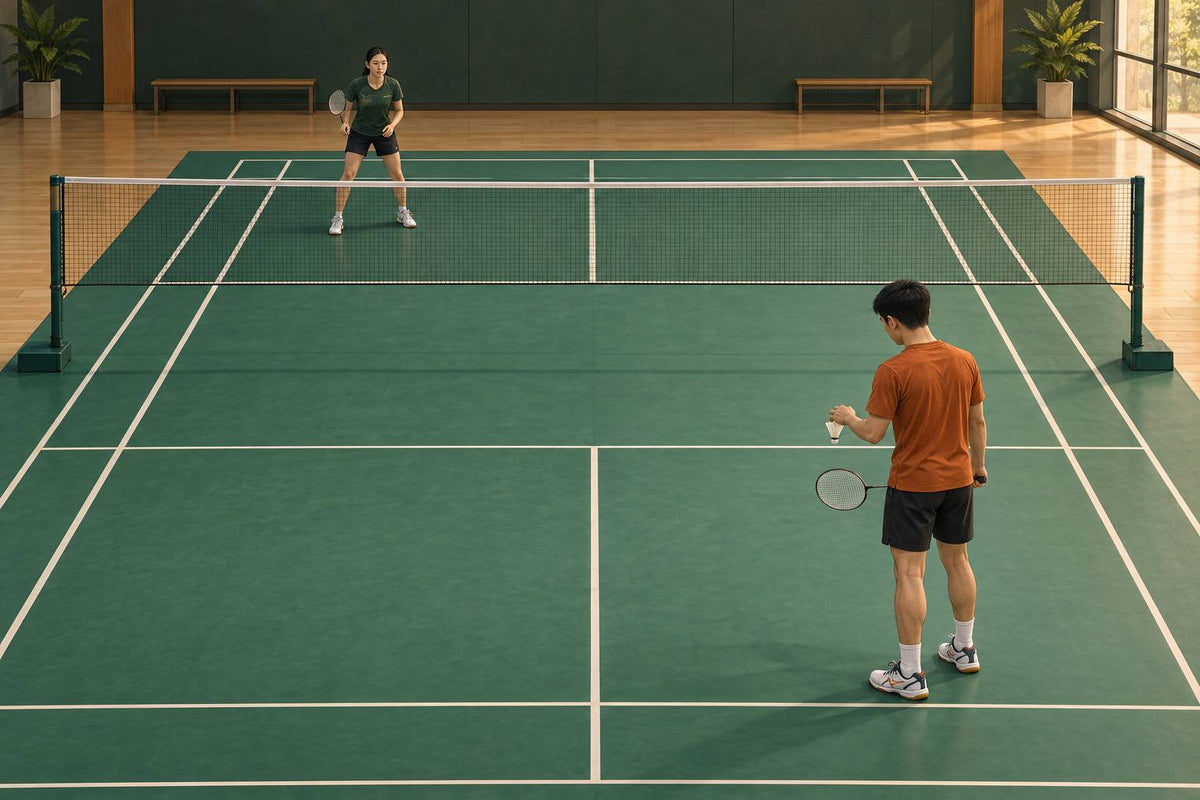
For standard standing badminton, both server and receiver must stand in their diagonally opposite service courts without touching the boundary lines, with some part of both feet in contact with the court in a stationary position from service start until delivery. A service judge judges the server’s delivery; an umpire handles other service faults, including a receiver-side foot or position issue.
Start with Start within the standing-game service courts
For standard standing badminton, use a plain-Law foot check before trying to serve faster. Both players start in diagonally opposite service courts without touching the boundary lines, and some part of both feet stays in stationary contact with the court from service start until delivery.
- For standard standing play, stand in the correct diagonal service courts with a partner and trace the boundary lines under each foot.
- Start the serve only when both players are ready and neither foot touches a boundary line.
- Ask a partner to watch feet only from service start through delivery, using the Law’s contact-and-stationary wording.
- At an officiated match, the service judge judges the server’s delivery and the umpire handles other faults; do not use a local shortcut about heel lifts or moving weight.
Related reading: Where Can Your Doubles Partner Stand at Serve? — for the separate doubles-partner position rule at service.
Start within the standing-game service courts
In standard standing badminton, a correct serve is delivered diagonally into the receiver’s service court, and each player must stand within their service court without touching the boundary lines. Law 9 sets the standing-game service-court position and boundary requirements. BWF Laws of Badminton

Keep part of both feet stationary and in contact
In standard standing badminton, some part of both the server’s and receiver’s feet must remain in contact with the court in a stationary position from the start of service until it is delivered. Law 9.1.4 sets the stationary-contact requirement; Laws 9.2 and 9.3 define when service starts and is delivered. BWF Laws of Badminton

Law 9 gives the service window a defined beginning and end. Once server and receiver are ready, the first forward movement of the server’s racket head starts service. Service is delivered when the shuttle is hit by the racket or when the server misses it in an attempt to serve. The stationary-contact requirement applies throughout that interval. It does not create a separate unofficial rule for one heel, toe, or video frame; the Law’s contact-and-stationary wording is the standard. BWF Laws of Badminton
Know who can call the fault
A service judge judges whether the server delivers a correct service; the umpire applies the Laws to other service faults, including a receiver-side position or foot issue. ITTO 7.2 limits the service judge’s remit to the server’s service, while the Laws assign fault decisions to the umpire. BWF Laws of Badminton and BWF technical-official guidance

Do not confuse a stance fault with a service-court error. Law 12 describes a service-court error when a player serves or receives out of turn, or from the wrong service court. If discovered, it is corrected while the shuttle is not in play and the existing score stands. That is distinct from a service fault under Law 9.1. Keeping the categories separate lets a player describe what happened without relabelling every incorrect service-court sequence as a foot fault. BWF Laws of Badminton
The service judge’s role is server-specific: Law 17.3 and ITTO 7.2 assign that official the server’s delivery. The umpire remains responsible for upholding and enforcing the Laws, including a receiver-side position or foot fault. This is why the same Law 9 wording can apply to both players while the service judge’s call is limited to a fault made by the server. BWF Laws of Badminton and BWF technical-official guidance
Use this distinction on court
For standard standing badminton, separate setup, the service window, and officiating rather than inventing a shortcut about heels or toes. Record only the court position or stationary-contact wording that was observed; Para-badminton, including standing-class and wheelchair service variations, is outside this standard-standing guide.
The cited Laws specify position and stationary contact, not a slow-motion-video test. In an officiated match, the umpire applies the Laws and the service judge judges the server’s delivery.
Use a simple standing-play check
- Confirm diagonal service courts before service begins.
- Check that neither player touches a boundary line.
- Watch whether part of both feet remains in stationary contact through delivery.
- Use the appointed official for a live fault decision.
Questions the cited sources do not settle
- A whole-sole requirement or a claim that every heel lift is automatically a fault.
- Para-badminton service exceptions or a slow-motion-video test beyond the standing-game wording of the Laws.
What to do next
In an officiated match, the service judge judges the server’s delivery and the umpire applies the Laws, including any receiver-side position fault. In club practice, use the Law’s boundary and stationary-contact wording rather than a heel-lift shortcut.


Leave a comment
This site is protected by hCaptcha and the hCaptcha Privacy Policy and Terms of Service apply.