
Last checked: August 2026 · Written by the player-led team at Badminton House
Quick answer
BWF's Laws recognise exactly three short formats when agreed in advance: a single game to 21, a best-of-three to 15, or a best-of-five to 11. The 15-point best-of-three becomes the worldwide default on 4 January 2027. A club running a single game to 11 or 15 is using neither. It's a local convention needing its own rules for a close finish.
- Agree which of the three sanctioned formats (or informal single-game target) you're using before you start.
- Write down what happens at a near-tied score; not every format defines one.
- Expect a short target to punish a slow start harder than 21 points does.
Assumes you know 21-point scoring: this guide covers only the alternative targets. For service courts, faults, and the full current system, see our badminton rules and scoring guide.
What BWF Actually Sanctions as a Short Format
By prior arrangement, BWF's Laws recognise exactly three alternatives to a standard match: a single game to 21 points, a best-of-three to 15 points, or a best-of-five to 11 points. From 4 January 2027, the 15-point best-of-three stops being an optional extra and becomes the default for every BWF-sanctioned match worldwide.
Right now, the standard is best of three games to 21 points: a two-point lead settles a 20-all score, and a hard cap at 30 settles a runaway deuce. BWF's current Laws of Badminton hold that best-of-three-to-21 applies “unless otherwise arranged.” That changes with the Laws taking effect on 4 January 2027, which make 15 points the target everywhere, the same two-point-lead logic now triggering at 14-all with a cap at 21.
That rulebook section, the Alternative Laws of Badminton, lists only three sanctioned short formats, each agreed before play starts. A single game to 21 points changes one thing: players switch ends at 11 points instead of between games. The best-of-three to 15 is already fully defined, with the numbers about to become standard. A best-of-five to 11 is scored differently again: no deuce clause at all, so the first side to reach 11 simply wins the game, with the match settled across up to five short games instead of one long one.
Historically, “games to 11” meant something else. Before 2006, badminton used serve-only scoring, where only the server could add a point: men's singles and doubles played best of three to 15, women's singles best of three to 11, both with a “setting” option to extend a close finish. That system disappeared with rally scoring in 2006, so a modern best-of-five-to-11 match and the old best-of-three-to-11 women's game share a target and nothing else.
Points, Games, and What Each Format Does to a Session
Every format trades fairness for speed. Fewer points per game finishes faster but leaves more room for a lucky run to decide it; more games, as in the best-of-five option, protects the stronger player at the cost of total court time. The table below lines up what each one actually changes.
| Format | Points / games | Deciding-point rule | Effect on a booked court |
|---|---|---|---|
| 21 pts, best of 3 (today's standard) | 21, up to 3 games | Win by 2 from 20-all; cap at 30 | Current baseline; two close games can run long |
| 15 pts, best of 3 (2027 default; sanctioned today) | 15, up to 3 games | Win by 2 from 14-all; cap at 21 | About a quarter fewer points a game, same number of games |
| 21 pts, single game (sanctioned) | 21, 1 game | Win by 2 from 20-all; cap at 30 | One match-deciding game, full-length rallies throughout |
| 11 pts, best of 5 (sanctioned) | 11, up to 5 games | None: first to 11 wins the game | Most games in the match, but a lopsided one ends fast |
| 11 or 15 pts, single game (club convention) | Organiser's choice, 1 game | Not defined by any Law | Short target, with the finish rule agreed first |
That last row is the one most clubs actually run, and it isn't in the rulebook. When a one-hour booking has four pairs waiting for one court, a single rally-scored game to 11 or 15 can shorten the match, although a point target cannot guarantee its duration: the single game to 21 stays fairly long, and the best-of-five option needs up to five games to finish. Running that informal game means picking your own deciding-point rule, because no BWF Law supplies one for that shape of match.
BWF members have had this exact debate twice. The same best-of-five-to-11 format was trialled at lower-tier BWF events from 2014, then put to a vote at the federation's Annual General Meeting in 2018 and again in 2021. Both votes fell short of the two-thirds majority needed to replace the 21-point standard, so it stayed an opt-in alternative rather than becoming what 15 points is about to become in 2027.
How Tactics Shift When There's Less Room to Recover
A fixed early deficit costs more in a short game. Three points down is about 14% of a 21-point target, 20% of a 15-point target, and 27% of an 11-point one, so the same slow start eats a bigger share of a shorter game and leaves less time to settle in.
That math changes how a smart player opens a short-format match. Testing an unfamiliar serve or a low-percentage shot in the first few rallies costs more when every point carries proportionally more weight, so use reliable patterns early and adjust deliberately as you read the opponent. Front-loading pressure (serving for placement rather than aces, taking the net early, forcing errors rather than chasing winners) pays off more in an 11-point game than a 21-point one, since there are fewer rallies left to correct a bad start.
Interval and change-of-ends conventions shift with the target too, and they're worth knowing before you walk on. In a standard 21-point third game, players change ends at 11 points and get a full 60-second interval at the same score; in the 15-point format both move to 8. The sanctioned best-of-five-to-11 format has no mid-game interval outside the deciding fifth game. None of that carries over to an informal single game to 11 or 15. If your group wants a break or an end switch, agree it before serving, not at 8-all.
Before you post the sign-up sheet
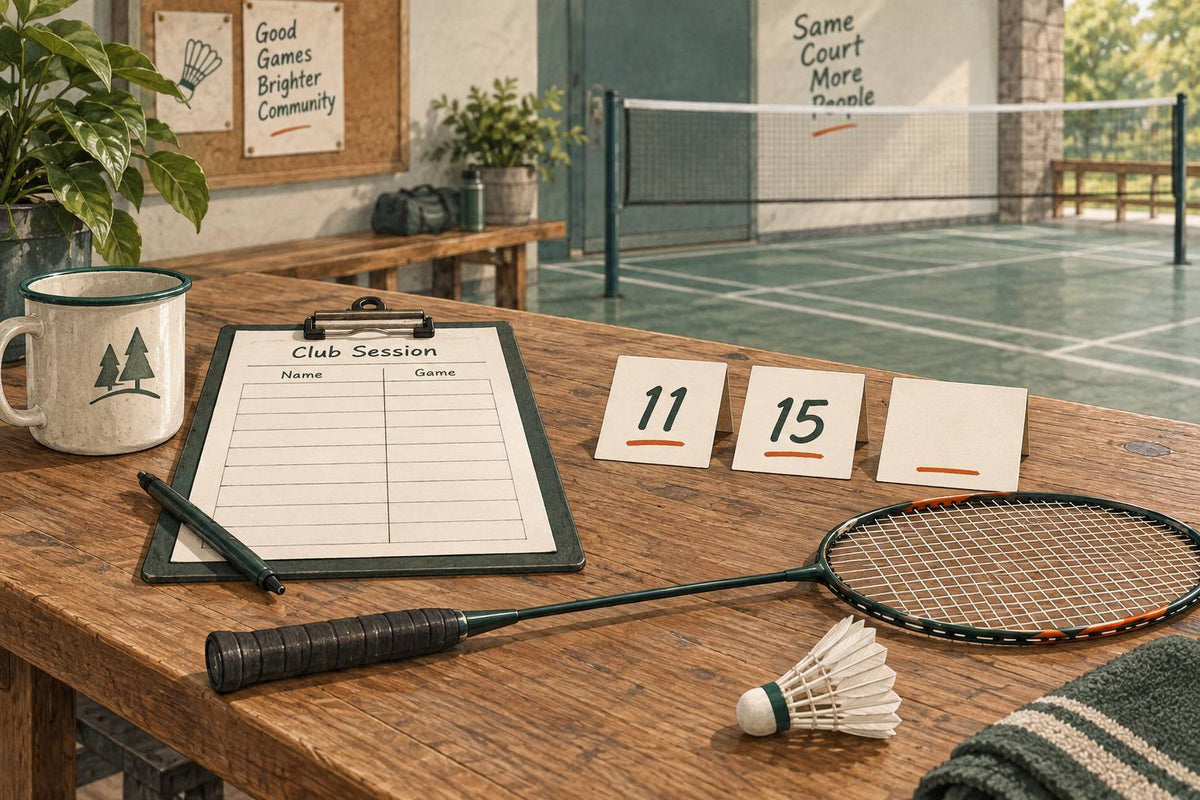
Pick the format, name the deciding-point rule for anything close, and settle any mid-game break, all before the first serve. A line on the whiteboard next to the court list takes ten seconds and avoids the argument at 10-all that a shorter game makes far more likely.

Leave a comment
This site is protected by hCaptcha and the hCaptcha Privacy Policy and Terms of Service apply.