
Last checked: August 2026 · Written by the player-led team at Badminton House
Quick answer
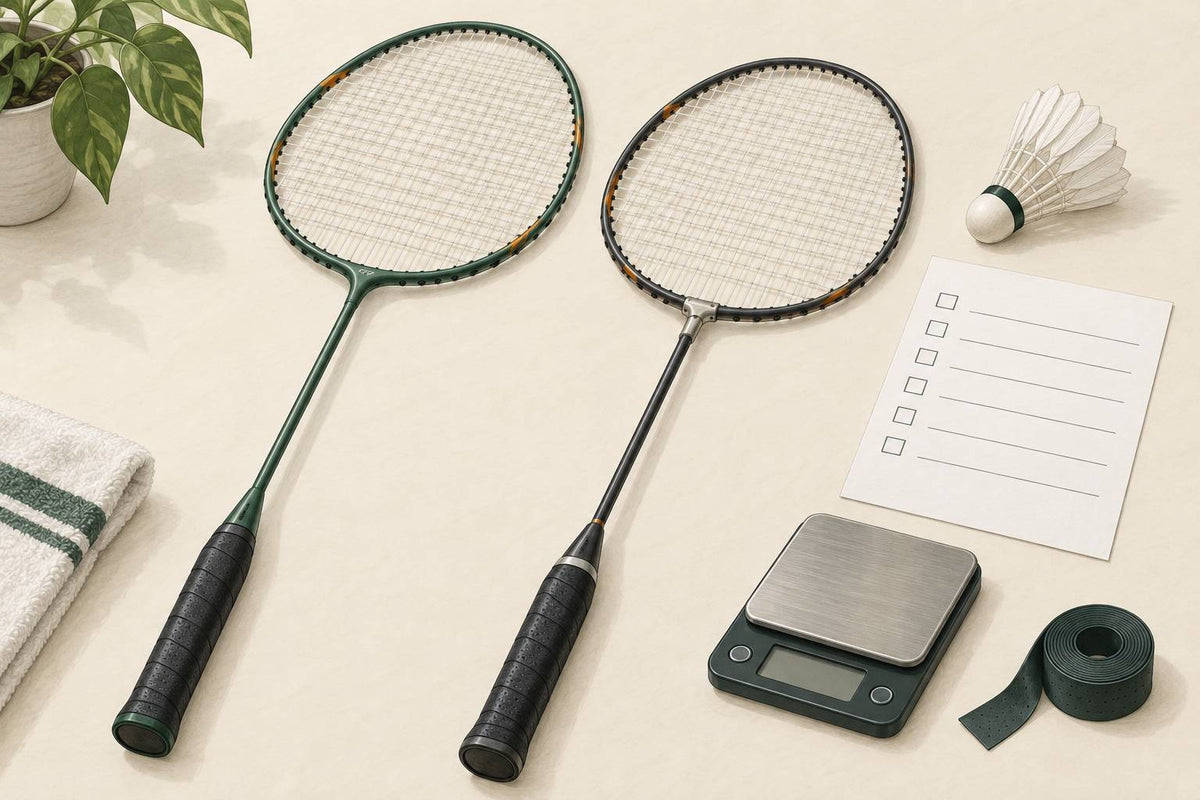
Five specifications separate a usable budget badminton racket from a frustrating one: frame and shaft material, weight code and balance point, the stated maximum string tension, the joint and frame construction, and the grip size. Every one is printed on the spec sheet or visible on the frame, so an unfamiliar brand can be judged without reading a word of its marketing.
Read the stated tension range before planning a restring. It defines the manufacturer’s permitted setup, but a higher ceiling alone does not establish overall quality or suitability.
- Material: frame and shaft named separately, graphite preferred over metal.
- Weight and balance: a printed U code plus a stated balance point.
- Tension cap: a printed range that accommodates your intended setup.
- Construction: one moulded piece rather than parts meeting at a collar.
- Grip size: a G code you can actually hold.
Related reading: How to Choose a Badminton Racket — the full sizing and playstyle guide for the frames that pass these five checks.
Check 1: What the frame and shaft are made of
A racket listing should name the frame material and the shaft material separately. Entry-level rackets pair an aluminum head with a steel shaft, which puts them in the heaviest weight class; better budget frames use graphite for both parts. A listing that names no material at all is the first and easiest fail.
The divide is visible inside a single catalogue. An aluminum-and-steel entry frame's Yonex Muscle Power 2 specifications list an aluminum frame, a steel shaft and a U weight class of 105 g and below, while graphite frames in the same catalogue sit in the 83 to 88 g weight classes. Roughly 20 g may not sound like much, yet it is the difference between a frame you can swing all evening and one your forearm notices by the third game.
Read the exact words on the listing. Carbon, graphite and carbon fibre describe the same family of material, and any of them is a good sign when it appears for both the frame and the shaft. Be more careful with vague blends: when a listing says composite without naming what is in the frame versus the shaft, treat it as unknown and ask, because honest manufacturers publish the two lines separately even on their cheapest models.
Pass: frame and shaft each named, both graphite or carbon. Fail: no material stated, or a metal head and shaft on a racket promoted for regular club play.
Check 2: Weight code and balance point
The weight code sorts frames into printed gram bands: 3U covers 85.0 to 89.9 g and 4U covers 80.0 to 84.9 g, with 5U lighter again. Pair the code with the balance point, because two rackets of identical weight can swing completely differently.
Victor's beginner racket guide recommends 4U as the standard choice and points players who are still learning to apply force toward 5U. It also sorts balance into three families: head-heavy frames carry the balance point closer to the head and drive momentum through the swing, even-balance frames sit near the centre for all-round play, and head-light frames keep the point near the handle for short, fast strokes.
Shaft flex belongs in this check too. That guide rates shaft handling on a numeric scale where 1 to 3 is more flexible, 4 to 7 is average and suits beginners, and 8 to 10 is stiffer and rewards players who can load the shaft with their own swing speed. A budget listing that states its flex at all is already ahead of most of its shelf.
Pass: a printed U code and a stated balance. Fail: adjective-only weight claims. A racket described as ultra light with no U code has told you nothing that can be compared against another listing.
Check 3: The stated tension cap
The stated maximum string tension is a setup limit to check on a budget spec sheet. Entry-level metal frames carry stringing advice around 16 to 20 lb, budget graphite frames sit in the low-to-mid 20s, and stronger graphite frames are rated to 27 lb and beyond, with quality frames approved past 30 lb.
The ladder is easy to see across real spec sheets. An aluminum-and-steel entry frame lists 16 to 20 lb, a mid-tier graphite frame lists 19 to 24 lb, a premium graphite frame reaches 19 to 27 lb, and a box-profile graphite frame is approved up to 32 lb in 4U. These examples show different amounts of tension headroom; compare the intended setup rather than treating their ceilings as a universal quality ranking.
Two warnings before you lean on the number. The cap describes the ceiling and never the racket as it arrives: Victor's string and tension guide notes that pre-strung rackets ship at around 20 lb, recommends starting near 24 lb when you restring, and reserves tensions above 26 lb for players who already generate power well. And a stringer will work inside the printed range, a cap of 20 lb limits future higher-tension setups but may remain suitable if you prefer to play within that range. Our guide to what a max tension rating really means covers the frame-stress side in detail.
Pass: a printed tension range whose ceiling is at least the mid-20s lb on a graphite frame. Fail: no range anywhere on the listing or the cone, or a single number with no units.

Check 4: Joint and frame construction
Study the throat, where the shaft meets the head. A racket that lists different metals for frame and shaft is assembled from separate parts, and the junction shows a collar or seam; a one-piece graphite frame moulds that junction into the layup itself. On a budget shelf, this is the fastest visual sort you can do.
Construction is also where stability and the tension cap connect. A box-profile frame design is described on Victor's frame technology page as one that "effectively increases the stability and anti-torque, can stand higher string tension". That one sentence is the quality story in miniature: the frame's cross-section and joint decide how much tension it tolerates and how solid it stays when the shuttle lands off-centre, which loops this check straight back into check 3.
Two smaller details reward a close look. Squared-off isometric head shapes have travelled a long way down the range: one manufacturer lists an isometric head shape among the technologies on both its aluminum-and-steel entry frame and its mid-tier graphite frame, where the shape is described as giving a larger sweet spot and enhanced stability. And check the string holes: manufacturers that care about string life say so in the spec, as a box-profile graphite frame does with single-pass grommet holes, so make sure every hole on a budget frame is cleanly lined. For how the junction itself is engineered, see our guide to T-joint versus one-piece frames.
Pass: one material through frame and shaft, a moulded junction, lined string holes. Fail: mixed metals meeting at a visible collar on a racket promoted beyond casual rallies.
Check 5: Grip size
Grip circumference is coded with a G number on the cone. G5 is the most common size and the slimmer G6 suits smaller palms; manufacturers ship frames in G4, G5 or G6 depending on model. A slim grip can be built up with an overgrip, so treat this as a fit check rather than a quality check.
Budget rackets usually ship in a single grip size, and listings often skip the code entirely. That silence is worth one question to the seller rather than an automatic fail, because the fix is cheap: an overgrip adds thickness in minutes, and most club players change overgrips regularly anyway. What no wrap can fix is a handle that is already too thick for your hand, so if you sit between sizes, take the slimmer one.
Keep the priority straight when a listing tempts you the other way. A perfect grip on a frame that failed the material or tension checks is still a failed racket, while a passed frame in a slightly wrong grip is one overgrip away from right.
Pass: a printed G code that matches your hand, or sits one step slimmer. Fail: no code stated and no answer when you ask.
Specs that mean nothing
- Invented fibre names. A trade name that appears only in one brand's own listings cannot be compared with anything, so it adds no information the plain material line does not already give.
- Claimed smash speeds. A speed figure with no stated test conditions cannot be compared between rackets; treat it as decoration.
- Weight adjectives. Ultra light, featherweight and super light mean nothing without a printed U code; the gram bands in check 2 are the comparison.
- A lone tension number. A single figure with no range and no units is not a rating; the printed range in check 3 is.
When a budget frame is enough, and when to move up
A racket that passes all five checks will hold up for learning strokes, casual games and early club nights, and nothing about its price tag changes that. Move up a tier when a specific ceiling starts costing you points: you want string tension the printed cap will not allow, a lighter or more head-light frame than the budget lineup offers, or a stiffer shaft that your swing speed can now load. Upgrading to solve a named limit is a decision the spec sheet can confirm; upgrading because a listing shouted louder is the exact trap the five checks exist to close. Whatever the next racket costs, the same five lines will grade it.
The order of the checks is also a triage order. Material and tension cap disqualify a frame fastest, weight and balance decide whether it suits your game, construction confirms the first two were honest, and grip size is the only line an accessory can fix later.


Leave a comment
This site is protected by hCaptcha and the hCaptcha Privacy Policy and Terms of Service apply.