
Last checked: August 2026 · Written by the player-led team at Badminton House
Quick Answer: A Scored Serve Routine
Score 12 short serves in three separate columns: legal delivery, target hit, and useful short-serve flight. Keep the columns separate, then repeat four serves with a modest pressure cue. The counts and scoring system below are a Badminton House practice design, not an official BWF test.
Legal
First check: record whether each delivery meets the service requirements you can observe in practice.
Target
Give one point when the unintercepted shuttle lands in the target area.
Flight
For this short-serve audit, observe net clearance and whether the apex occurs before the net.
Retest
Add four serves after announcing the target or inviting a partner to score them aloud.
A useful badminton serve practice score should tell you what changed. One total can hide the problem: a serve may land in the right place after an illegal delivery, or clear the net tightly but miss the intended lane. This routine keeps legality, landing, and flight separate so the next practice decision is visible.
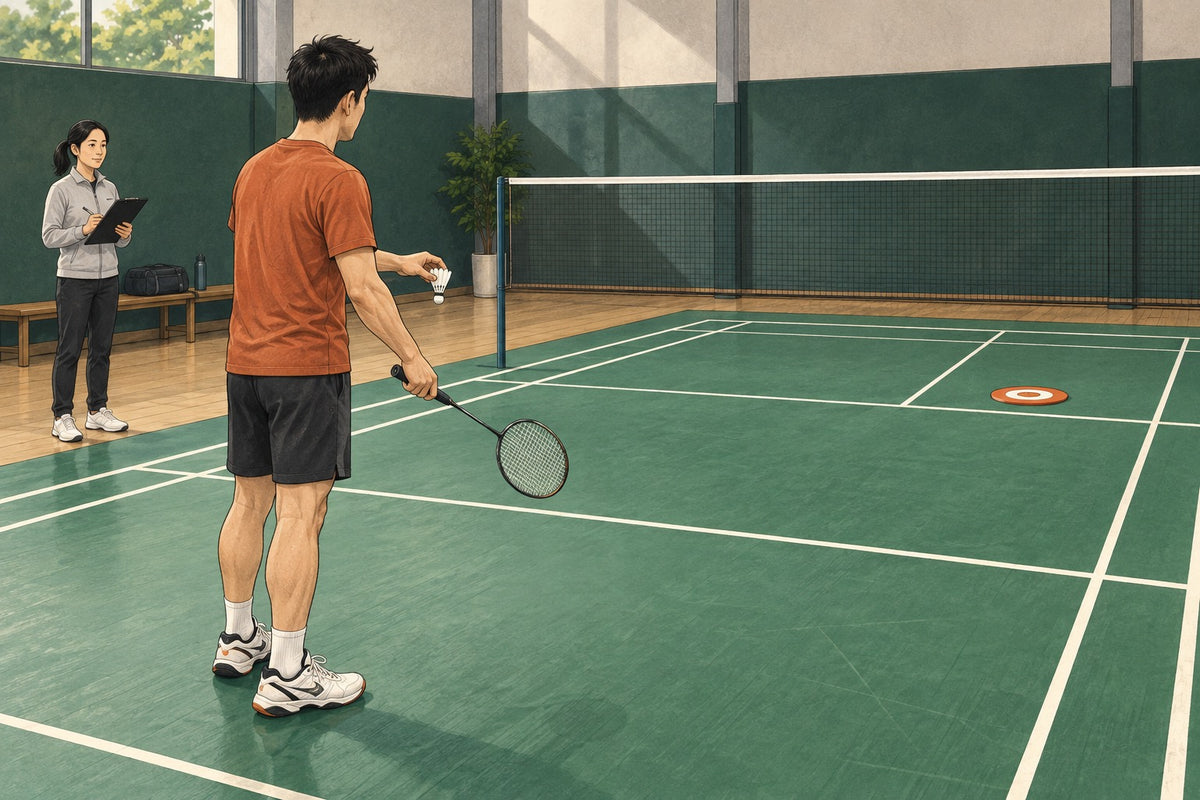
Use one short serve and one target for the whole audit. Do not mix a low serve, flick serve, and singles high serve on the same sheet; their useful flight patterns are different. If you want a collection of serve exercises instead, use our six badminton serve target drills.
Keep it diagnostic. Your score is a comparison with your own previous session. It is not a grade, a selection standard, or proof that a serve will succeed against every receiver.
Build three scores before you think about a total
Use three yes-or-no observations for every serve: was the delivery legal, did the shuttle reach the chosen target, and did the short serve show the intended flight? Twelve attempts produce three scores out of 12. Those separate numbers are more useful than one combined mark because they expose different practice needs.
Legal delivery: The current BWF Laws of Badminton, Version 5.0 (2) require the server and receiver to occupy diagonally opposite service courts without touching their boundary lines, maintain the prescribed stationary contact, release the shuttle without adding spin, strike its base first, contact the whole shuttle below 1.15 metres, continue the racket forward, and not miss the shuttle. Use this as a practice checklist, not as a substitute for an official's decision in competition.
Target hit: The same BWF Laws state that court lines form part of the areas they define and that a correct unintercepted serve lands on or within the service-court boundary lines. Define a smaller visible practice area inside the receiver's correct service court. Decide before serving whether that target includes its edge, then keep the convention unchanged for the session.
Short-serve flight: Ask a partner standing safely outside the court to observe whether the shuttle crosses low and reaches its apex before the net. A study of eight national-level players used trajectory because a short serve is normally intercepted and landing alone may not represent its quality; its preliminary work identified low net clearance and a pre-net apex as useful features. Read the short-serve trajectory study for its limited sample and method.
Do not copy the study's reported percentage into your scorecard as a pass mark. The article did not validate this 12-serve routine, and a club player's session is not a comparison with its national-level sample.
Run the 12-serve baseline
Warm up normally, choose one legal service court and one short-serve target, then deliver 12 serves at a pace that lets you reset deliberately. Record each observation immediately. This number is an editorial choice that keeps the audit compact; it is not an official test or evidence-based dose.
- Clear the area. Keep bags, spare rackets, loose shuttles, and raised markers away from feet and court traffic.
- Define the target. Use court lines or facility-approved flat markers. Do not attach a cord, tape, or object to the net.
- Name the serve. Use the same short-serve intention for all 12 attempts.
- Keep one side. Use the same service court for all 12 attempts; audit the other side on a separate sheet.
- Record three marks. A fault receives zero in the legal column. You may still note target and flight as diagnostic observations, but do not call that delivery a valid serve.
Counting target hits has an official teaching precedent: BWF Shuttle Time's backhand-serve activity gives pupils at least ten shuttles and counts those landing in a target box. That supports the idea of recording hits; it does not supply a universal adult target size or passing score.
| Column | Mark 1 when | Next-session clue |
|---|---|---|
| Legal | The observable delivery requirements are met. | A lower score makes setup and delivery the first priority. |
| Target | The unintercepted shuttle lands in the pre-declared area. | A lower score suggests keeping the target broad and stable. |
| Flight | The partner observes the agreed low-clearance, pre-net-apex pattern. | A lower score makes contact and trajectory the practice focus. |

Read the score without inventing a pass mark
Compare each column with the same player's previous attempts under the same setup. Work first on the lowest or least stable column, then rerun the unchanged baseline. Do not shrink the target, add pace, and change the service side together; multiple changes make the next score difficult to interpret.
- Legal score trails: pause target scoring and rehearse the service setup. Our guide to serving in badminton covers the basic sequence.
- Target score trails: retain the same serve and flight goal, but use a broader target until direction becomes repeatable.
- Flight score trails: keep the landing zone generous and ask the observer to watch only net clearance and apex location.
- All three vary: simplify the setup and collect another baseline on a different day before drawing a conclusion.
Record conditions that can change the comparison, such as shuttle type, service side, target, and whether a receiver was present. Do not explain a one-session change as proof of improvement or decline. The scorecard is a practical log, not a controlled experiment.
The BWF Laws make clear that the 1.15-metre condition is not universal across Para badminton. They include half-court provisions, wheelchair wheel-stationarity rules, medically justified exceptions to the stationary-contact rule, an armpit-height condition for wheelchair service, and alternative service provisions for Para badminton Standing Classes. Use the rules and coaching appropriate to the player's classification.
Add a four-serve pressure check
After the baseline, repeat four serves with one modest change: announce the target, let a partner record the marks, or take the check after your normal rally practice. Keep the serve and target unchanged. This retest is an editorial practice option, not a validated competition simulation.
A study of 20 competitive players found better short-serve performance in a practice climate than a competition climate, while perceived exertion and anxiety also differed. That result supports checking whether a serve holds up outside quiet repetition, but it does not predict every player or prescribe extra fatigue. See the study abstract on PubMed.
Compare the four retest marks only with the corresponding final four baseline serves. If one column drops, repeat the same modest pressure condition another day before changing technique. If pain, dizziness, unsafe flooring, crowding, or uncontrolled movement appears, stop; a completed score is never more important than a safe court.
Your next serve session
- Choose one short serve and one unchanged target.
- Score 12 attempts in separate legal, target, and flight columns.
- Run four more with one modest pressure cue.
- Practise the weakest column, then repeat the same audit before making it harder.


Leave a comment
This site is protected by hCaptcha and the hCaptcha Privacy Policy and Terms of Service apply.