

Last checked: August 2026 · Written by the Badminton House player-led team.
Quick answer: how should you breathe between points?
Allow one ordinary, unforced breath to anchor a short routine: release unnecessary tension, choose one court task, and return ready. It is a behavioural cue, not a physiological recovery protocol.
Anchor
One comfortable breath: no forced depth, prescribed route, or inhale-to-exhale ratio.
Add
One court-facing task, such as your serve target, return posture, or first recovery position.
Avoid
Fixed counts, deliberate holds, forced breathing, delay, and claims about faster recovery or better performance.
Breathing between points can be simple enough to survive real play. The point ends, you release the last rally, one natural breath marks the transition, and you choose the next court task. There is no need to turn the gap into a breathing exercise or measure whether the breath “worked.”
This routine does not claim to lower heart rate, improve oxygen delivery, clear fatigue, treat anxiety, or win the next rally. It is a repeatable sequence for organizing the short space between one shuttle becoming dead and the next service beginning.
Related reading: For breathing during rallies, see our whole-rally breathing guide. For pressure and attention rather than breathing mechanics, read how to respond to choking under pressure.
How much time do you have between rallies?
Ordinary gaps between rallies are part of continuous play, not mini time-outs with a guaranteed length. The BWF Laws specify longer formal intervals at the mid-game score and between games, but they do not give every rally its own recovery allowance. Your reset must fit normal play.
Under the current BWF Laws of Badminton, Version 5.0 (2), play is continuous except for specified intervals and suspensions. Law 16 allows up to 60 seconds when the leading score reaches 11 in a game and up to 120 seconds between games.
Those are formal match intervals, not longer breathing prescriptions. Law 16 also says play must not be delayed so a player can recover strength or wind or receive advice, and the umpire judges delay. In an unumpired club game, the same practical principle is courteous: reset without making the other side wait.
Do not build the routine around an assumed number of seconds. Retrieve or return the shuttle, take your position, and let the breath fit inside those normal actions. If your event uses a separate time-clock trial, follow its instructions; our badminton time-clock guide covers that changing rules topic.
Why avoid a fixed breathing count?
The controlled-breathing study cited here does not validate a fixed count as a badminton between-rally recovery method. Controlled-breathing research has used prescribed patterns in other exercise settings, but that does not establish a dose for an open-skill rally sport. This article therefore avoids importing a prescriptive pattern.
A 2025 randomized crossover study compared spontaneous and fixed breathing patterns after cycling intervals in 40 physically active university students. It did not test badminton, the transition between rallies, or one ordinary breath as a routine anchor.
That scope is enough to reject a copy-and-paste prescription. A pattern tested after cycling is not automatically suitable while a player retrieves a shuttle, checks the score, chooses a serve or return position, and resumes continuous play. This article therefore supplies no inhale length, exhale length, breathing route, hold, or cycle count.
Keep the claim as small as the routine: one comfortable breath can mark the transition because it is easy to remember. We are not claiming that the breath changes a physiological measurement or improves the next rally.
What is the one-breath badminton reset?
Use one comfortable breath as a marker, then move directly to one court decision. The breath does not need to be deep, slow, nasal, or longer on the exhale. If forcing it feels awkward, return to ordinary breathing and keep the between-rally routine even simpler.
Badminton House practical adaptation, not a validated physiological protocol: use the following sequence inside the normal flow of play. “One breath” is an anchor, not a breathing rate or exercise dose.
- Release the previous rally. Let unnecessary pressure go from the racket hand and shoulders as you retrieve, return, or receive the shuttle.
- Allow one ordinary breath. Do not force depth, count phases, choose a route, or pause the breath. If another natural breath happens, that is not an error.
- Choose one court task. Pick the serve target, return posture, or first recovery position that belongs to the next rally.
- Become ready. Finish your legal preparation and resume play promptly. The sequence should disappear into normal match flow.
| Part | Simple cue | Boundary |
|---|---|---|
| Release | Let go of unnecessary racket-hand and shoulder tension. | No claim that this clears fatigue. |
| Breathe | One comfortable, unforced breath. | No count, hold, route, or promised body response. |
| Choose | One specific court task. | No promise that the task prevents errors. |
| Ready | Take position and continue promptly. | No deliberate delay for recovery. |
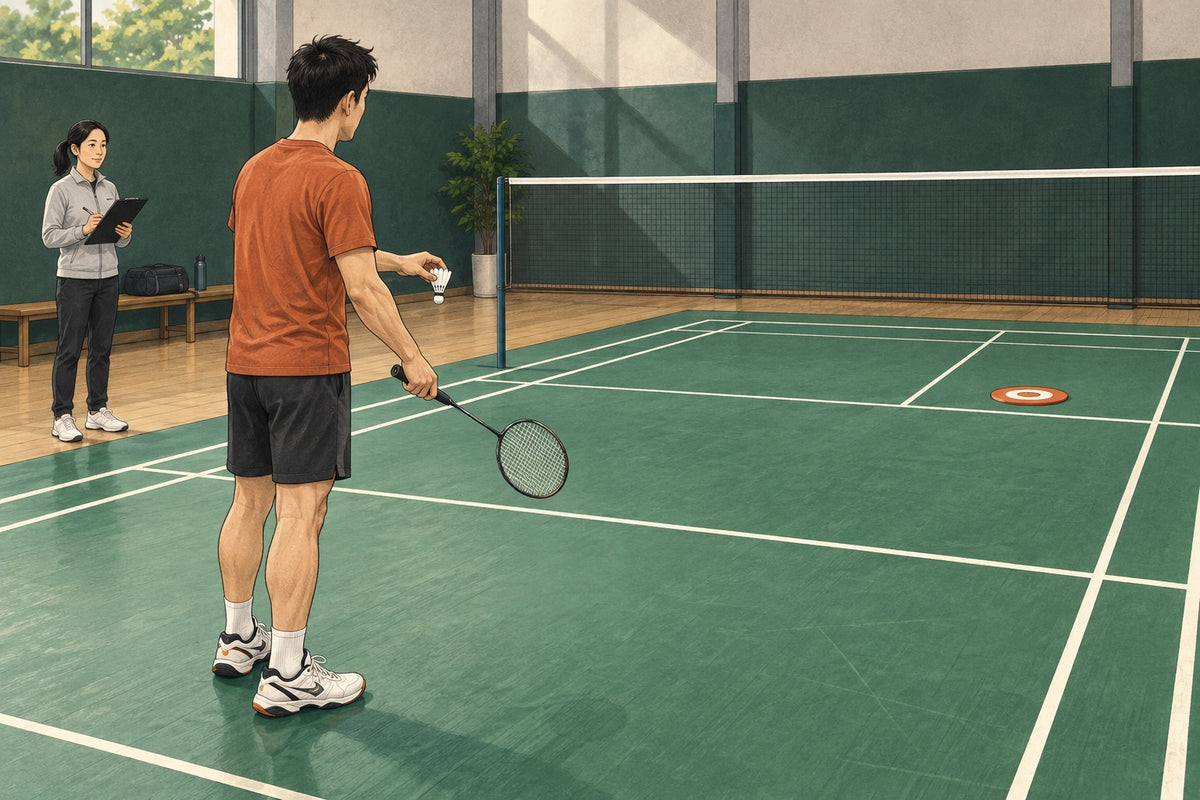
The court task should be concrete and immediate. “Serve toward the body,” “racket up on return,” or “recover after the first lift” is enough. Do not add a full tactical review, visualization sequence, or argument about the rally that just ended.
How do you rehearse the reset without delaying play?
Rehearse the sequence during ordinary drills and games, not as a separate breathing workout. Start it when the rally ends and finish as you become ready for the next serve. Keep it only if it remains comfortable, simple, and invisible inside normal play.
- Use the same trigger. The dead shuttle starts the sequence. You do not need a watch or countdown.
- Keep the order stable. Release, ordinary breath, one court task, ready.
- Let a partner or coach watch the flow. The useful question is whether you remain ready without holding up service.
- Drop any awkward element. If the breath becomes forced or the sequence distracts you from score, shuttle, or position, return to normal preparation.
There is no repetition target, practice duration, or success percentage. The routine has done its job when you can move from the completed rally to one clear court task without adding delay. It does not have to feel calming, lower a device reading, or produce a better result on the next point.
When should breathing symptoms stop play?
Use regular breathing as the default and stop if breathing becomes a symptom rather than a cue. Chest pain that feels tight or squeezing, pain spreading to the arms, neck, or jaw, severe difficulty breathing, or passing out and not responding normally are emergencies: call local emergency services immediately.
The NHS heart-attack guidance gives those emergency thresholds. Do not use a breathing cue to wait out or test serious symptoms.
The American Heart Association’s exercise guidance advises breathing regularly during warm-up, exercise, and cool-down rather than intentionally holding the breath. This supports a simple boundary, not a badminton performance claim.
A Newcastle Hospitals NHS exercise guide separately lists unexplained shortness of breath and unexplained dizziness or faintness as reasons to stop and seek medical advice.
This article is for pain-free adults. Players with a diagnosed respiratory or cardiovascular condition should follow their clinician’s plan. Recurrent symptoms during badminton need proper assessment; a breathing count should not be used to mask them. For recurrent exercise-related airway symptoms, see our exercise-induced asthma and badminton guide.
Bottom line
- Let one ordinary breath mark the transition between rallies.
- Choose one court task and become ready promptly.
- Use no fixed count, breath hold, or recovery promise.
- Stop for unexplained symptoms; call local emergency services for the emergency signs above.

Leave a comment
This site is protected by hCaptcha and the hCaptcha Privacy Policy and Terms of Service apply.