
Last updated: July 2026 · Written by the team at Badminton House
Quick Answer: How to Serve in Badminton
For most beginners, learn a legal low serve first, then add a high serve for singles so you can start rallies without giving away easy attacks.
Low serve
Best starting point: use a short, controlled serve that just clears the net and lands near the short service line; it is the default serve in doubles and helps prevent an attacking return.
High serve
Use this mainly in singles: send the shuttle high and long so it drops close to the backline, making the receiver move deep before returning.
Legal check
The standard BWF rule requires the whole shuttle below 1.15 m at contact; ask the organizer whether a published alternative service law applies.
Learning how to serve in badminton can feel surprisingly awkward at first. You are trying to stand in the right box, contact the shuttle legally, keep both feet under control, and still send the shuttle exactly where you want it — all before the rally has even started.
Practising your serve? Repetition matters more than power — browse our badminton shuttlecock collection for practice options. Badminton House ships across Canada.
In This Guide
- What Makes a Badminton Serve Legal?
- Where to Stand When You Serve
- How to Do a Low Serve in Badminton
- How to Do a High Serve in Badminton
- What Are the Most Common Badminton Serve Faults?
- Low Serve or High Serve: Which Should You Use?
- Beginner Serve Practice Drills and Gear
- Serve Selection Cheat Sheet: Five Common Situations
What Makes a Badminton Serve Legal?

Quick legality checklist
- Hit the shuttle at a legal height. At BWF international events, the whole shuttle must be below 1.15 m from the court surface at the moment your racket hits it.
- Keep the racket moving forward. Once your service action starts, the racket movement must continue forwards until the serve is delivered.
- Do not miss the shuttle. If you attempt to serve and miss the shuttle, the serve is delivered and it is a fault.
- Wait until the receiver is ready. The server must not serve before the receiver is ready.
- Keep both feet stationary. Part of both feet of server and receiver must remain stationary on court from service start until delivery.
Use the standard 1.15 m rule unless the organizer specifies an alternative service law; do not assume Canadian club play uses the old waist rule. The fixed-height rule does not add the old downward-shaft requirement. See BWF Laws 9 and 12 for service requirements and court errors.
| Rule area | What beginners should remember |
|---|---|
| International BWF serve height | The whole shuttle must be below 1.15 m from the court surface when it is hit. |
| Published alternative rules | Check the organizer’s stated alternative service law rather than assuming the standard changes by country. |
| Racket action | The racket movement must continue forwards from the start of the service action until the shuttle is hit. |
| Feet | Do not lift or move either foot before contact; part of both feet must remain on the ground. |
| Contact point | Release without added spin and contact the base first. |
Playing drop-in in Canada? If you are unsure which serve-height rule your group uses, ask before the first game. For the rest of the scoring basics, see our badminton rules and scoring guide.
A simple beginner habit is to serve with a still base, contact the shuttle clearly below the expected height standard, and avoid any stop-start racket motion. That keeps the focus on the rally instead of a debate over whether the serve was legal.
Where to Stand When You Serve

Before you think about low serve or high serve technique, get the service court right. In badminton, your serving side is based on the server’s score: even scores serve from the right service court, odd scores serve from the left service court.
Simple rule: 0, 2, 4, 6 and other even scores serve from the right. 1, 3, 5, 7 and other odd scores serve from the left. For the full scoring breakdown, see our badminton rules and scoring guide.
| Server’s score | Server stands | Receiver stands |
|---|---|---|
| 0-0 to start | Right service court | Diagonally opposite, in the right service court from their side |
| Even score | Right service court | Diagonally opposite the server |
| Odd score | Left service court | Diagonally opposite the server |
Singles vs doubles service court lines
The side you stand on follows the same even-and-odd pattern in singles and doubles, but the court lines used for a legal serve are different:
- Singles: the service court is narrower, so the side tramlines are out. The serve can still travel the full length of the court to the back baseline.
- Doubles: the service court is wider, so the side tramlines are in. The service area is shorter because the doubles long service line is used instead of the back baseline.
A good habit for beginners is to say the score, check whether it is even or odd, then step into the correct box before serving. That small routine prevents wrong-court mistakes before they become match-losing habits.
How to Do a Low Serve in Badminton
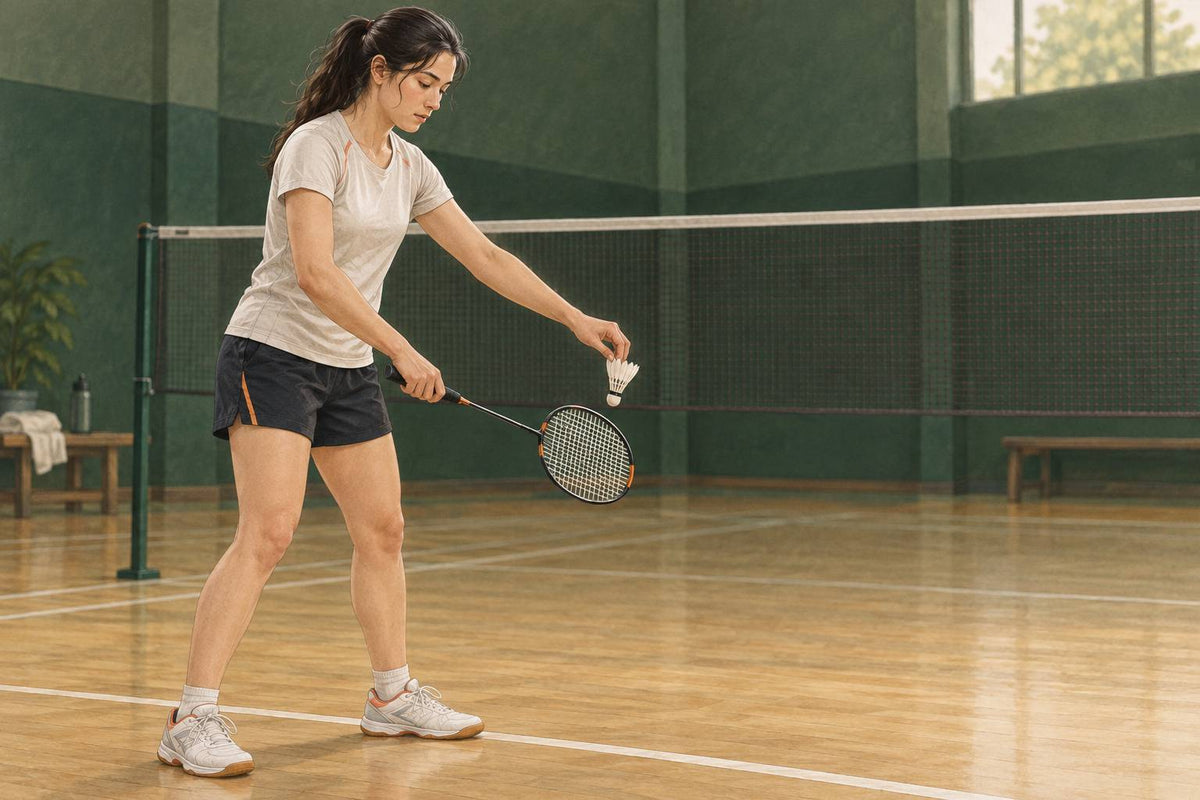
A low serve in badminton is a short, controlled serve that skims just above the net tape and lands on or just beyond the short service line, 1.98 m from the net. The backhand low serve is the serve most beginners should learn first for doubles: when it stays low and short, your opponent has much less chance to attack the return.
Key idea: a low serve is not a big swing. It is a short, controlled backhand push with the racket moving back and forward in one compact motion.
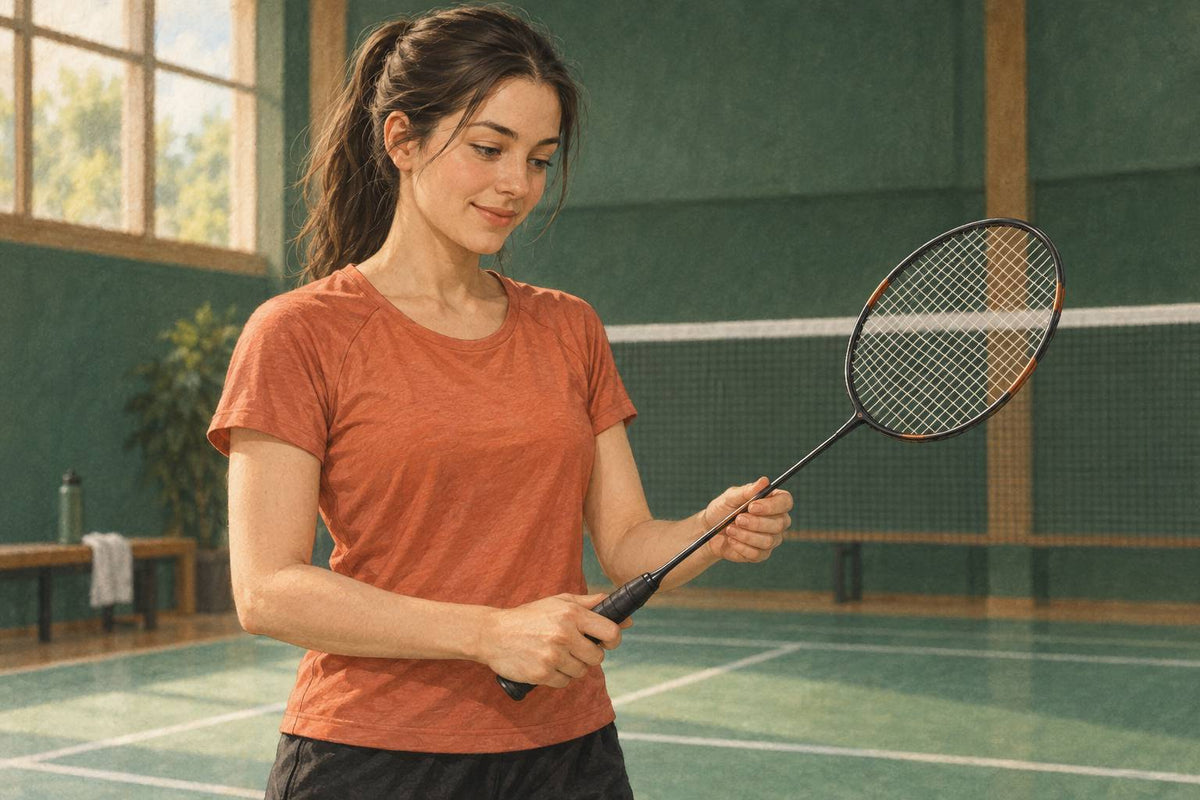
- Use a backhand grip. Turn the racket so your thumb supports the wider bevel of the handle. This makes the serve easier to control because the swing can stay short and precise.
- Set the shuttle in front of your body. Hold the feathers lightly with thumb and index finger, then release without adding spin so the racket contacts the base first.
- Place the racket behind the shuttle. Start with the racket face close behind the cork, ready to move forward through the shuttle. Keep your hand positions calm and repeatable.
- Keep the backswing minimal. Avoid pulling the racket far back. An uncontrolled backswing can make the shuttle pop up, which gives the receiver an easier attacking return.
- Move back and forward in one short motion. Let the racket move slightly back, then forward through the base of the shuttle. The feeling should be more like a gentle push than a hit.
- Aim low over the tape. Your best low serves just clear the net and land close to the short service line. If the shuttle drops short of that line, it is a fault.
What a Good Low Serve Should Look Like
A clean low serve starts upward from the racket, travels on a shallow controlled arc, clears the net by a small margin, and begins dropping quickly after crossing. In doubles, that shape matters because a loose serve that sits high gives the receiver a chance to pounce. A tight low serve often forces a lift, net return, or push instead of an immediate smash.
| Serve detail | What to feel | Beginner mistake to avoid |
|---|---|---|
| Grip | Backhand grip with thumb support | Using a loose forehand-style action that is hard to control |
| Shuttle hold | Thumb and index finger hold the shuttle steady | Tossing it inconsistently or striking it while still held |
| Swing size | Short back-and-forward motion | Taking a big backswing and lifting the shuttle too high |
| Target | Just over the net, close to the short service line | Serving short of the line or floating the shuttle high |
A Simple Cue for Consistency
Before settling to serve, check three things without undue delay: shuttle steady, racket behind the cork, short forward push. If your serve keeps rising too high, reduce the backswing first. If it keeps falling short, keep the same compact motion but send the shuttle slightly farther through the service line target.
Shop Practice Shuttles in Canada
Ships across Canada · 14-day returns · Canadian badminton specialty shop
Once your low serve is landing consistently, add pressure: practise with a receiver standing ready to attack anything high. That is when you start learning the real purpose of the low serve — not just getting the shuttle in, but starting the rally without giving away the first attack.
How to Do a High Serve in Badminton
A high serve, sometimes called a long serve, is a forehand serve hit high and deep so the shuttle drops almost vertically near the back boundary line, 6.7 m from the net. It is mainly a singles serve: it forces your opponent to start the rally from deep in the court instead of attacking immediately.
Singles serve mindset: do not just hit the shuttle “far.” Hit it high enough that it falls steeply near the backline. That shape is what makes the return harder.
- Use a forehand grip. The high serve is a forehand serve. Set your racket in a forehand grip before you start, rather than trying to create power with a backhand motion.
- Stand side-on, one step behind the service line. Turn your body sideways rather than facing the net square-on. This gives your swing room to travel upward and forward.
- Start with your body weight on the rear foot. Your racket begins just behind the side of your body, ready to swing through the shuttle.
- Hold the shuttle near chest height in front of you. This is only the starting hold. Drop the shuttle before contact so your serve stays legal under the service-height rule used in your game.
- Drop, then swing upward. Let the shuttle fall, then swing the racket upward through the cork. The motion should continue forwards from the start of the serve until you strike the shuttle.
- Transfer weight forward. Move your body weight from the rear foot to the front foot as you hit. This adds energy without needing to slap at the shuttle.
- Aim high and long. Your target is not the middle of the rear court; it is a deep landing area close to the furthest backline in singles.
A good high serve should feel smooth, not rushed. Beginners often try to muscle the shuttle with the arm only, but the better pattern is a controlled upward swing plus a forward weight transfer. If the shuttle is landing short, check your setup first: are you side-on, is your weight starting on the rear foot, and are you actually swinging upward toward the back of the court?
In doubles, the high serve is much less useful because the doubles service area is shorter in length than singles. Against stronger doubles opponents, a high serve can give them time to attack from near the doubles long service line. That is why the low serve is the usual doubles choice, while the high serve remains a common option in singles. For a deeper comparison, see our singles vs doubles strategy guide.
Is There a Backhand High Serve?
Not in the same way. The conventional high serve uses a forehand action. If you are serving with a backhand action and want to send the shuttle deeper, that is normally a backhand flick serve rather than a full high serve.
For beginners, keep the techniques separate: practise your forehand high serve for singles, and practise your backhand low serve for doubles or short-serve situations. Trying to blend the two too early usually makes both serves less consistent.
Quick self-check before you serve
- Are you in the correct right or left service court for the score?
- Are both feet still touching the floor until contact?
- Did you drop the shuttle before contact, rather than hitting it from the hand?
- Is the shuttle travelling high and long enough to drop near the backline?
Whichever service-height standard your club uses, the practical habit is the same: hold the shuttle comfortably, drop it, and make contact low enough that your high serve is clearly legal.
What Are the Most Common Badminton Serve Faults?
A good badminton serve is not legal just because the swing looks tidy. Beginners usually fault because one small detail breaks down: the timing, the feet, the service court, or the part of the shuttle they contact.
| Fault | What it means | Beginner fix |
|---|---|---|
| Serving from the wrong court | This is a service-court error: correct positions when the shuttle is not in play; the existing score stands. | Check the score before every serve: even score from the right service court, odd score from the left. For a full refresher, see our badminton rules and scoring guide. |
| Low serve drops short | On a low serve, the shuttle must at least touch the short service line. If it falls before that line, it does not count. | Aim a little past the short service line in practice, then reduce the height as your control improves. |
| Missing the shuttle | If you attempt to serve and miss the shuttle, it is a service fault. | Slow the routine down. Hold the shuttle still, shorten the backswing, and make clean contact before trying to add disguise or speed. |
| Moving or lifting a foot too early | Part of each foot must stay stationary on court from the start of service until delivery; weight transfer must preserve that contact. | Set your stance first, then serve from a quiet base. If you are stepping during contact, practise serving without any weight transfer until the habit is stable. |
| Hitting the feathers instead of the cork | When serving, the racket should contact the cork base of the shuttle, not the feathers. | Hold the shuttle so the cork is clearly presented to the racket face. This makes contact cleaner and helps the shuttle leave the strings predictably. |
Serve checklist before every point: correct court, receiver ready, both feet set, shuttle below the required height standard for your match, racket moving forward, and cork contact first.
Follow the event’s stated rules and build a repeatable, legal release and contact before adding disguise.
Low Serve or High Serve: Which Should You Use?

The simplest answer: use the serve that gives your opponent the least attacking opportunity for the format you are playing. In doubles, that usually means a tight low serve. In singles, both low and high serves are useful, and the right choice depends more on your opponent, your consistency, and how well you can recover for the next shot.
| Format | Best starting choice | Why it works |
|---|---|---|
| Doubles | Low serve | A low serve that just clears the net and lands near the short service line makes it hard for the receiver to attack immediately. Because the doubles service box is shorter in length, a high serve is much easier for strong doubles players to attack. |
| Singles | Low and high serve | Singles players use both. A high serve can push the receiver deep toward the back line, while a low serve can stop a powerful smasher from attacking a long serve right away. |
| Modern competitive play | Low serve most often | The low serve is common in today’s professional badminton, especially in all doubles, because a tight low serve reduces the receiver’s attacking options. |
Beginner rule of thumb: if you play mostly doubles at Canadian drop-ins or club nights, build your backhand low serve first. If you play singles, practise both a reliable low serve and a high serve that travels deep enough to stop easy attacking returns.
One common trap is trying to disguise a low serve by copying a high-serve action. That can create more errors than pressure, because good high serve technique and good low serve technique are very different: the high serve uses a longer forehand action and weight transfer, while the low serve relies on a short, controlled motion.
If you are still deciding whether your game is more singles- or doubles-focused, read our related guide to badminton singles vs doubles strategy and gear.
Beginner Serve Practice Drills and Gear
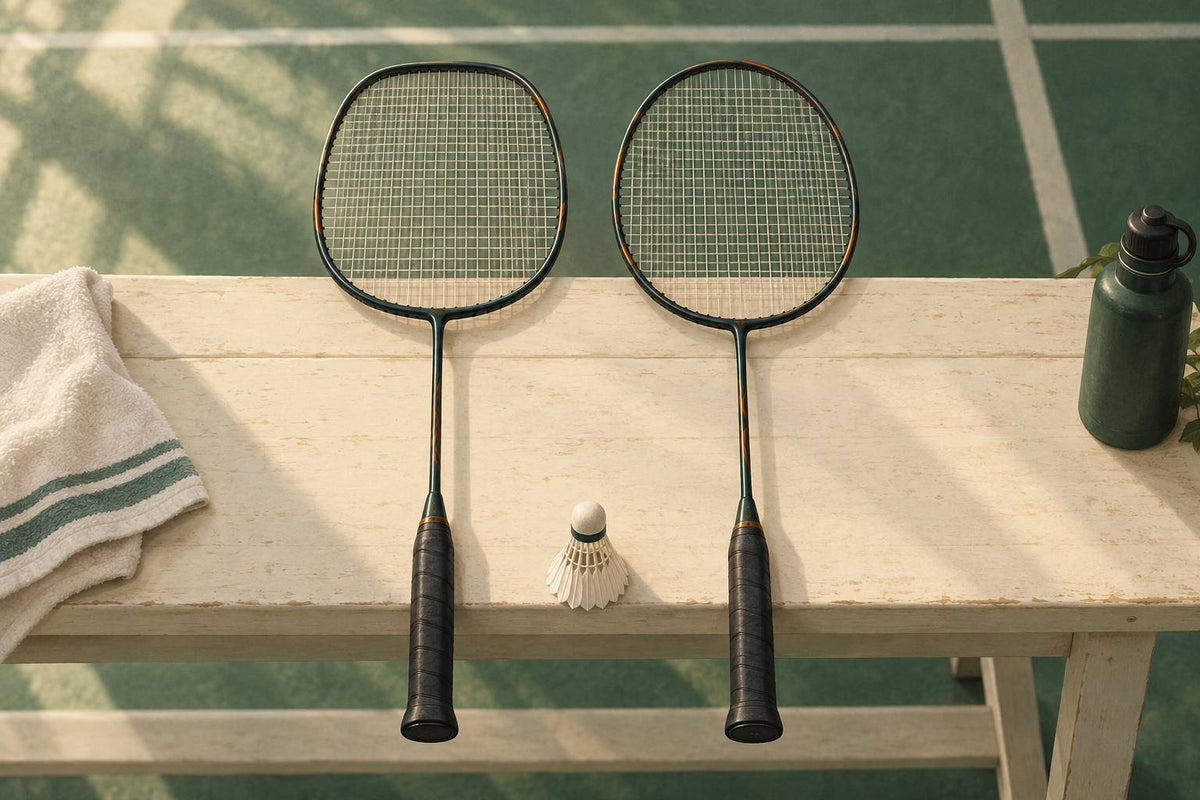
Practice gear note. If you are doing serve reps at home, school, or club night, keep extra practice shuttlecocks on hand and use a racket that feels easy to control from the service position. You can also compare current badminton rackets. Badminton House ships across Canada.
Drill 1: Low-Serve Target Practice
Place a small target just beyond the short service line in the correct diagonal service box. Your goal is not power — it is a serve that clears the net, lands legally, and stays low enough that the receiver cannot attack it easily.
- Use the same starting position each time so your contact point becomes repeatable.
- Aim for one target first, then move the target slightly wider or more central.
- If the shuttle drops short of the service line, reset and focus on a smooth forward motion.
Drill 2: High-Serve Depth Practice
For singles practice, place targets deep in the back part of the service court and work on sending the shuttle high and long. The goal is a serve that travels with enough height to push the receiver back, then drops close to the rear service area.
- Start with an easy rhythm rather than trying to hit maximum distance.
- Keep your swing smooth and repeatable.
- Alternate between the right and left service courts so you learn both diagonals.
Drill 3: Four-Zone Serving
Once you can land a basic low serve and high serve, divide the service court into target zones: short-middle, short-wide, deep-middle, and deep-wide. Serve to one zone at a time before mixing them randomly.
| Target Zone | Best Serve to Practise | What It Builds |
|---|---|---|
| Short-middle | Low serve | Net clearance and short-serve control |
| Short-wide | Low serve | Directional accuracy without overhitting |
| Deep-middle | High serve | Length and height for singles serving |
| Deep-wide | High serve | Court awareness and diagonal placement |
Drill 4: Consistency Before Deception
Beginners should earn consistency before trying trick serves. Pick one serve, one target, and repeat it until your misses become predictable. If most misses are short, add a little length. If most serves sit too high, soften the swing and focus on the shuttle crossing just over the net.
A useful rule for practice: do not change everything at once. Adjust only one thing at a time — contact point, swing size, target, or starting position — so you can feel what actually fixed the serve.
What Gear Helps Most?
- Practice shuttles: use consistent shuttlecocks so you can tell whether the miss came from your technique or from a damaged shuttle.
- A controllable racket: beginners usually benefit from a racket that feels stable in the hand and easy to guide through a short service motion. If you are unsure where to start, read our badminton racket choosing guide.
- Court targets: cones, flat markers, or spare shuttle tubes can work as visual targets, as long as they are safe and do not create a tripping hazard.
- A simple score sheet: track how many serves land in your chosen target area so practice becomes measurable instead of random.
Serve Selection Cheat Sheet: Five Common Situations
| Situation | Choose | Why it works |
|---|---|---|
| Most doubles points | Low serve | The low serve is the default in doubles because it restricts the receiver from making an attacking return. Aim for a serve that just clears the net and lands close to the short service line. |
| Singles against a strong smasher | Low serve | A low serve is frequently used in singles against players who can punish long serves with strong smashes. It can force a lift, net shot, or push instead of giving away an easy attack. |
| Singles when you want to push the receiver back | High serve | The high serve is most commonly used in singles. The goal is to send the shuttle high and long so it drops close to the backline, making an effective return harder. |
| High-level doubles | Avoid relying on the high serve | The doubles service area is shorter in length than singles, so a high serve is not particularly useful at higher levels. Strong doubles receivers can attack a shuttle that travels too long or sits up. |
| Beginner practice | Practise both | Beginners should build consistency with both basic serves: low serve and high serve. Target practice with repeated serves to marked court areas is a simple way to improve precision. |
Practice tip for Canadian players: nylon shuttles are a practical choice for repeated serve drills. The Yonex Mavis 350 Nylon Shuttlecocks are designed for durable low- and high-serve practice. Badminton House ships across Canada.
For a bigger picture on court positioning and scoring, see our badminton rules and scoring guide. If you are choosing tactics by format, the singles vs doubles strategy guide is the natural next read.
Get 10% off your first order
Join the Badminton House list and we’ll email you a 10% welcome code — plus subscriber-only restock alerts, giveaways, and honest gear advice from players.
By subscribing, you agree to receive Badminton House emails and can unsubscribe anytime.
Serving gets easier when you practise it like a badminton shot, not just a way to start the rally. We play badminton ourselves, so if you are unsure whether your racket, strings, grip, or shuttle choice is making your serve harder than it needs to be, contact us and we will help you choose gear that fits your level and playing style.
Practise your low and high serves with the right badminton gear.
Shop Shuttlecocks for Serve PracticeShips across Canada · Canadian badminton specialty shop

Leave a comment
This site is protected by hCaptcha and the hCaptcha Privacy Policy and Terms of Service apply.