
Last checked: August 2026 · Written by the Badminton House player-led team.
Quick answer: should you replace badminton shoe insoles?
Replace a stock insole when it is worn, broken, no longer lies flat, or no longer lets the shoe fit securely and comfortably. Keep it when it still fits cleanly and you have no specific problem to solve. A thicker or more structured replacement changes shoe volume, so test it inside the actual court shoe before playing.
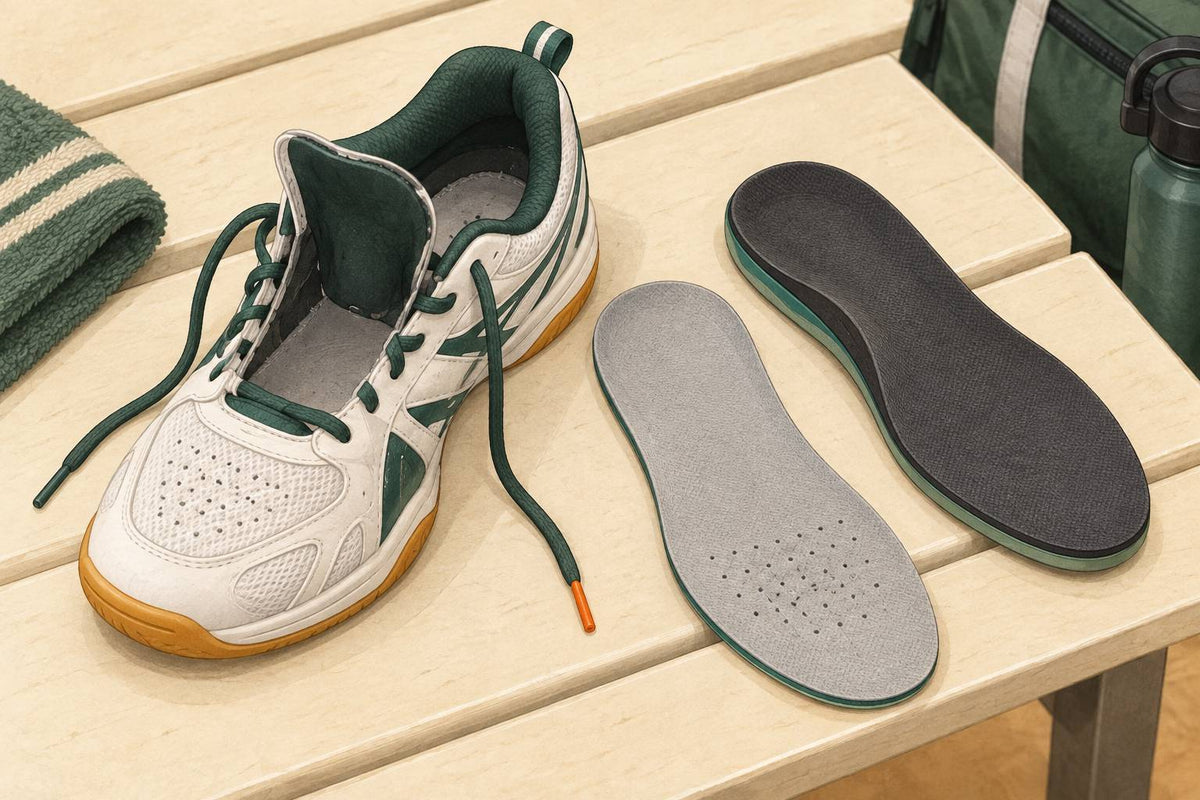
Badminton shoe insoles are easy to blame because they are removable. Sometimes they are the right part to change. Often, though, the real issue is a shoe that is too shallow, too loose, damaged, or simply no longer suitable for the way it feels on an indoor court.
Start with one question: what would a replacement solve? “More support” is not yet an answer. A clear answer might be a damaged liner, a prescribed device you have been given, or a need for a different underfoot feel that still leaves the shoe secure. If you cannot name the problem, do not create a fit problem by changing parts at random.
Related reading: If arch or heel symptoms are part of the decision, begin with our badminton shoes for flat feet and heel pain guide. If the shoe itself feels less secure, inspect it with our when to replace badminton shoes checklist.
When to keep or replace the stock insole
Keep the stock insole when it remains flat, intact and comfortable inside a securely fitting shoe. Replace it when there is visible wear or breakage, it will not sit flat, or you have a specific replacement device to fit. Do not use a generic calendar as the deciding rule.
| What you notice | Useful next step | Do not assume |
|---|---|---|
| The liner is torn, broken, curled, or will not lie flat. | Replace it with a correctly fitted liner or have the shoe assessed with the intended device in place. | Any thicker insole will improve the shoe. |
| The stock liner is intact and the shoe still feels secure and comfortable. | Keep it and inspect it occasionally when cleaning the shoes. | Factory insoles must be upgraded on a schedule. |
| You have persistent pain, rubbing, numbness, skin changes, or symptoms that worsen with a new device. | Stop the experiment and seek qualified clinical advice. | A consumer insole can diagnose or treat the cause. |
There is no reliable badminton-wide replacement interval for stock liners. One NHS service says many prescribed insoles may last about 18 months with moderate use and proper care, while also advising review if material is worn or the device breaks. That is useful evidence for checking condition, not evidence that every factory liner or retail insert lasts the same period. Read the NHS insole-care guidance.
Fit a replacement without crowding the shoe
A replacement insole has to fit the shoe as well as it fits your foot. Check the instructions for both the shoe and the intended device. When an ordinary replacement liner is designed to take the place of a removable stock liner, fit it flat in that space and test the complete shoe cautiously before court use. For a prescribed device, follow the clinician or provider’s fitting and wearing-in plan.
- Check whether the stock liner is removable. Lift it out carefully. If it is fixed in place, do not force it out. A shoe without a removable liner needs enough internal depth for an additional device.
- Fit the intended device as directed. For a prescribed insole or orthosis, follow its clinician or provider instructions. For an ordinary replacement liner, follow the shoe and liner maker’s instructions and do not stack layers unless those instructions specifically allow it.
- Check that it lies flat. Run your hand through the shoe. The heel, sides and toe area should not have a fold, raised edge or bunched section.
- Test cautiously before court use. With an ordinary replacement liner, walk indoors first in your usual socks and normally laced shoe. With a prescribed insole or orthosis, follow the clinician or provider’s wearing-in plan and do not use it for badminton or other rigorous activity until you are comfortable with the device.
- Reassess the whole shoe. Check toe room, heel hold and pressure across the top of the foot. If the shoe now feels crowded, do not rely on a break-in period to solve obvious compression.
NHS fitting guidance for prescribed devices begins by removing the shoe’s footbed liner and checking that the replacement is snug with no rucking at the sides or toe area. The East Sussex fitting instructions are for orthoses, yet the physical lesson is useful for any replacement liner: a device that bunches or rides up is a poor fit before badminton movement even begins.
More thickness uses more internal room. Guy’s and St Thomas’ NHS guidance notes that a shoe without a removable liner needs enough depth for an insole without squashing the toes. Its shoe-fit advice supports checking depth and toe room rather than assuming an insole can be added to every court shoe.
Choose the change that matches the problem
The right replacement is the smallest change that solves a clear fit problem without making the rest of the shoe worse. Compare shape, thickness and how the shoe holds your foot with the insole installed. Do not choose by a support label alone.
| Your actual problem | What to test | Decision boundary |
|---|---|---|
| The original liner is visibly damaged or no longer stays flat. | A same-purpose replacement that follows the shoe’s outline and leaves normal toe and heel room. | Stop if the new layer changes the shoe from secure to crowded. |
| You have been advised to use a specific device. | The device, the intended court shoe and your normal socks together. | Follow the clinician or orthotics provider’s fitting and introduction instructions. |
| The shoe feels loose, unstable, split, or structurally worn. | The upper, lacing, outsole and midsole condition before changing the insole. | An insole is not a substitute for a shoe that no longer holds or protects the foot reliably. |
If a new insole will not fit, the answer may be a different shoe shape rather than forcing the device into the existing pair. The Rotherham NHS notes that an individual may need a half or whole size more room when an insole does not fit. That is a fit possibility, not a rule to size up blindly: extra length can create a different heel-hold problem. Read the Rotherham NHS footwear advice.
Know when the shoe or your health needs attention
Stop treating the insole as the only variable when the shoe has a damaged upper, a separating sole, unreliable traction, major loss of fit or visible structural change. Those are shoe-condition questions. A new liner may change comfort briefly, but it does not repair a worn-out court shoe.
Treat pain and skin signals differently from ordinary fit testing. NHS services advise review for prolonged discomfort, rubbing or chafing, and advise users to stop when a device causes blistering, skin damage or persistent pain. If your symptoms worsen, if you notice numbness, or if you have a condition that affects sensation or circulation, do not continue experimenting through it. The NHS guidance on insole stop signals is a sensible boundary for a badminton player too.
This is not a diagnosis guide. An insole can change the fit and contact inside a shoe, but it cannot explain the cause of heel, arch, knee or lower-leg symptoms. If those concerns persist, take the shoes and the insole you actually use to an appropriate qualified clinician. They can assess the full footwear setup rather than guessing from one component.
A replacement insole should improve the fit test, not create a new one.
Keep the stock liner when it works. Replace it by condition and purpose, test it inside the actual shoe, and step back when the issue is bigger than a removable footbed.

Leave a comment
This site is protected by hCaptcha and the hCaptcha Privacy Policy and Terms of Service apply.