
Last checked: August 2026 · Written by the Badminton House player-led team.
Quick answer: when should you replace badminton shoes?
Replace badminton shoes when their condition changes how securely or comfortably you move: the tread has become smooth, the upper no longer holds your foot, the midsole looks uneven, or the sole and upper are separating. A calendar can prompt an inspection, but it cannot decide for every player.
Court time, body size, movement style, floor conditions, storage and the shoe's materials all affect how quickly a pair changes. That is why this guide uses evidence-bounded condition checks instead of an invented badminton mileage or hours-of-play rule.
Related reading: Start with our guides to cleaning slippery badminton shoe soles, breaking in badminton shoes and non-marking court shoes.
Replace by condition, not a date
Keep a badminton shoe in your bag because it still grips, fits and feels structurally reliable—not because it has not reached a particular birthday. General footwear guidance can tell you what to inspect, while your pair's actual condition determines the decision.
The American Podiatric Medical Association's athletic-footwear guidance advises checking tread and midsole and replacing shoes showing uneven wear. It is broad guidance rather than a badminton lifespan, but the practical lesson travels well: inspect what is actually under and around your foot before trusting a number on a calendar.
The research also argues against a universal expiry date. A study of worn running shoes found changes in some movement mechanics after 200 miles, while a separate 500-kilometre study of cushioning materials found that EVA cushioning diminished and that foam construction affected the change. Neither distance transfers to badminton. The safe conclusion is simply that shoes can change before damage becomes dramatic and that different shoes do not age identically.
| Use as an inspection prompt | Do not use as a verdict |
|---|---|
| A new slip, a loose upper, unusual soreness, visible foam compression or a smooth patch that has grown. | “All court shoes expire after this many months.” |
| A familiar pair feels less secure than it did on the same clean, dry court. | “This wear mark proves my technique is wrong.” |
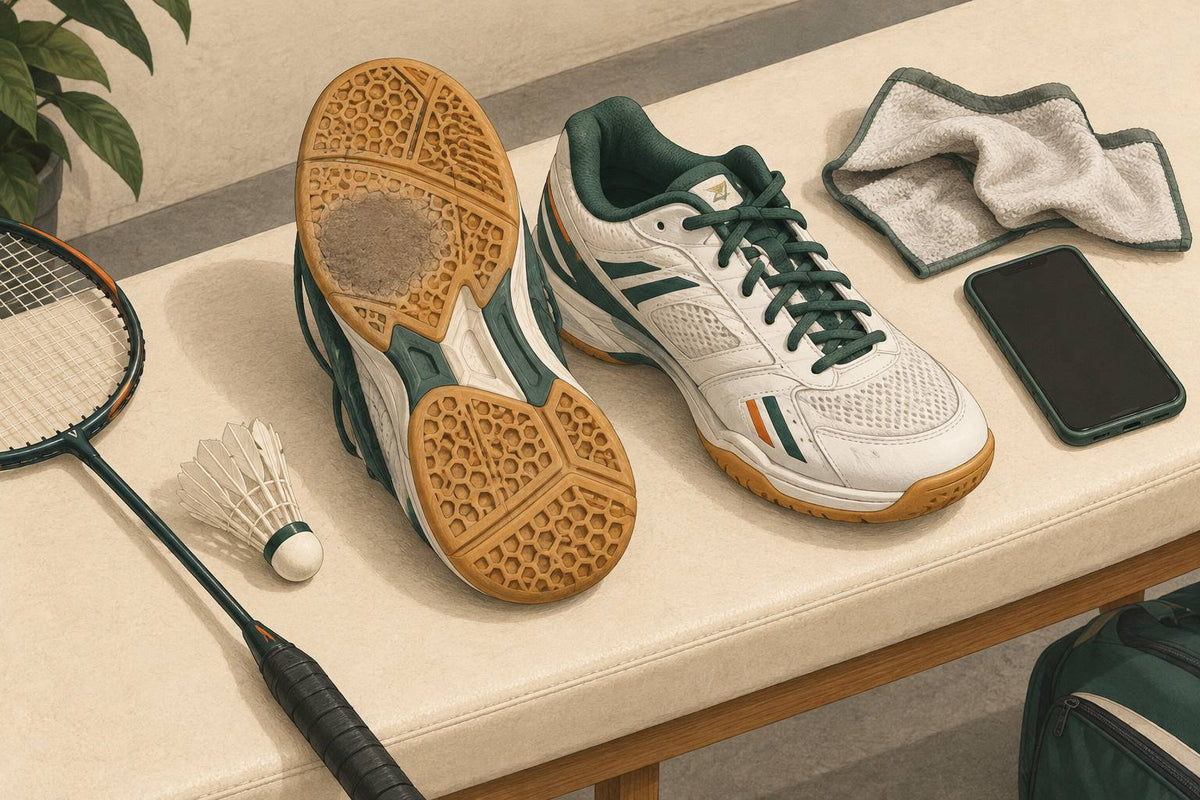
Keep a simple record instead. Photograph both outsoles after cleaning, then repeat after several ordinary sessions. If the same worn area grows, or confidence in a normal stop or change of direction changes with it, you have a concrete reason to inspect more closely.
Check three retirement signals first
The useful checklist has three parts: traction, fit and structure. One severe problem can be enough to retire a pair, while several smaller changes together matter more than one cosmetic scuff.
1. The outsole no longer gives dependable traction. Clean and dry the sole, then inspect it in good light. Look for a smooth contact patch, missing rubber, cracks or an edge beginning to peel. Do not judge the sole only by tread that remains elsewhere. Ask whether the areas you load still feel predictable during easy stops, turns and recoveries.
A laboratory study of progressively worn slip-resistant shoes found declining traction as worn regions grew in a wet-contaminant test. That is not a dry badminton-court study, and the authors noted that replacement criteria were not established. It supports taking a clearly worn contact patch seriously, not copying its laboratory threshold.
2. The upper no longer holds your foot securely. Lace the shoes normally and check for torn eyelets, a split upper, a detached toe bumper, stretched heel material or a foot that slides inside during ordinary movement. A lace adjustment can solve minor looseness. Repeated internal movement or damaged material is a condition problem even if the outsole still looks good.
3. The midsole or structure is no longer even. Place both shoes on a level surface and compare them from behind and from the side. Look for separation, visible tilt, deep permanent foam compression or one side sitting differently. Pressing or gently flexing the matching shoes can reveal a difference, but no home squeeze or twist measures remaining protection. Pair the observation with fit, visible damage and ordinary on-court feel.
- Retire now: a separating sole, exposed material, a crack, an upper that will not hold the foot or traction you no longer trust.
- Inspect again soon: a growing smooth patch, new foam compression, mild looseness or one shoe becoming visibly less level.
- Keep monitoring: light cosmetic scuffs when traction, fit and shoe integrity remain unchanged.

Read wear patterns as clues, not diagnoses
Wear patterns show where material changed, but they cannot reliably identify one badminton error, your racket side or an injury risk. Treat a pattern as a prompt to inspect movement and condition. Use a short video or coaching feedback before deciding what to change.
A toe scuff can come from a lunge recovery, a late stop, a crowded court, walking to the hall or the shoe's own shape. Wear along one edge can reflect a turn, a floor surface or a difference between the two shoes. The observation remains useful because it tells you where to look. The unsupported leap is claiming that one movement caused it.
| What you notice | Useful next step | Do not conclude |
|---|---|---|
| A smooth or missing-tread patch | Clean it, compare both shoes and check traction during easy controlled movement. | One footwork fault caused it. |
| Toe abrasion or a worn toe bumper | Check for separation, rubbing and enough room at the toes; film one controlled approach if useful. | Your lunge is unsafe. |
| One shoe wears differently | Record the difference and ask a coach to watch one specific movement. | The difference proves an injury. |
| A loose heel or stretched upper | Check lacing, fit, tears and whether your foot moves inside during play. | More practice will repair the shoe. |
A sole is not a medical assessment. If pain, numbness, repeated giving-way or a change after injury is part of the picture, pause the activity that hurts and seek individual advice from an appropriate clinician rather than reading the answer from the outsole.
Run a five-minute shoe check
A quick check works when it separates cleaning, inspection, fit and movement. Run it before a normal session or after cleaning the pair. Do not test questionable shoes by forcing a hard lunge or jump.
- Clean and dry the outsole. Remove dust and loose debris so you can see the rubber rather than court dirt.
- Compare left and right. Inspect the toe, forefoot, heel, edges and high-contact areas. Photograph both for a later comparison.
- Inspect connection points. Check the upper, eyelets, toe bumper, heel and the join between sole and upper.
- Check stationary fit. Lace normally, stand and notice whether heel and midfoot are held without rubbing or obvious movement.
- Use easy familiar movement as the final check. Stop if the pair feels uncertain. Compare with a known-good pair if available rather than escalating the test.
A known-good comparison does not mean everyone needs two identical pairs or that rotation doubles shoe life. It simply makes a gradual difference easier to notice. If you rotate shoes, label the pairs and inspect each on its own condition.
If you want to explore an apparent wear difference, keep the follow-up narrow. Film a few controlled repetitions of one movement, such as a net approach or rear-court recovery, and ask a coach about that movement. Do not rebuild your whole footwork system because one sole edge looks different.
Make the replacement decision safely
Retire a pair when it no longer provides traction, fit or structural confidence for your normal movements. You do not need to wait for every part to fail, and you do not need an unsupported hours-of-play rule to justify replacing an unreliable pair.
Use the old pair to improve the next purchase without drifting into model assumptions. Note where fit failed or traction changed, bring the old shoes when practical and choose an indoor court shoe that fits securely from the start. Pain or instability is not a normal break-in requirement.
The practical rule
Clean the sole, inspect traction, fit and structure, and retire the pair when normal play no longer feels secure. Use visible wear as a question—not a diagnosis.

Leave a comment
This site is protected by hCaptcha and the hCaptcha Privacy Policy and Terms of Service apply.