
Last checked: August 2026 · Written by the Badminton House player-led team.
Quick answer: how to measure badminton racket balance point
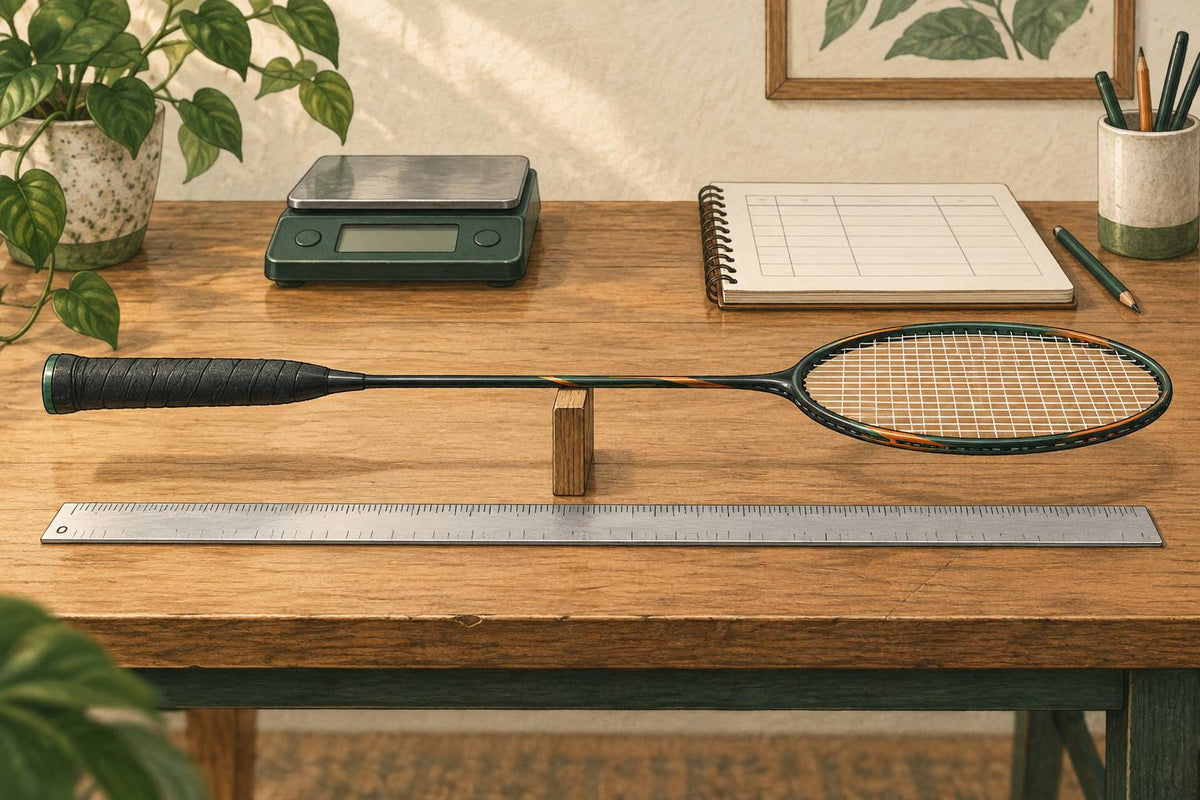
Weigh the racket exactly as you play with it, balance it on a narrow pivot, then measure from the butt cap to the balance point. Record the setup beside both numbers. The result is a useful static comparison, not a home swingweight test or a complete verdict on feel.
A printed 3U or 4U label is a starting point. It does not tell you what your own racket weighs after strings, grip changes and any other additions. A simple home record gives you a more useful answer: which of your rackets is actually heavier, where each one balances, and whether a setup change moved either number.
Use this procedure to compare like with like. Measure each racket in its current playing state, use the same scale and pivot, and keep the log. The aim is repeatable personal information, not a laboratory certificate.
Related reading: Once you have your numbers, see our badminton racket swingweight guide for the missing dynamic measurement. If you are deliberately changing a setup, our racket-balance tuning guide explains why location matters.
What weight and balance point actually tell you
Static weight is the number on the scale. Balance point is where the complete racket balances, measured from the butt cap. Together, they describe a racket at rest. They are useful for comparing your own setups, yet they cannot tell you the full resistance you feel while swinging.
| Number | How to record it | What it does not settle |
|---|---|---|
| Static weight | Grams, using the racket exactly as measured. | Where those grams sit along the racket. |
| Balance point | Millimetres from the butt cap to the point of balance. | How much the racket resists acceleration and redirection in play. |
| Swingweight | A separate dynamic measurement, normally obtained with specialist equipment or a calculation method. | It cannot be read directly from a kitchen scale and pencil pivot. |
The Global Racket Stringers Association describes static balance as the point where a racket balances on a board, pencil or finger, measured from the butt cap. It describes swingweight separately as dynamic balance that depends on mass placement and other racket properties. Its A–Z of Stringing guide is tennis-focused in places, but the distinction between a static pivot point and rotational inertia applies directly to any racket.
That distinction is why this page avoids declaring a universal head-heavy, even-balance or head-light cut-off. A number is most useful when you compare it with another racket measured the same way, or with the same racket before and after one deliberate setup change.
Measure your racket at home in five steps
You need a kitchen scale, a ruler or tape measure with millimetres, a pencil or narrow dowel, painter’s tape and a clear level surface. Keep the racket in one stated setup throughout the process. Do not remove an overgrip, cut strings or add tape halfway through a comparison.
- Name the setup first. Write down whether the racket is unstrung, strung, carrying its original grip, carrying an overgrip, or carrying any added material. This label prevents a useful measurement becoming a misleading comparison.
- Measure static weight. Place the complete racket centrally on the scale. Record the displayed grams. Repeat if the reading changes when you reposition the frame.
- Make a narrow pivot. Lay the pencil across the level surface so it forms a straight, stable ridge. A dowel or the narrow edge of a purpose-made balance board also works. Add painter’s tape to stop the pivot from rolling if needed.
- Find the balance point. Rest the racket across the pivot and slide it gently until it stays level without you holding either end. Do not press down on the frame. Mark the location along the shaft with a small removable piece of tape.
- Measure from the butt cap. Lay the ruler from the very end of the butt cap to the marked point. Record the result in millimetres. Repeat the pivot test two more times and use the repeated readings to decide whether your procedure is consistent.
A pencil pivot is for static balance only. It does not turn a home measurement into swingweight. In a badminton-smash study, researchers calculated swingweight using a balance board and a simple-pendulum method across five modified rackets, which is a different measurement task from finding the one point where a racket sits level. The Scientific Reports study is a useful reminder to keep the labels honest.

Keep a setup log, not a memory
A number without a setup label quickly loses value. Strings, grips and added material are part of the racket you play with, so record them as part of the measurement. Re-measure only after a clear change, then keep the old row as a reference instead of overwriting it.
| Racket | Setup | Weight | Balance point | Date and note |
|---|---|---|---|---|
| Frame A | Strung, original grip, one overgrip | 87.4 g | 295 mm | August 2026, match setup |
| Frame A | Strung, original grip, fresh overgrip | [record] | [record] | [record what changed] |
The exact brand of scale matters less than using the same scale and process for every comparison. If one reading cannot be repeated, check the pivot surface, the ruler start point and whether the racket is truly settled before deciding that the frame changed.
This log also makes grip experiments easier to judge. The GRSA guide notes that adding mass in different locations changes both balance and swingweight. A grip change can therefore be worth recording even when it seems too small to matter by hand. Read the GRSA explanation of static balance and swingweight before interpreting a moved balance point as the entire story.
Why matching two numbers is not enough
Two rackets can weigh the same and balance at the same point yet still swing differently because their mass can be distributed differently. Static weight and balance are worth measuring, but neither replaces swingweight, shaft behaviour, head shape or your own timing with the racket.
There is a useful, carefully bounded example. Aiyuke reported two configurations that both weighed 99.6 g and balanced at 289 mm. Its measured swingweight values were 86.6 and 90.6 after the same added grip mass was positioned differently. The report says it averaged five measurements and still carried error, so treat it as an illustration of the principle rather than a promise about what any two rackets will feel like. Aiyuke’s comparison report shows why a spec sheet cannot replace a real swing.
The research is equally cautious about making one number a buying rule. In 20 experienced players hitting forehand smashes with five modified rackets, higher swingweight in an 85–106 kg·cm² range reduced racket-head speed by an average 0.7 m/s per 5 kg·cm², yet did not produce slower shuttlecock speeds in that experiment. That is evidence about this test range and stroke, not a universal prescription for every player or rally. Read the full badminton-smash study.
Use your home numbers to narrow a question, not to finish it. If two rackets are supposed to match, first confirm that they are being weighed in comparable setups. If weight and balance still match but the rackets feel different, note the observation and test the relevant shots: drives, blocks, defensive lifts, clears and smashes. That is a better next step than arguing over one label.



Leave a comment
This site is protected by hCaptcha and the hCaptcha Privacy Policy and Terms of Service apply.