Last checked: August 2026 · Written by the Badminton House player-led team.
Quick answer: badminton shoe midsoles
EVA, PU, expanded thermoplastics and named inserts identify materials or construction choices. They do not, by themselves, prove that a complete badminton shoe will feel softer, rebound more, last longer or hold you more securely during a lunge.
Material
Name the family: EVA, PU, a thermoplastic foam or a separate insert.
Build
Ask where it sits, how much is used and which sidewalls, plates or outsole parts work around it.
Claim
Check the comparison baseline and test method before treating a percentage as useful.
The midsole sits between your foot and the outsole rubber, compressing and recovering as you land, push and change direction. Product pages often reduce that complicated system to one decisive word: EVA, “boosted” foam, gel, nitrogen, plate or a proprietary name. The useful question is narrower: what does this label identify, and what does it leave unknown?
For the broader anatomy—stack, carrier, insert and stabilizer—start with our badminton shoe midsole specifications guide. This article focuses on material taxonomy and the boundary between independent evidence and manufacturer-specific claims.
Read every midsole in three layers: material family, complete shoe construction and evidence for the specific claim. Skipping any layer turns a useful specification into a performance guess.
What do EVA, PU and newer foam labels mean?
EVA and polyurethane are conventional footwear-midsole material families. A modern shoe may use a reformulated version, an expanded thermoplastic, a gas-foamed material or a separate cushioning element. The family name is the beginning of the description, not a universal score for softness, rebound or durability.
| Label | What it can identify | What remains unknown |
|---|---|---|
| EVA | A conventional foam family widely used in footwear. | This formulation's density, hardness, cell structure and full-shoe feel. |
| PU | Another established midsole-material family. | Whether this shoe is automatically firmer, heavier or longer-lasting. |
| Expanded thermoplastic | A material and foaming approach used to create a cellular structure. | A universal rebound ranking across different formulations and shoes. |
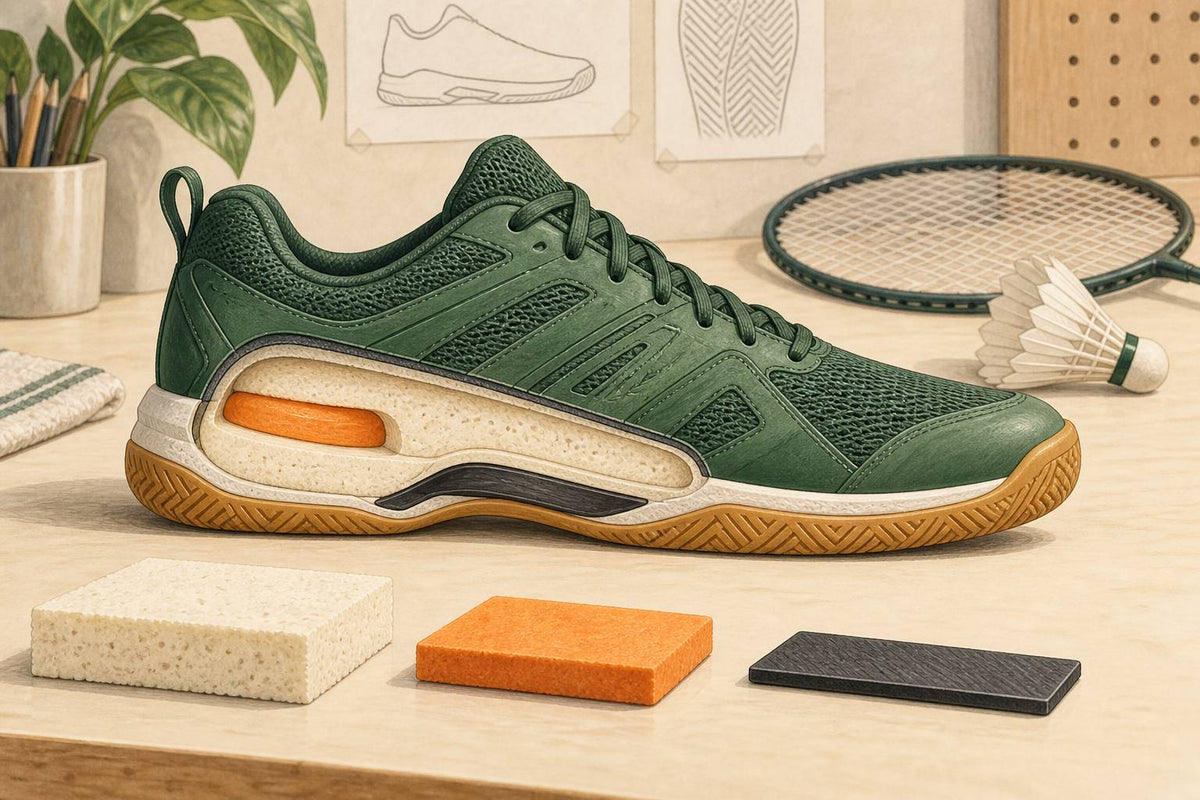
| Insert or dual density | More than one zone, element or formulation is involved. | Its size, placement, surrounding carrier and effect on the complete shoe. |
A peer-reviewed footwear study describes EVA and PU as generally used midsole materials and notes that cushioning constructions can also incorporate gas, gel or water-based elements. Its focus is not a ranking of badminton shoes, but it supports the basic distinction between a material name and a complete damping system (footwear damping study).
“EVA” therefore does not mean one recipe. Two EVA midsoles can differ in hardness, density, thickness and geometry. “PU” does not guarantee a particular lifespan. Expanded foam does not automatically mean bouncy. A useful specification tells you the actual construction or gives a measured comparison; a bare family name cannot settle the buying decision.
Why does construction change the material result?
A midsole works as part of a shoe. Thickness changes how far it can compress. Sidewalls can influence how the foot sits over the platform. A firmer carrier may surround a softer insert. The outsole, upper hold and any plate or shank also affect what you feel during a lateral plant.
Independent evidence illustrates why formulation details matter. A controlled study used running shoes that differed in EVA or two PU formulations and followed them over 500 km. The materials showed different cushioning and energy-return behaviour, and the authors concluded that material category plus hardness and density affected the measured properties (EVA and PU durability study).
That is valuable evidence of complexity, not a winner's podium for EVA or PU. The study used running shoes and repeated running mileage, not lateral badminton movements or controlled comparisons of current badminton models. Its result should make a reader ask for more construction detail, not claim that one family always lasts longer on court.
Carrier, insert and plate are different jobs
A carrier is the larger foam structure that shapes the platform. An insert is a localized element placed inside or alongside it. A plate or shank is a separate structural component, not automatically a cushioning material. A product can combine all three, so listing one named insert does not describe the amount or behaviour of the rest of the midsole.
This is also why squeezing a shoe with your thumb or twisting it by hand cannot measure protection or remaining rebound. Those checks may reveal obvious damage and help compare two shoes informally, but they do not reproduce controlled loading or account for fit, outsole grip and movement under bodyweight.

How should you read proprietary badminton foam claims?
A proprietary name becomes useful when the brand explains what the material is, where it sits, what comparison was made and how the result was measured. Keep the source attached: a manufacturer test can describe its own system, but it is not an independent cross-brand ranking.
Yonex says POWER CUSHION+ measured 28% greater shock absorption and 62% greater repulsion than standard EVA in its stated testing. The percentages belong to that Yonex comparison and method, as described in the POWER CUSHION+ announcement. They should not be carried across to every shoe using the name or compared directly with another company's percentage from a different test.
Victor's technology page describes HYPEREVA as a midsole technology and NITROLITE as high-performance EVA produced with a nitrogen-impregnating foaming process. Those definitions help decode the labels. They do not independently prove which complete shoe is more comfortable, stable or durable (Victor technology descriptions).
| Question for a technology claim | Why it matters |
|---|---|
| What is the comparison baseline? | “Better” is meaningless unless the reader knows what the new material was compared with. |
| Was a material sample or complete shoe tested? | A sample result may not describe fit, stability or the final construction. |
| Which method and loading direction? | A vertical drop test and a lateral badminton plant are not the same task. |
| Is the source independent? | A manufacturer claim can be informative when clearly labelled, but it should not be presented as an independent ranking. |
For a closer look at one branded system, our Yonex Power Cushion guide keeps its test claims tied to the named technology and source.
What is a better way to compare badminton shoes?
Compare the complete shoe in an order you can verify: secure fit, appropriate indoor outsole, stated midsole construction and the specific evidence behind any performance claim. The material name is one input in that sequence, not the conclusion.
- Name the material or element: do not let a proprietary label end the question.
- Locate it: full-length carrier, heel insert and forefoot pod are different constructions.
- Separate cushioning from stability: a soft feel does not tell you how the upper and platform control lateral movement.
- Keep evidence in scope: material, running-shoe and brand tests do not automatically rank complete badminton shoes.
- Judge fit in badminton movement: use controlled starts, stops and side steps on a suitable indoor surface when a proper try-on is available.
For the separate question of foam ageing and durability language, continue with badminton shoe midsole foam. For structure outside the foam, see our badminton shoe torsion-support guide.
The useful takeaway
A midsole label tells you what to investigate, not how the whole shoe will perform. Read material, geometry and evidence together, keep manufacturer percentages attached to their test and choose the complete indoor court shoe—not the loudest foam name.


Leave a comment
This site is protected by hCaptcha and the hCaptcha Privacy Policy and Terms of Service apply.