
Last checked: August 2026 · Written by the Badminton House player-led team.
Quick answer: badminton or padel?
Choose badminton for a light, stringed racket, a shuttle that cannot bounce and fast open-court reactions. Choose indoor padel if you want doubles play built around a bouncing ball, enclosed walls and compact racket control. The shared word “racket” hides two very different rally problems.
Badminton
Read early: the shuttle slows sharply, cannot bounce and must be contacted before it reaches the floor.
Padel
Read the bounce and enclosure: walls can extend the rally after the ball lands legally.
Switching
Keep balance and partner awareness, but deliberately reset the projectile, contact and recovery rules.
Badminton and padel look related from the entrance to an indoor racket centre: two pairs, a net and a racket in every hand. Once the rally begins, the resemblance narrows. Badminton asks you to intercept a very light shuttle in open space. Padel asks you to control a much heavier ball inside an enclosure where a bounce or wall can create the next shot.
That difference is more important than deciding which sport is “faster” or “harder.” Each rewards a different timing model. If you play both, the useful goal is not to make one technique fit the other; it is to recognize which general habits transfer and which sport-specific habits need a conscious reset.
The fastest verbal reset: before padel, say “ball, bounce, walls.” Before badminton, say “shuttle, no bounce, open court.” That reminder changes the information you look for before your old swing takes over.
How are badminton and padel equipment different?
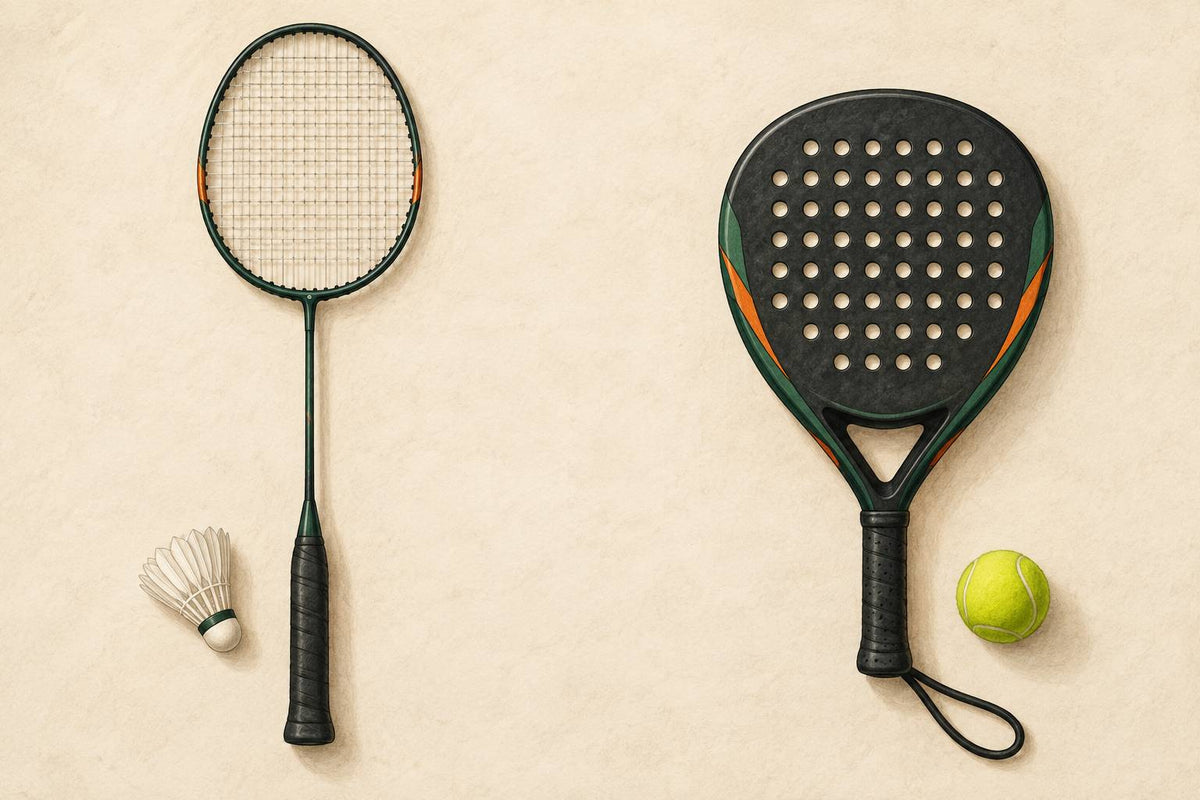
A badminton racket is long, light and stringed; a padel racket is short, solid and perforated. A legal feather shuttle weighs only 4.74–5.50 g under the BWF laws, while the FIP padel ball specification is 56.0–59.4 g. The mass, shape and bounce rule change how early you prepare and how much swing you need.
| Feature | Badminton | Padel |
|---|---|---|
| Racket | Stringed hitting area on a long shaft. | Solid perforated face; FIP maximum total length 45.5 cm. |
| Weight examples | Current 4U models are commonly listed around 83 g average. | Babolat's current adult examples span 345–370 g, each with a ±10 g tolerance. |
| Projectile | Feather or synthetic shuttle; no bounce. | Pressurized rubber ball with a specified bounce. |
| Flight problem | High drag and rapid deceleration. | Ball flight followed by court and possible wall rebounds. |
The BWF Laws of Badminton, in force 26 April 2025 and the 2026 FIP Rules of Padel establish those core differences. Current Yonex and Babolat product listings illustrate the large racket-weight gap, but individual examples are not universal limits for either sport.
A peer-reviewed shuttlecock aerodynamics study describes the shuttle as a high-drag projectile that slows rapidly. This is why a badminton player can see a very fast initial shot yet still have a distinct late-flight interception window. A padel player must instead keep calculating bounce height, pace after contact and the enclosure.
How do the courts, walls and scoring differ?
Badminton uses an open court with a net 1.524 m high at the centre. Padel uses an enclosed 10 m by 20 m court and a lower net: 0.88 m at the centre and 0.92 m at the ends. In padel, the ball can remain in play after a legal court bounce and contact with the walls or fence if it is returned before a second bounce.
The tactical consequence is larger than the dimensions. In badminton, letting the shuttle land ends the rally. In padel, stepping away from a fast ball can create time for a rebound off the back wall. A badminton player’s instinct to intercept everything early can be useful at the padel net, but costly when the better padel decision is to let a playable ball travel.
At the August 2026 check, badminton's BWF scoring law remains best of three games to 21, requiring a two-point margin after 20-all and ending at 30. Padel uses 15, 30, 40 and game, but the 2026 FIP rules permit three scoring options: Advantage, Star Point and Golden Point. Ask the facility or organizer which option applies instead of assuming every session resolves deuce the same way.
For another equipment-and-rules comparison, read badminton vs tennis. The useful lesson is similar: shared vocabulary does not guarantee shared contact, movement or scoring decisions.
Which habits transfer, and which ones interfere?
The safest crossover claims are general: balanced preparation, early visual pickup, partner communication and recovery after contact are useful habits in both sports. Exact stroke mechanics and court positions are task-specific. The transfer notes below are Badminton House coaching guidance, not evidence that playing one sport scientifically improves the other.
| Habit | Keep | Reset |
|---|---|---|
| Ready position | Balanced feet and preparation before the opponent contacts. | The exact spacing and recovery point for the new court. |
| Partner awareness | Call early and avoid occupying the same hitting space. | Formation cues based on padel walls versus badminton attack and defence. |
| Soft contact | Awareness of racket-face angle and pace. | A solid padel face does not respond like badminton strings. |
| Reading flight | Early pickup from the opponent’s contact. | Add bounce and wall paths in padel; remove them entirely in badminton. |
Do not turn “compact padel swing” into a universal locked-wrist rule. A Babolat padel technique guide describes a continental grip and a body-led sequence while also discussing wrist pronation for spin. The practical point is to learn the padel stroke on its own terms rather than inserting a badminton hand action into every shot.
When returning to badminton, restore the light-racket habits deliberately: relaxed preparation, no waiting for a bounce and early recovery toward the relevant base. Our guides to badminton forearm pronation and badminton finger power explain the sport-specific hand and forearm actions.
What is a simple reset routine between sports?
Use a short reset before the first scored rally whenever you change sports. This is a practical rehearsal, not a research protocol. Its purpose is to place the new object, contact and court rules in front of your automatic habits.
- Name the object: say “ball and bounce” or “shuttle and no bounce.”
- Feel the racket: make slow preparations and notice the new length, mass and face.
- Rehearse control: use cooperative contacts before attempting full pace.
- Add the court rule: practise one padel wall rebound or one badminton rally in which every shuttle is intercepted before the floor.
- Delay the score: play one cooperative exchange while calling the ball or shuttle early.
Choose badminton if the light racket, unusual shuttle flight and open-court interception problem appeal to you. Choose indoor padel if you prefer doubles exchanges shaped by a bouncing ball and walls. If you play both, curiosity is more useful than forcing one sport’s familiar stroke into the other.
The useful takeaway
Keep balance, early vision and partner communication. Reset the racket, projectile, bounce and court rules before every switch. The sports are close enough to feel familiar and different enough to punish the wrong automatic assumption.

Leave a comment
This site is protected by hCaptcha and the hCaptcha Privacy Policy and Terms of Service apply.