
Last updated: August 2026 · Written by the player-led team at Badminton House
Quick Answer: Badminton Shoe Wear Patterns
Treat a sole as a maintenance clue, not a diagnosis. A smooth, torn, or separating area deserves attention; a left-right difference is a prompt to observe your movement, not proof of a fault.
First
Inspect both shoes clean and dry. Look for lost tread, tears, loose sole edges, and one clearly different contact area.
Then
Compare that area with a short video and your on-court feel before changing technique or equipment.
Stop
Do not use a wear mark to self-diagnose an injury, predict an ankle roll, or identify a single footwork mistake.
A badminton sole records lots of sessions, floors, turns, lunge recoveries, walking to the hall, shoe age, and its own rubber pattern. That makes it useful for spotting obvious damage and asking a better practice question. It does not turn into a map of your handedness or a medical report. The productive question is, “What should I look at next?” rather than “What fault has this shoe proved?”
The research behind shoe wear is strongest on traction and general footwear, not on named badminton wear signatures. In workplace footwear, studies found that natural outsole wear can reduce measured friction. Those results are a reason to take a smooth patch seriously, but they do not provide a court-shoe replacement number or a technique verdict for one player.
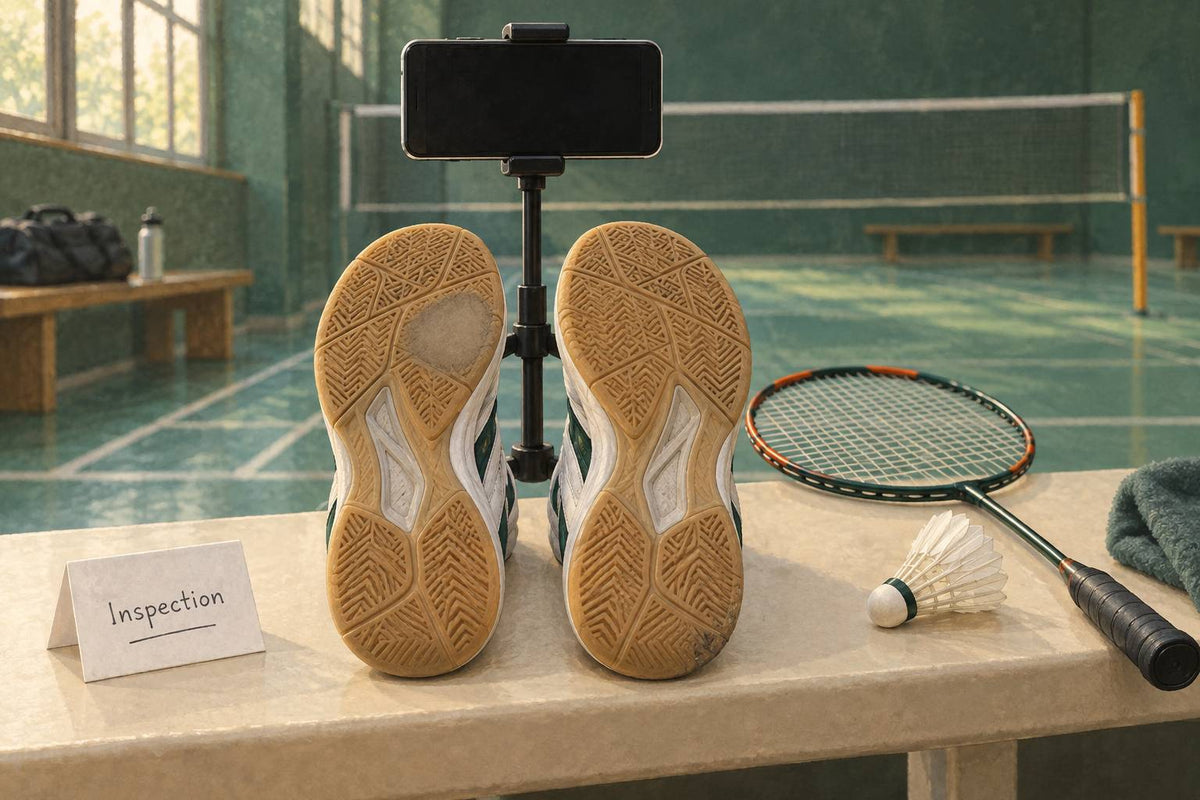
Use one shoe as a comparison tool. Photograph both outsoles in the same light, then repeat after several normal sessions. The useful signal is a change you can see and feel, not a single scuff judged in isolation.
What Shoe Wear Can and Cannot Tell You
Wear can tell you where outsole material has changed and whether the tread or sole construction now needs attention. It cannot reliably identify a badminton fault, force level, injury risk, or handedness, because the same visible area can reflect many movements, surfaces, and shoe-design variables.
That boundary matters. A walking-based study of 291 people examined shoe abrasion alongside several gait and personal factors for forensic identification. It did not test badminton lunges, turns, injury outcomes, or racket side. Read its scope in the walking abrasion study before borrowing any online “wear map” as coaching advice.
So label your observation honestly. “The outer forefoot is smoother than it was last month” is an observation. “My toe-in lunge is causing ankle risk” is a conclusion that the sole alone cannot support. Separating the two keeps a small maintenance check from becoming a scary or misleading diagnosis.
| What you see | Useful next question | Do not conclude |
|---|---|---|
| A smooth patch or lost tread | Does that area feel less secure on your normal dry court? | One exact movement caused it. |
| One shoe looks different | Can video show a repeatable difference in a chosen movement? | Your racket side explains it. |
| Toe, upper, or sole-edge damage | Is the shoe still intact, comfortable, and stable in play? | A rep drill will repair the shoe. |

Five Observations, Not Five Diagnoses
These five visible patterns are sensible prompts for an inspection, but none has a universal badminton meaning. Use them to choose one movement to film or one equipment check to make; keep the result as an observation unless a qualified coach or clinician assesses you directly.
1. A more-worn inner forefoot
Do not assign this to the non-racket-side shoe, a forehand pivot, or a force total. First check whether the tread is still present and whether the same area feels different during a controlled split step and recovery. Film a short, easy sequence from behind, then simply note whether both feet land and leave the floor as intended. The video may show nothing unusual. That is still a useful result.
2. A heel area that looks dragged or flattened
A heel mark does not prove that you recover with the heel down. Inspect for a flattened tread pattern, cracking, or a sole edge beginning to peel. Then film one calm rear-court return or one push-and-turn movement at a pace you can control. Watch the clip for where your foot contacts and whether you feel stable. Describe what you see; do not force it into a toe-versus-heel rule.
3. An outer-forefoot scuff
An outer scuff is not evidence that your toes point in, that you are rolling an ankle, or that a lunge is unsafe. Check the shoe’s upper and sole edge for tears, then record a few comfortable net approaches from the side. Notice whether the shoe feels secure when you brake and recover. If pain, repeated giving-way, or a recent injury is part of the picture, stop treating the sole as the answer and seek individual assessment.
4. Toe-tip abrasion or a damaged toe bumper
This is a condition check first. Look for exposed material, a separating bumper, or an upper that rubs or pinches during play. A short, low-intensity shadow sequence can help you notice whether a particular approach feels cramped, but it cannot prove why the toe is worn. Compare shoe length, fit, and session conditions as well as movement before deciding what to change.
5. Similar wear near the big toe and outer heel
Similarity between shoes is not a universal baseline, and difference is not automatically a problem. Use symmetry as a practical record: photograph both soles, mark the date, and compare the same shoes later. If traction, comfort, and shoe integrity remain good, there may be no action beyond monitoring. If the surface is becoming smooth or the shoe feels unreliable, move from diagnosis to maintenance.
Turn a Sole Check Into a Better Practice Question
The best follow-up is one small, repeatable observation: inspect the shoe, choose one on-court movement, and compare feel with video. This preserves the value of the wear mark while avoiding a false correction based on a pattern that has not been validated for badminton.
- Clean and inspect. Remove dust, let the sole dry, and compare both shoes for missing tread, cracks, tears, loose edges, or obvious unevenness. APMA likewise advises players to check the tread and midsole for wear.
- Name one movement. Pick a net approach, a rear-court recovery, or a defensive change of direction. Do not test every pattern in one session.
- Film a few controlled repetitions. Use a phone from one useful angle. Your job is to describe contact, balance, and recovery, not to score yourself against a universal shape.
- Compare feel and condition. Note any slip, discomfort, instability, or upper/sole damage. A coach can then view the clip with the real question in hand.
- Recheck after normal use. The next photo tells you whether the observed patch is progressing. It does not need an invented rep target to be useful.
A short, stable clip gives a coach more to work with than a sole pattern alone.
When Wear Becomes a Shoe Decision
Replace or assess a shoe for its condition and traction, not because a sole claims to diagnose your mechanics. Missing tread, a separating sole, a damaged upper, reduced confidence under normal movement, or discomfort are concrete reasons to pause and decide whether the shoe remains suitable for play.
The evidence does support taking worn tread seriously. A laboratory study of workplace slip-resistant shoes found lower friction in naturally worn pairs than in their new counterparts, while a longitudinal study linked growing worn areas with lower simulated-slip traction. Read the new-versus-worn friction study and the longitudinal traction study in their workplace context. Neither supplies a universal badminton mileage or calendar rule.
If the shoe looks intact but you feel pain, repeated instability, numbness, or a change after an injury, do not try to solve that from the outsole. Get appropriate individual advice. For a simple equipment decision, use our guide to cleaning slippery badminton shoe soles and check condition again on a clean, dry court.
A sole check is most useful when it leads to a clearer question, a safer shoe decision, or a better video for your coach.
Explore Court FootwearCompare court-shoe options and check live availability.

Leave a comment
This site is protected by hCaptcha and the hCaptcha Privacy Policy and Terms of Service apply.