
Last checked: August 2026 · Written by the player-led team at Badminton House
Current badminton shuttlecock rules separate two questions: does the shuttle meet the Law 2 construction specifications, and does it land inside the Law 3 speed-test band? Under the BWF Laws in force from 26 April 2025, Version 5.0 (2), correct speed means landing 530–990 mm short of the opposite back line after the prescribed hit.
Law 2
Build: material, feathers or skirt, dimensions, base, fastening, and weight.
Law 3
Speed: prescribed stroke plus an inclusive 530–990 mm landing band.
Law 5
Ruling: BWF decides whether equipment complies with the specifications.
A shuttle can land at the right distance yet still fail a separate construction requirement. Think of the court test as a pace check, not a complete certificate.
What makes a feathered shuttle legal?
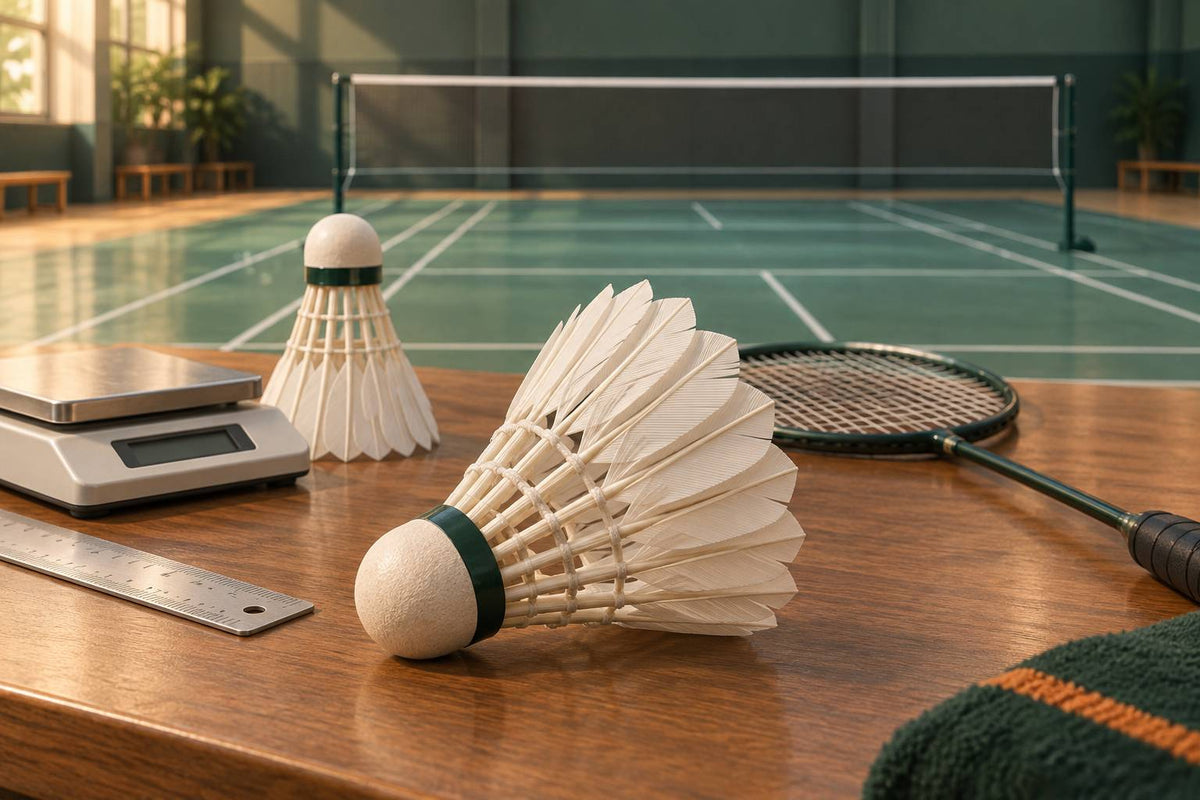
For a feathered shuttle, the current BWF rule is a six-part specification. The figures below come from Laws 2.2.1–2.2.6 in the current official Laws PDF.
| Feature | Law 2 requirement | How to read it |
|---|---|---|
| Feather count | 16 | A count, not a tolerance range. |
| Feather length | 62–70 mm | Uniform, measured from tip to the top of the base. |
| Tip circle | 58–68 mm diameter | The circle made by the feather tips. |
| Fastening | Firmly fastened | Thread or another suitable material. |
| Base | 25–28 mm diameter | Rounded on the bottom. |
| Total weight | 4.74–5.50 g | The complete shuttle, not only the base. |
Law 2.1 also allows natural and/or synthetic materials, provided the shuttle's flight characteristics generally resemble the natural feathered reference with a cork base covered by a thin layer of leather. That comparison governs flight; it does not say every legal synthetic shuttle must literally contain cork and leather. For the physical parts behind those terms, see the guide to shuttlecock cork, base, and skirt anatomy.
How do the synthetic-shuttle limits differ?
A non-feathered shuttle replaces natural feathers with a synthetic skirt or simulation. Its base still follows the 25–28 mm rounded-bottom requirement. The important exception is narrower than “synthetic shuttles get 10% on every measurement.”
Law 2.3.3 allows up to 10% variation because synthetic material differs in specific gravity and other properties, but it cross-references only feather length, the tip-circle diameter, and total weight. The Law 2.3 wording does not extend that 10% to the base diameter or to every feature in Law 2.
The 10% shortcut to avoid
Do not take 10% off every minimum and add 10% to every maximum. Apply the allowance only to the three clauses Law 2.3.3 names: length, tip circle, and weight.
Law 2.4 creates a different, local exception. A specification may be modified only with approval from the Member Association concerned, where altitude or climate makes the standard unsuitable, and without changing the shuttle's general design, speed, or flight. A club vote or agreement between players is not the approval named in the rule.
How do you perform the BWF speed test?
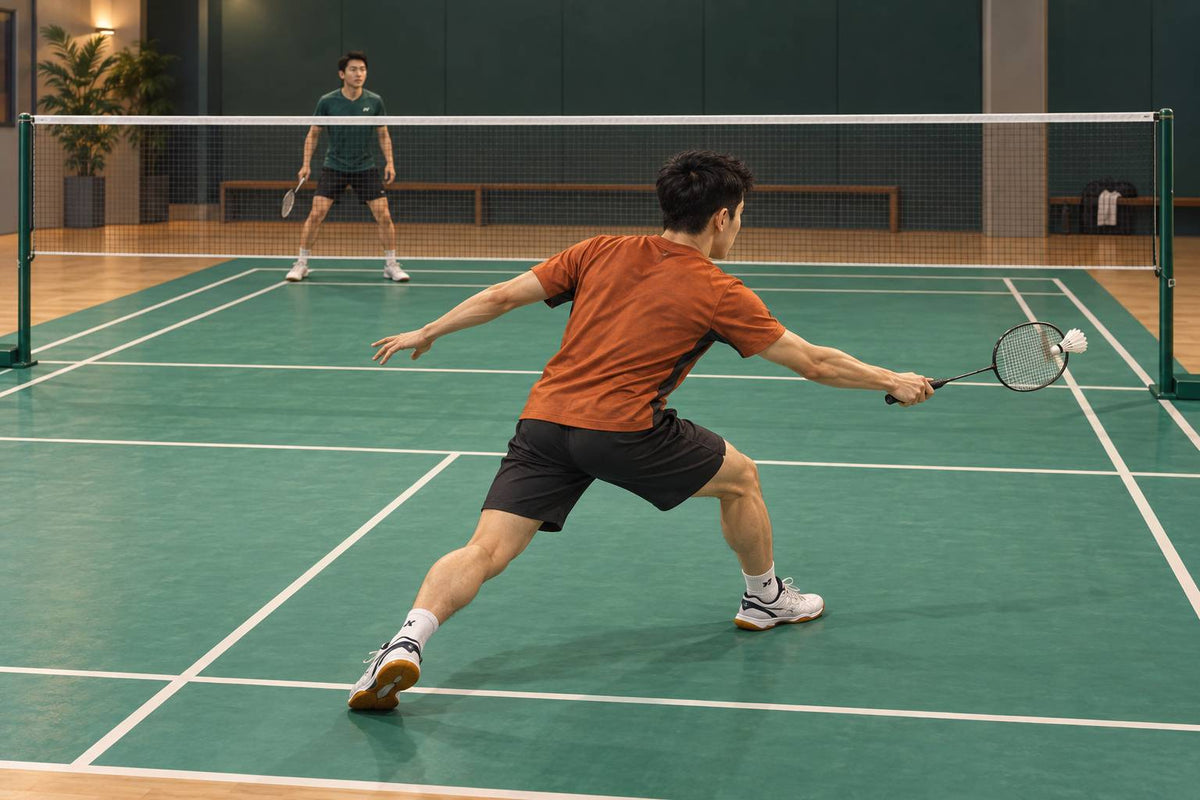
Law 3.1 defines one test stroke: a player uses a full underhand stroke, contacts the shuttle over the back boundary line, hits it upward, and sends it in a direction parallel to the side lines. Those details matter because a shortened swing, contact well inside the court, or a diagonal path changes the result.
- Start at the back: arrange the stroke so contact occurs over the back boundary line.
- Use the specified action: make a full underhand stroke rather than a serve, drive, overhead clear, or gentle feed.
- Choose the line: hit upward and parallel to the side lines.
- Read first contact: judge where the shuttle lands relative to the opposite back boundary line.
Law 3 says “a player”; it does not, by itself, assign the hit to the umpire or referee. For tournament responsibilities and the distinction between authorizing, observing, and hitting, use the companion guide to shuttle speed-test roles.
The court diagram labels the shuttle-testing marks optional. If a hall has no permanent marks, measure 530 mm and 990 mm inward from the opposite back line and use removable markers only with venue permission. That marking method is practical setup advice, not an extra BWF requirement.
How do you interpret the landing?
The Law 3.2 result is inclusive: a correct-speed shuttle lands not less than 530 mm and not more than 990 mm short of the other back boundary line. A landing exactly 530 mm or exactly 990 mm short is therefore inside the band.

| Landing relative to opposite back line | What the result supports | What it does not support |
|---|---|---|
| Less than 530 mm short | The shuttle travelled beyond the accepted band. | A universal replacement tube number. |
| 530–990 mm short | Inside the Law 3 speed band, endpoints included. | Proof of every construction requirement. |
| More than 990 mm short | The shuttle fell before the accepted band. | A climate correction formula. |
Calling the first outcome faster and the third slower is a comparison with this prescribed band. It is not a claim that every brand uses the same retail speed code or that one test can be translated into a colour, number, temperature, or tube choice.
What does a passing speed test not prove?
A pass establishes only that the tested flight ended inside the Law 3 distance band after the prescribed stroke. It does not count 16 feathers, measure the base, check the skirt dimensions, weigh the shuttle, or inspect how its parts are fastened. Those remain Law 2 questions.
Law 5 separately says BWF decides whether a racket, shuttle, equipment, or prototype complies with the specifications. A club court test is useful evidence about speed, but it is not an official ruling that every legal requirement has been met.
Nor may players solve a fast or slow result by deliberately modifying or damaging the shuttle. Law 16.6.2 prohibits doing so in order to change speed or flight; it states no exception for player agreement. If a shuttle becomes damaged or needs replacement during play, follow the separate badminton shuttle-change procedure.
Current versus future text
The published BWF Laws Version 6.0 is marked in force from 4 January 2027. It carries the same Laws 2 and 3 wording, but it is future law—not the current authority in August 2026.
A clean shuttle-check sequence
Use the rules in order so one result does not stand in for another.
- Identify the construction: feathered or non-feathered, then apply the correct Law 2 clauses.
- Check the specifications: use the exact count, dimensions, fastening, base, and weight that apply.
- Set the speed band: find or measure 530 mm and 990 mm short of the opposite back line.
- Make the prescribed stroke: full underhand, contact over the back line, upward, and parallel to the side lines.
- Record the landing: inside, beyond, or before the inclusive band.
- Keep the conclusion narrow: report the speed result without declaring blanket compliance or altering the shuttle.
That distinction is the heart of the rule: Law 2 describes the shuttle, Law 3 tests its speed, and neither should be silently substituted for the other.


Leave a comment
This site is protected by hCaptcha and the hCaptcha Privacy Policy and Terms of Service apply.