
Last checked: August 2026 · Written by the Badminton House player-led team.
Quick answer
A short-foot exercise is a small, gentle arch lift: keep the heel and both sides of the ball of the foot grounded, leave the toes long, and draw the forefoot slightly toward the heel without curling or gripping. Start seated and use a harder supported position only while the same action stays pain-free and clean.
Action
Lift, do not grip: the inside arch rises slightly while the toes, heel and forefoot contacts stay quiet.
Start
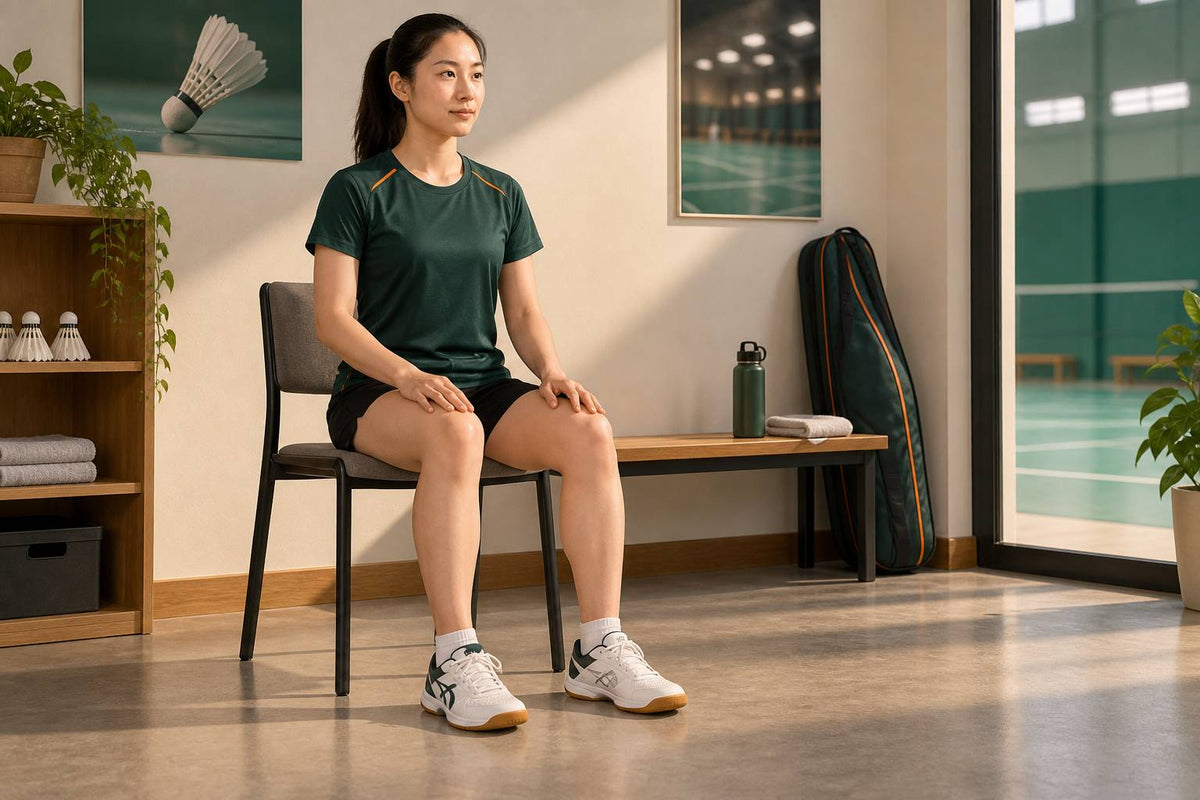
Use the seated version: it removes most balance demand so you can learn the foot action first.
Progress
Follow form, not a calendar: move to the next position only when the contacts stay down and the toes remain relaxed.
Scope: This is an off-court motor-control guide for pain-free adults. It is not a treatment for foot pain, flatfoot or ankle instability, and it is not a rehabilitation or return-to-play plan. Recent injury or surgery and clinician-directed rehabilitation sit outside this routine. Pain, altered sensation, diabetes-related foot risk and prescribed protective-footwear advice are addressed in the medical-help section below.
The five drills below do not promise quicker movement, better lunges or fewer injuries. They give you five stable ways to practise one small foot action. Treat that action as one accessory skill, not a substitute for a complete badminton leg-strength program.
What Is a Short-Foot Exercise?
“Short foot” describes a slight shortening of the foot's arch line, not a visible scrunch. Think of gently drawing the ball of the foot toward the heel while keeping the toes relaxed. The heel, the mound under the big toe and the mound under the little toe stay in contact. The inside arch rises only a little.
That cue follows the published technique in a 21-person asymptomatic-adult study: draw the metatarsal heads—the ball of the foot—toward the heel without toe flexion, using a submaximal contraction. A current NHS Trust arch-lift instruction also keeps the toes and heel grounded. We use those contact cues here without importing that patient handout's diagnosis or dose.
The exercise is often discussed as intrinsic-foot-muscle training. A laboratory study of 9 healthy men showed that plantar intrinsic muscles could actively resist longitudinal-arch deformation under controlled loading. That is useful mechanism evidence, but it is not evidence that this exercise improves badminton performance or prevents injury.
Nor does short foot isolate one muscle. After 8 healthy collegiate runners completed one set of 40 repetitions, T2 magnetic-resonance imaging showed increased activation across every plantar intrinsic muscle the researchers measured. “Arch skill” is a more honest mental model than “switch on one hidden muscle.”
What Does the Evidence Show—and Not Show?
The studies do not point to one best short-foot program. They use different feet, populations, positions, doses and outcomes. Some measure muscle activity in one session; others measure balance or pressure after several weeks. None tests the five-drill sequence in this article.
| Evidence | What it found | Limit for this guide |
|---|---|---|
|
Acute EMG study 20 adults with normal feet |
Short foot produced greater abductor-hallucis activity than toe curls, and activity increased with weight-bearing demand. | An immediate muscle signal does not prove long-term benefit, and a harder stance is not automatically a better starting point. |
|
Healthy-volunteer randomized study 24 university-age adults; 4 weeks |
Despite 100 daily repetitions, groups did not differ in navicular height or static balance. The dynamic-balance finding differed by limb. | The mixed result does not validate 100 repetitions as a general dose. |
|
Asymptomatic-adult single-group study 21 adults; 4 weeks |
Arch and selected balance measures changed after a seated-to-standing program using submaximal 5-second holds. | There was no control group. The authors called the evidence preliminary, so its protocol is an example, not a prescription. |
| Clinical-population trials Flatfoot or chronic ankle instability |
A 32-person flatfoot trial favoured sensorimotor training plus short foot over sensorimotor training alone for balance, while a 2026 trial of 24 people with chronic ankle instability improved static control and subjective instability but not dynamic control. A separate 34-person flatfoot trial found different plantar-pressure changes after short foot and toe curls. | These are clinical or selected-foot populations. One intervention was combined with sensorimotor training, and none measured badminton performance or injury prevention. |
| Sport transfer Running and badminton context |
A broad 12-exercise runner program changed selected kinematics but not impact peak, braking force or vertical loading rate. A 2025 study of 50 university badminton players observed arch measures under static loads but tested no exercise. | A multi-exercise running program is not short foot alone, and a cross-sectional badminton study cannot establish a training effect. |
Bottom line: short-foot exercise is a reasonable way to practise a controlled arch action, but the evidence does not supply a universal badminton dose or a promise of on-court transfer.
How Do You Perform the Short-Foot Action?
Use a firm, clean, dry, nonslip indoor surface. For every standing version, keep a wall, rail or sturdy bench within easy reach. Wear secure footwear that does not slide or bunch. The action can be practised through a shoe; bare feet are not required.

- Find three contacts. Feel the heel, the mound under the big toe and the mound under the little toe.
- Leave the toes long. Do not dig their tips into the floor or mime pulling a towel.
- Use a small effort. Gently draw the ball of the foot toward the heel until the inside arch rises slightly.
- Keep the rest quiet. The heel does not swivel, the forefoot does not lift, and the foot does not roll onto its outside edge.
- Release fully. Let the arch return without losing the three contacts, then reset rather than holding a permanent brace.
Form check: If the toes curl, a contact point lifts, the heel turns, the ankle rolls, the knee rotates, balance goes or pain appears, the version is too demanding right now. Reduce the effort or return to an earlier position.
5 Short-Foot Drills for Pain-Free Adult Training
Evidence boundary: Research protocols use different populations, doses and combinations. The five drills below are Badminton House's teaching progression for the same short-foot action in increasingly demanding stable positions; this exact five-drill sequence has not been clinically validated.
These are choices, not a mandatory five-station circuit. Select the first position in which you can keep the action small, quiet and pain-free.
1. Seated Arch Lift
Set up: Sit on a stable chair with the whole working foot supported. Find the heel, big-toe mound and little-toe mound.
Do it: Leave the toes relaxed, make the gentle short-foot action, then release fully. Keep the knee and heel still. If you cannot lift the arch without toe curl, make the effort smaller rather than pressing harder.
Use this level when: you are learning the movement or any standing version changes the contact points.
2. Supported Double-Leg Arch Lift
Set up: Stand with both feet down and a sturdy support within reach. Keep your weight comfortably shared.
Do it: Work one foot at a time. Build the same small arch lift without shifting the body, lifting a forefoot contact or turning the knee. Release before switching sides.
Regress when: standing makes you grip the floor with the toes or roll toward the outside of the foot.
3. Supported Lateral Weight Shift
Set up: Keep both feet down and your hands available at the support. Establish short foot on the receiving side before moving.
Do it: Transfer only a small amount of body weight toward the working foot. Stop the shift while all three contacts, relaxed toes and a quiet knee remain intact; return to centre and release.
Regress when: the shift pushes the foot onto its outer border or makes the arch collapse suddenly.
4. Supported Split-Stance Arch Lift
Set up: Take a comfortable half step, keep both feet down and place the working foot in front. This is a stable stance, not a deep lunge.
Do it: Establish the short-foot action on the front foot, then make a small forward weight shift without letting the heel or forefoot contacts lift. Return and release.
Regress when: the front knee twists, the heel swivels, or lunge depth becomes the challenge instead of foot control.
5. Supported Single-Leg Arch Lift
Set up: Keep both hands available at a sturdy support. Set the short-foot action before making the stance harder.
Do it: First lighten the other foot. Lift it only if the working foot keeps its three contacts and the toes stay relaxed. Put the other foot down at the first balance or form change, then release.
Remember: single-leg stance creates more postural demand; it is not inherently more useful. A clean supported version is the goal, not removing your hands or chasing wobble.
How Much Should You Practise, and When Should You Progress?
There is no validated universal dose for badminton. Published protocols range from 100 daily repetitions in one healthy-volunteer study to roughly 30 submaximal 5-second holds in an uncontrolled study; a flatfoot trial used 20 5-second holds before supervised sensorimotor work, while the public abstract of a 2026 chronic-ankle-instability trial reported 3 sessions per week for 4 weeks. Those are study designs, not interchangeable prescriptions.
Practically, treat short foot as brief skill practice. Choose one suitable drill. Repeat only while each effort looks and feels the same, and stop the set when a contact lifts, a toe grips or another form error appears. If a brief hold helps you learn, 5 seconds is one study-aligned option—not a minimum, maximum or target. Release sooner if control changes.
Progress one variable at a time: seated, then supported double-leg, then a small supported weight shift, split stance and finally supported single leg. Do not add an unstable surface, closed eyes, a band, external weight, heel raise, deep lunge, jump, racket or shuttle distraction. This article has no evidence for those combinations.
Move forward only after you can reproduce the current version pain-free across practice without substitutions. Move backward if the toes curl, contact changes, the ankle rolls, the knee turns or balance becomes the task. If ankle or hip range limits your stance, train that separately with the hip and ankle mobility guide rather than forcing more short-foot effort.
When Should You Stop or Get Medical Help?
Do not use this routine to test an injured or painful foot. After a recent injury or surgery, or when a clinician has given you a rehabilitation plan, use individualized exercise selection instead. The American Academy of Orthopaedic Surgeons says post-injury or post-surgery foot-and-ankle conditioning should be chosen with a doctor or physical therapist and should not cause pain.
Stop immediately if an exercise causes pain or you feel unwell. Seek assessment rather than continuing generic training if foot symptoms limit normal activity, worsen or keep returning, or include tingling, loss of sensation or weakness; these are current NHS assessment triggers. For symptom care rather than pain-free training, use the separate badminton foot-pain guide.
After an injury, seek prompt urgent assessment for very painful or worsening pain, large or worsening swelling or bruising, inability to bear weight or walk more than a few steps, marked stiffness or difficulty moving, or a very high temperature or feeling hot, cold or shivery; current NHS sprain-and-strain guidance places those signs in its urgent pathway. Current NHS foot-pain guidance also calls for urgent help after a snap, grinding or popping noise. Use emergency care now if you heard a crack at the time of injury, the injured part changed shape or points at an odd angle, it is numb, tingling or has pins and needles, or the surrounding skin looks blue or grey or feels cold; those are emergency features in the same NHS sprain-and-strain guidance.
Diabetes and foot protection: The CDC says people with diabetes should never go barefoot, even indoors, and should ask their doctor which activities are appropriate. Do not let this generic routine override protective-footwear or foot-care advice. With diabetes, do not wait for a routine appointment: warning signs including tingling, burning or pain, loss of sensation, a colour or temperature change, or a blister, sore or ulcer should be reviewed right away by a doctor or foot doctor.
Short-Foot Exercise FAQ
Should my toes curl during a short-foot exercise?
No. Toe curl changes the task into gripping. Make the effort smaller until the arch can rise slightly while the toes remain long and the heel and both forefoot contacts stay down.
Must short-foot exercise be done barefoot?
No. Use secure footwear when you need protection or have been told to wear it. The CDC says people with diabetes should never go barefoot, including indoors, and should ask their doctor which activities suit them.
How many short-foot repetitions should I do?
Research does not establish one badminton dose. The studies used markedly different counts, holds, frequencies and populations. Practise one suitable version only while form stays identical, and do not copy a clinical or research protocol as a universal target.
Which of the five drills is best?
The first one you can perform cleanly. Seated is the default learning position. A supported single-leg version adds balance demand, but more demand does not make the arch action more precise.
Will short-foot exercise prevent badminton injuries or improve performance?
The evidence reviewed here does not establish either result. It supports a narrow arch-control exercise and selected outcomes in specific study groups. Use the five positions to practise that skill without attaching a speed, balance, lunge or injury-prevention promise.
The useful standard is simple: a quiet, pain-free arch lift with relaxed toes and steady contact. Keep the easiest position that meets that standard; there is no prize for making a small exercise look dramatic.

Leave a comment
This site is protected by hCaptcha and the hCaptcha Privacy Policy and Terms of Service apply.