
Last updated: July 2026 · Written by the team at Badminton House
Quick Answer: Badminton String Break Location
Use the break location as a clue, then confirm it against visible wear, nearby grommets, and the timing of earlier failures. Location alone cannot certify one cause.
Centre wear
Best first read: notching or fraying where mains and crosses rub supports gradual wear, especially after normal playing time.
Frame edge
Off-centre contact is one possibility; inspect the adjacent bumper and grommet for a split, sharp, missing, or sunken edge.
Early repeat
Repeated early failures call for a full review of grommets, tension, stringing marks, frame condition, and setup history.
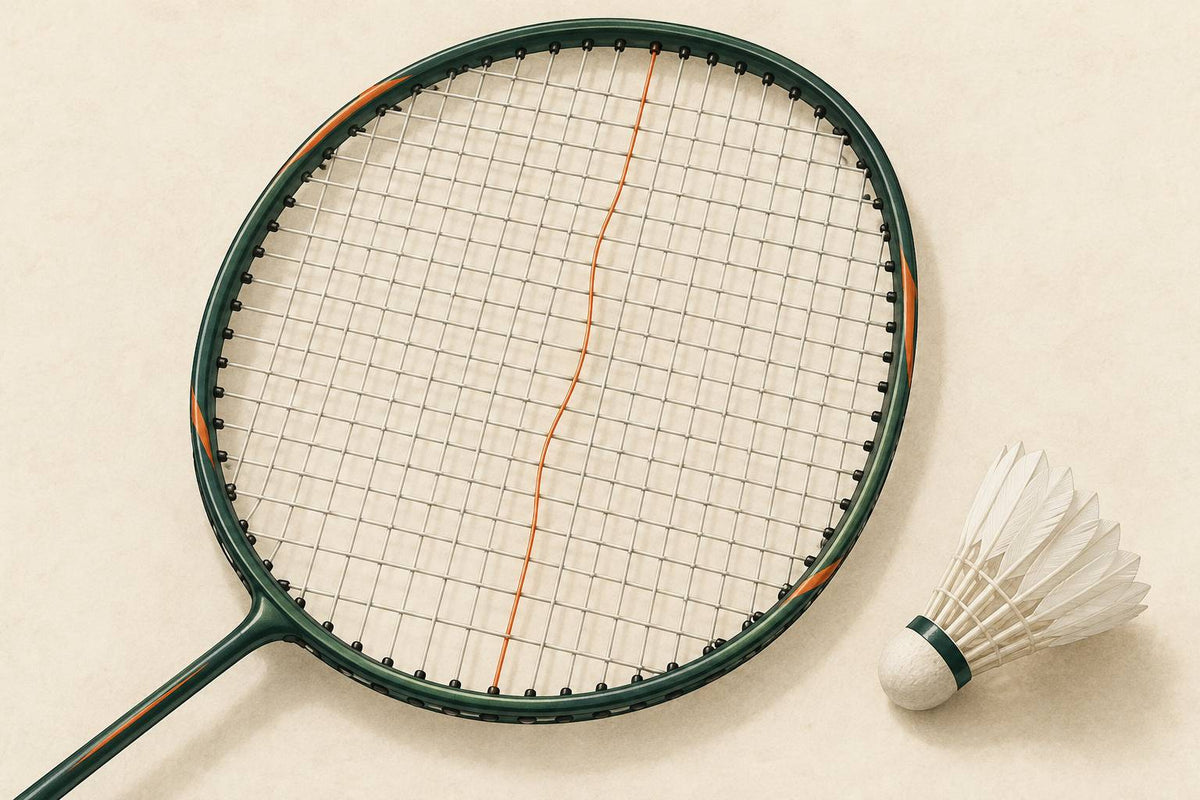
When a string snaps, don’t just ask “how long did it last?” Look at where it broke. A badminton string break location can tell you whether you’re seeing normal centre-bed wear, an off-centre hit near the frame, a sharp or sunken grommet, or a setup issue that has been building over multiple restringings. The key is not to overcall one clue.
A break near the edge might be a mishit, but it might also be a split grommet cutting the string. A clean centre break usually points toward mains-and-crosses wear, but the string type changes what you see: notching on some strings, fraying fibres on others. Use the location as your first clue, then confirm it with the frame, grommets, tension history, and recent playing conditions.
In This Guide
Badminton string break location: centre-bed wear clues
A snap close to the middle of the stringbed often points toward gradual wear, because that is where many clean shots land. Treat it as a useful clue, not proof. The same broken string can be influenced by string age, tension, storage, stringing quality, and how the last few rallies were played.
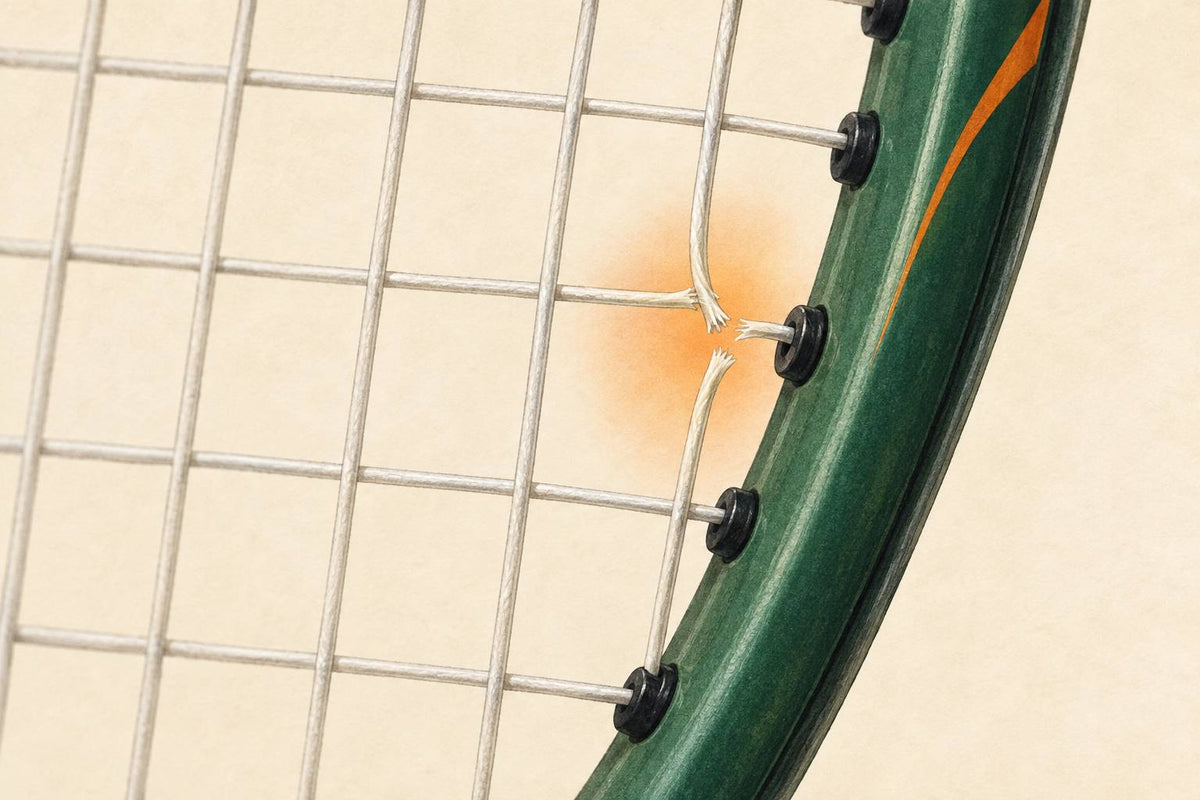
The key evidence is usually at the intersections where the main strings and cross strings rub against each other. Look for notching—small grooves at the crossings—and fraying, where the outer coating wears through and fibres begin to separate. Badminton multifilament strings can show either or both; these clues are not an exclusive test of string construction. Deep notches or heavy fraying are strong end-of-life signs rather than a one-off mystery failure.
Frame-edge breaks: mishit clues without overcalling it

A snap near the frame, especially high toward the top of the head or low near the throat, is a clue for off-centre contact — not a verdict. As Racket Stringers explains, top and bottom hits can overstress the mains because there is less cross-string support there, so the mains bend and stretch more than they would in the central bed.
Breaks right beside a grommet can also happen because the string makes a tight 180-degree turn through the frame. That hairpin turn is stiffer and less flexible, so a hard off-centre contact can overload a spot that already has higher resistance.
Still, do not blame every edge break on technique. Yonex Japan warns that impacts from anything other than the shuttlecock can damage a frame, and the racket may fail later after its durability has been reduced. If frame hits keep showing up in play, use the pattern as feedback and revisit why mishits keep happening.
Shared-hole and grommet clues to inspect closely

When the snap is right at a hole, inspect the plastic before blaming the string. Grommets are the soft liner between the string and the hard frame; once that liner fails, the frame edge can cut the string.
- Worn or sunken grommet: the string may be pressing through the plastic toward the frame, a known cause of easier breakage.
- Split or sharp grommet: a cracked edge can act like a blade, especially when load concentrates near that hole.
- Missing grommet: Ashaway warns that bare drilled frame holes may be sharp enough to cut string directly.
- Shared hole or tie-off: some frames route two strings through one hole, or concentrate stress at a tie-off, so look closely for crushing or uneven wear.
Also check the bumper guard. The GRSA A–Z of Stringing gives general racket-servicing guidance: if the bumper is worn significantly, especially through to the frame, replace it before stringing again. Do not modify the frame yourself; have a qualified stringer replace the correct grommets.
Early or repeated breaks: check the full setup history

If a string breaks unusually early, or the same racket keeps breaking strings in different places, stop treating the break location as the whole answer. Build the history: when it was strung, at what tension, whether the frame stayed its original shape, and whether the tension was within the racket’s recommended range. Also inspect the full frame, not just the failed hole, because once a few grommets are damaged, more often follow.
Ask how the racket was stored and used before the break. Cold exposure matters: cold can contract string, raise effective tension, and make nylon more brittle before hard play. Age matters too, because rackets, grommets, and bumpers can deteriorate over years even when they sit unused.
Finally, look for process and material clues: a nick from a tool or sharp edge, cross-string burn from fast pulling, roughness, dents, discoloration, or unravelling on otherwise-new string. If the pattern points back to the restring, use this badminton stringing quality check before blaming your swing.
Which Break Clue Should You Trust First?
Use the location as your first sorting tool, then confirm it with the surrounding evidence. One break point can have more than one cause, especially near the frame.
| Condition | Choose this path if... | Next check |
|---|---|---|
| Centre wear | The snap is near the main hitting area and you see notching or fraying where mains and crosses rub. | Treat gradual wear as the leading clue unless another sign is obvious. |
| Frame edge | The break is near the top, bottom, outer edge, shared hole, or tie-off. | Check the bumper and nearby grommet for wear, splitting, sharp plastic, or frame exposure before blaming only the swing. |
| Early repeat | Breaks happen soon after stringing or keep returning in similar areas. | Review grommets, tension, stringing marks, frame condition, age, and storage history. |
Get 10% off your first order
Join the Badminton House list and we’ll email you a 10% welcome code — plus training guides, technique advice, and badminton updates.
By subscribing, you agree to receive Badminton House emails and can unsubscribe anytime.
String break location is a clue, not a verdict. If you are unsure whether the pattern points to wear, mishit damage, grommets, or the stringing job, ask us before you restring. We play badminton ourselves, so send a clear photo of the break point, frame edge, and grommets through our contact page and we’ll help you think through the likely next step.
Refresh the small parts that protect your racket.
Browse Badminton AccessoriesExplore strings and racket-care accessories.


Leave a comment
This site is protected by hCaptcha and the hCaptcha Privacy Policy and Terms of Service apply.