
Last updated: July 2026 · Written by the team at Badminton House
Quick Answer: Multifilament vs Monofilament Badminton String
Start with multifilament unless you have a specific reason not to: it is the badminton-friendly construction for power, resiliency, and a softer hit.
Multi
Best choice: thousands of fine fibres stretch somewhat independently, giving lively rebound and better comfort than a stiff single-core string.
Mono
Choose only if you knowingly want a firmer, stiffer response; monofilament notches at string crossings and has largely fallen out of favour in badminton.
Micro
Consider when you want an even thinner multi-style core: microfilament describes finer fibres; compare the actual diameter, construction and durability of the product.
Choosing between monofilament and multifilament badminton string is not just a brand or model preference. Construction changes how the string flexes, how much shock you feel at impact, and how it tends to wear out. In badminton, monofilament cores are usually stiffer, while multifilament designs are valued for resiliency and power. The tricky part is that coatings, gauge, and outer jackets can make two “multis” feel very different, so reading the package name alone is not enough. Use this guide to separate core construction from marketing terms before you restring.
Comparing strings for your next restring? Browse Accessories, then match the model to the construction notes below.
In This Guide
What String Construction Actually Means

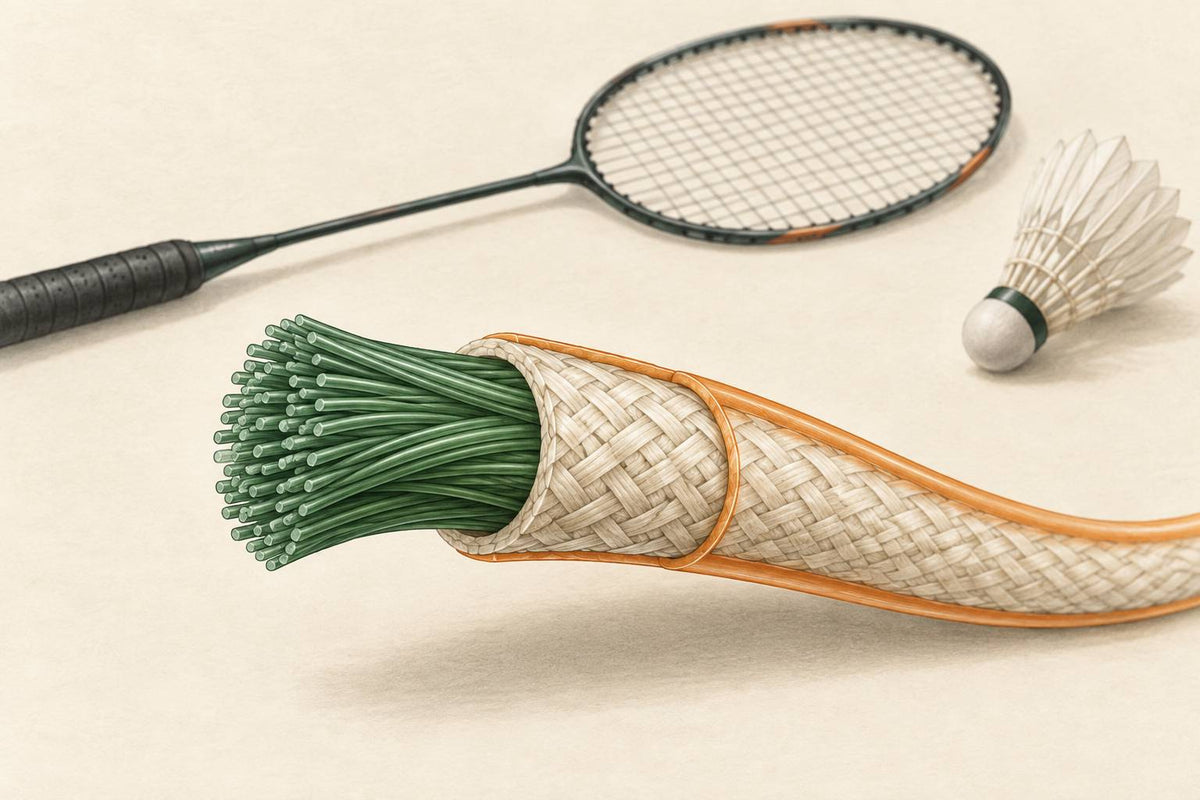
Synthetic badminton strings are not just “one material.” They usually split two jobs between two parts: a load-bearing core and a protective jacket. The core is the engine of the string, shaping much of its strength, stiffness, resiliency, and power response. The jacket is the wear layer around it, helping protect the core from abrasion while adding surface texture that can affect control.
This guide looks at construction first: monofilament, multifilament, and microfilament cores, plus the jacket and coating choices layered around them. That matters because when you compare multifilament vs monofilament badminton string, you are comparing real physical tradeoffs, not just brand or model wording.
Keep construction separate from tension. Tension changes how the installed stringbed plays; construction defines what the string can realistically offer before it is pulled. For that separate setup question, see our badminton string tension guide.
Monofilament, Multifilament, and Microfilament Cores

In a multifilament vs monofilament badminton string discussion, the core is the key starting point. A monofilament core is one relatively heavy fibre, similar in concept to monofilament fishing line. In the very thin diameters used for badminton, that single-fibre build tends to feel stiff, which is why monofilament construction is far less common in badminton than in sports where a firmer response can be useful.
A multifilament core uses thousands of thin fibres twisted together. Those fibres are still able to stretch somewhat independently, giving the string more resiliency. That elastic rebound is a major reason multifilament construction is associated with power and a livelier feel.
A microfilament core takes the same idea further with even thinner fibres. Finer fibres can be used in different constructions, but the term alone does not guarantee a particular diameter reduction, retained strength or faster shot. Compare the finished string’s stated diameter and play-test the complete setup.
How Construction Changes Feel, Power, Comfort, and Durability

For players, the biggest difference is impact feel. Multifilament badminton strings usually feel softer, absorb more shock, and feel gentler on the arm during repeated clears, drives, and defensive blocks. That extra resiliency can make repulsion feel easier, especially when you are not hitting perfectly through the centre of the string bed. Monofilament strings feel firmer and stiffer by comparison, so feedback can feel more direct, but the tradeoff is that more impact shock may travel into the hand, wrist, and elbow.
Durability is not the same as playability life. Multifilaments tend to be less durable than monofilaments because their multi-fibre structure can fray as fibres break. However, they tend to maintain tension better than most polyester monofilaments and keep their elastic response longer. In practice, a monofilament may resist cutting for longer, while a multifilament may feel lively and comfortable deeper into its usable life before visible wear becomes the limiting factor.
Jackets, Notching, Fraying, and Gauge


The outer jacket is not just decoration. It is the wear layer that takes repeated string-on-string contact, especially where the mains and crosses rub and cut small grooves into each other. In a twisted jacket, once one fibre breaks at a notched spot, the cover can unravel and deteriorate quickly. In a braided jacket, the over-under structure locks fibres together, so one broken fibre does not automatically mean the string is about to fail.
Multifilament strings can fray as individual fibres break out of the bundle. Notching describes grooves at string crossings and can occur alongside fraying; it is not exclusive to monofilaments.
Gauge changes the picture again. Badminton strings commonly come in 20, 21, and 22 gauge. Thicker 20 gauge strings are more durable, hold tension longer, and offer greater control, but they also feel stiffer.
Coatings Are Separate from the Core

Coatings sit on top of the string’s core-and-jacket build. They can change surface feel, bite, and impact sensation, but they do not redefine whether the string underneath is monofilament, multifilament, or microfilament.
A useful example is Yonex’s compound titanium hydride coating: Yonex describes it as giving a sharp but comfortable impact feel for hard hitters, yet the listed construction still includes a high-polymer-nylon multifilament core and a special braided high-polymer-nylon outer underneath. In other words, the coating is an added layer, not the core type.
Choose in this order: core for basic stiffness and resiliency, jacket for wear behaviour and feel, gauge for thickness and durability, then coating as a final preference.
Which Should You Choose?
Start with construction, then fine-tune by gauge, jacket, coating, and tension after play-testing.
| Your priority | Start here | Why |
|---|---|---|
| Softer feel, power, comfort | Multifilament | Many fibers stretch somewhat independently, giving resiliency and power; watch for both fraying and wear at crossings. |
| Firmer, stiffer response | Monofilament | A single heavy core feels firm and can transmit more shock; this stiffness is why it has largely fallen out of favor in badminton. |
| Thin-string speed and power | Microfilament | Finer fibres are a construction feature; compare the actual diameter and performance of the finished string. |
| Frequent breakage | Thicker gauge or braided jacket | 20 gauge is more durable and holds tension longer, while braided covers resist rapid unraveling after a fiber breaks. |
Get 10% off your first order
Join the Badminton House list and we’ll email you a 10% welcome code — plus training guides, technique advice, and badminton updates.
By subscribing, you agree to receive Badminton House emails and can unsubscribe anytime.
If you’re unsure which construction fits your racket and arm, start with feel: softer resiliency from multi-fiber builds, firmer response from stiffer single-core designs. We play badminton and can help you match strings to your tension, breakage pattern, and style of play—contact us for advice.
Shop Badminton Strings and Accessories
Use the guide above to narrow your preferred construction, then check live availability in our Accessories collection before your next restring.
Check Accessories Availability

Leave a comment
This site is protected by hCaptcha and the hCaptcha Privacy Policy and Terms of Service apply.