
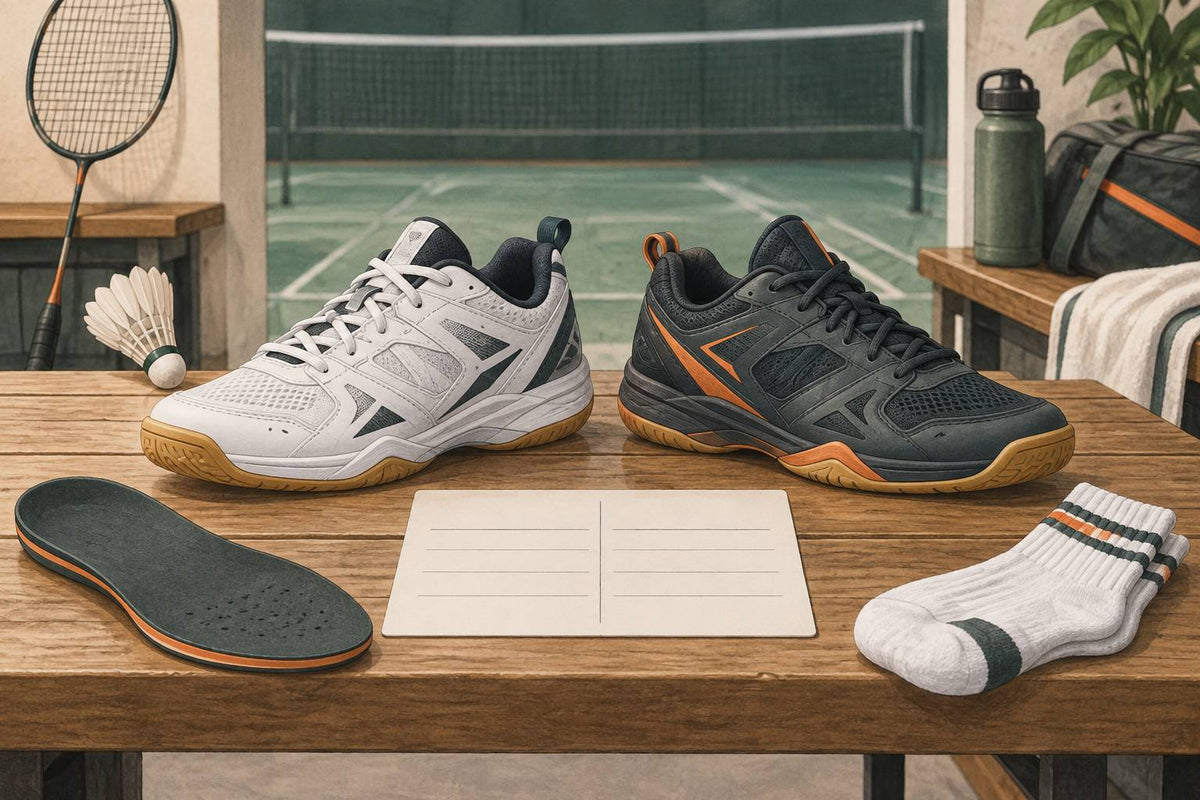
Neither Victor nor Yonex is the better shoe brand for every player. Choose the exact model and width that hold your heel, leave your toes room and feel secure when you move sideways. A brand name cannot tell you how a shoe will fit.
For a useful starting comparison, try the Yonex 65 Z and a Victor A970 variant. Both have technical cushioning and support features, but their construction and fit differ. Compare them in your playing socks before deciding which is worth the price.
Looking for rackets instead? See Yonex vs Li-Ning vs Victor rackets.
Victor vs Yonex: what to compare
| Decision | Yonex | Victor |
|---|---|---|
| Fit | The 2025-generation 65 Z has Slim, Women, Men and Wide versions. | Check the last code on the exact model. A970NitroLite A is labelled V-SHAPE 2.5. |
| Cushioning | 65 Z uses POWER CUSHION+ and Power Graphite Lite. | A970NitroLite A combines NitroLite, E-TPU and a carbon support sheet. |
| Wide feet | Compare an explicitly labelled Wide version with the standard fit. | P9600 is one documented wide-last option; a rounder toe shape alone does not establish width. |
| Value | Compare models at the same price and check the size, return terms and features you will use. Neither brand is always cheaper or better value. | |
These examples describe particular models, not every shoe in either range. Model suffixes and generations matter: an A970 variant can use different materials from another A970, just as a Wide 65 Z differs from a standard one.
Fit and width: read the whole label
Yonex: choose the fit version
Yonex’s 65 Z release notes identify four fits: Slim, Women, Men and Wide. That gives you a concrete comparison within one family. It does not mean every Yonex model has all four versions, or that every shop carries them.
Victor: shape and width are separate clues
Victor’s last descriptions distinguish a more tapered V-shape toe from a rounder U-shape toe. Read the numeric designation too: the A970NitroLite A specification says V-SHAPE 2.5. Do not interpret U-shape as a universal wide fit. Victor describes P9600 as a wide-last, thick-soled model.
Four checks during a try-on
- Start with measurements. Measure both feet and compare the longer one with the model’s size chart. Do not assume the same US or EU number fits identically across brands.
- Wear your playing setup. Use your badminton socks and the insoles you intend to wear. Lace both shoes as you would for a session.
- Check forward movement. In a controlled lunge, your toes should not hit the front and your heel should not lift noticeably. There should be room for your toes without the foot sliding inside the shoe.
- Check sideways movement. Take a few controlled side steps. The upper should hold your forefoot without pinching across the ball of the foot or letting it roll over the sole’s edge.
If the length is right but the forefoot is squeezed, try another width or last before buying a longer shoe. There is no reliable rule that everyone needs half a size more than their everyday shoes. Check the size guide and the return conditions before testing a purchase on court.
Cushioning and grip: what the specifications establish
POWER CUSHION+: Yonex reports 28% more shock absorption and 62% more repulsion than standard EVA in its published material comparison. Those figures are not a test against Victor, a promise of injury prevention or a measurement of how much faster you will move.
NitroLite and E-TPU: Victor lists both in the A970NitroLite A midsole, alongside TPU, a carbon support sheet and solid EVA. This establishes the construction; it does not prove that every Victor shoe feels firmer than every Yonex shoe. Compare heel comfort and forefoot flex in the pairs you are considering.
Grip: the outsole must suit the indoor surface and meet the venue’s non-marking rule. Dust, moisture, tread wear and the rubber’s condition all affect traction. Keep soles clean and dry, inspect worn patches and test movement gradually on an unfamiliar floor. Neither logo guarantees grip on every court.
Which models belong on your shortlist?
All-around: 65 Z and A970
These are useful families to compare when you want cushioning and lateral support for regular club play. Begin with the fit version, then compare the exact generation’s specification. The 2025 65 Z’s integrated inner bootie and the A970NitroLite A’s V-SHAPE 2.5 last are more useful details than a blanket “soft Yonex, firm Victor” rule.
Lightweight: Aerus and Victor’s lighter models
If weight matters to you, add Aerus and a Victor lightweight option to the try-on. Compare listed weights only when the reference shoe size and measurement basis match. A low weight does not tell you whether your heel stays secure or whether you like the cushioning.
Wide or entry-level choices
For a broad forefoot, start with an explicit width option such as 65 Z Wide or the P9600 family. For a first pair on a smaller budget, prioritize fit, a court-appropriate outsole and secure lateral movement. You do not need to pay for every premium midsole feature to start playing.
For a closer look at the ranges, read 65 Z vs Aerus vs Eclipsion or the Victor shoe guide.
Common questions
Is Victor better than Yonex?
There is no brand-wide winner. Compare the exact shoes on fit, width, cushioning, outsole and price. A comfortable Victor can be a better choice for you than a poorly fitting Yonex, and the reverse is equally true.
Is Victor a good badminton brand?
Victor makes purpose-built badminton shoes with documented cushioning, last and support systems. It is a reasonable brand to shortlist; the model and its fit still need checking.
Does Yonex run narrow compared to Victor?
Do not use that as a sizing rule. Yonex offers several 65 Z fits, and Victor uses different lasts and numeric fit codes. Compare the specific versions, not just the names on the box.
Should I size up in badminton shoes?
Only if the size chart and try-on show you need more length. If your heel already slips, a larger size may make that worse. A width problem calls for a different width or shape.
Which brand is better for wide feet?
Both have options worth trying. Compare 65 Z Wide with a documented Victor wide-last model such as P9600. Check forefoot room and heel hold together.
Can I use running shoes instead?
Choose indoor court shoes for badminton. Running shoes are designed primarily for forward movement; a non-marking running sole alone does not establish suitable lateral support. See badminton shoes vs running shoes.
Need help narrowing the fit? Send us your foot measurements, usual shoe model and what feels wrong in it. For a first pair, the beginner shoe guide explains the main buying decisions.

Leave a comment
This site is protected by hCaptcha and the hCaptcha Privacy Policy and Terms of Service apply.