
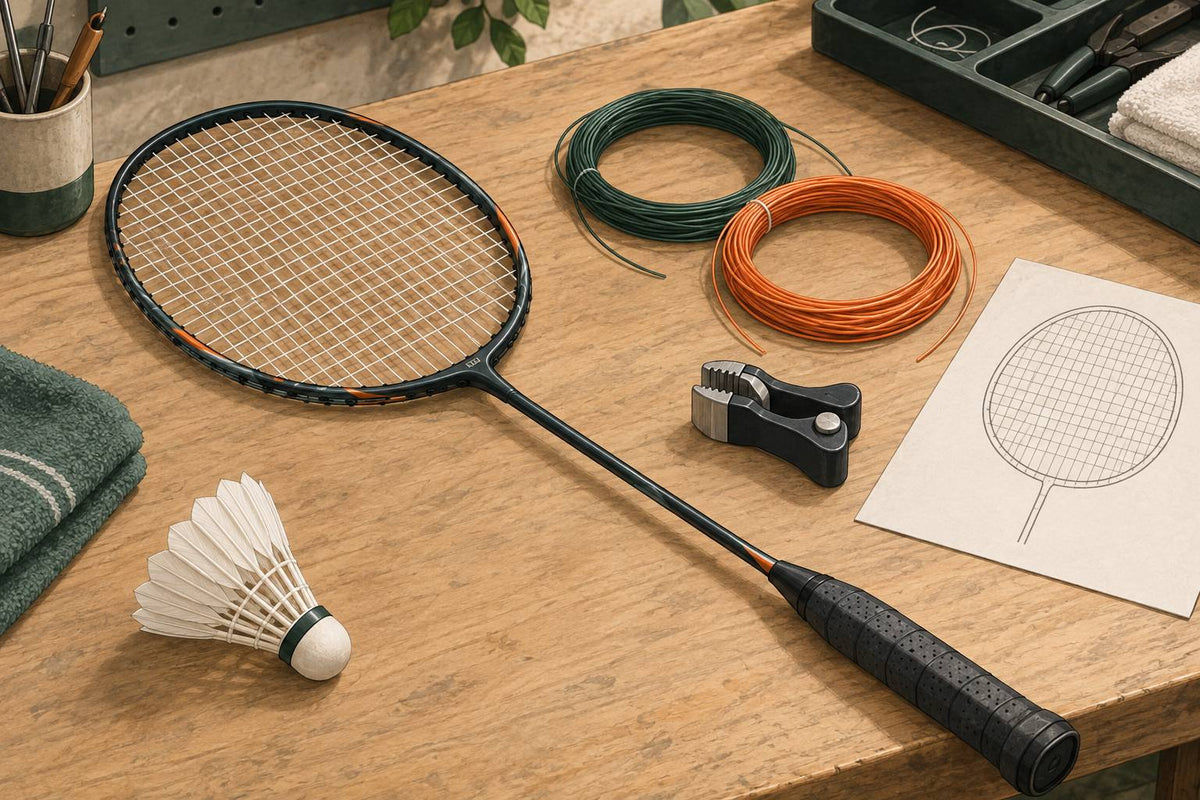
Last updated: July 2026 · Written by the team at Badminton House
Quick Answer: 2-Piece vs 4-Piece Badminton Stringing
If someone says “4-piece,” first clarify whether they mean the common two-piece, four-knot job; choose the method your racket pattern requires and your stringer executes best.
Default
Best ask: “Will this be one-piece/2-knot or two-piece/4-knot, and why for this frame?” Execution matters more than the label.
4-knot
Pick this for split mains/crosses, hybrid strings, or when the manufacturer pattern calls for separate mains and crosses.
2-knot
Fine when the frame pattern allows continuous stringing and your stringer uses clean clamps, pulls, and tie-offs.
When your racket comes back from restringing, the knots tell you a lot: two knots usually means one continuous string ran through mains and crosses, while four knots usually means the mains and crosses were cut and tensioned separately. That is why 2-piece vs 4-piece badminton stringing can get confusing—the real shop-floor question is normally one-piece/2-knot vs two-piece/4-knot. For most players, the label matters less than clean clamping, straight pulls, suitable tension, and whether your frame or string choice benefits from separate mains and crosses.
Need a careful restring? Start with the method and tension you want, or ask for help through our stringing service.
In This Guide
The terminology mix-up: pieces vs knots

Most confusion around 2-piece vs 4-piece badminton stringing comes from mixing two naming systems. The documented badminton comparison is normally one-piece, continuous, or 2-knot stringing versus two-piece or 4-knot stringing.
In a 2-knot job, one continuous length of string is used for both the mains and the crosses. In a 4-knot job, the stringer uses two separate lengths: one for the mains and one for the crosses, then ties off both sections.
So if someone says “4-piece,” ask whether they actually mean “4-knot.” A standardized badminton method using four separate pieces of string is not the usual technical reference point. For the rest of this guide, the useful comparison is continuous 2-knot versus two-piece 4-knot stringing.
Does one method hold tension better?

One stringer’s matched two-racket comparison tracked stringbed frequency for a month and found little difference between the tested one-piece and two-piece jobs. That is useful evidence against a blanket method ranking, but a small informal experiment does not establish equivalence for every frame, string and pattern.
That does not mean technique is irrelevant. A four-knot job has more tie-off points, so each knot is another place where sloppy work can leak tension or create a weak point. But the bigger driver is execution: clean clamps, straight pulls, consistent tensioning, and tidy knots. If two rackets feel different after restringing, the cause is more likely stringer technique, machine calibration, string choice, or requested tension than the method name alone.
Why stringers often use the two-piece, four-knot method


The two-piece, four-knot method is popular because it gives the stringer clean separation between the mains and crosses. Many badminton rackets are strung this way: mains and crosses are installed as separate string runs, with four tie-offs. Yonex-style four-knot patterns are especially widely recognized, so many players and stringers are familiar with what the finished job should look like.
That separation is useful for hybrid setups, where the player wants one string in the mains and another in the crosses. It also makes main-versus-cross tension tuning straightforward. The correct main/cross settings depend on the published frame pattern and machine setup; different pull settings are also possible in a valid one-piece job; see our badminton string tension guide for player-level tension choices.
There is also a practical handling benefit: the stringer works with shorter lengths of string instead of dragging one long continuous piece through the whole frame. That can make weaving, pulling, and keeping the string tidy easier, especially on frames with unique patterns.
Where one-piece continuous stringing fits

One-piece continuous stringing still has a legitimate place. Instead of cutting separate main and cross lengths, it uses one string through the mains and into the crosses, finishing with two knots. The main appeal is simple: fewer knots mean fewer tie-off points where a poor knot could create stress or tension loss. Fewer knots alone do not establish better durability or tension retention.
It is not a magic upgrade, though. Some continuous workflows are valid for the appropriate frame, and Around-the-World patterns are commonly used when a stringer wants a one-piece route while controlling where the crosses start and finish. In practice, the right answer is often decided by the frame pattern, the brand’s published guidance, and the stringer’s most reliable workflow. If your stringer can explain why they chose it and the racket comes out clean, even, and undistorted, continuous stringing is a reasonable option—not a red flag.
What should you ask your stringer?

Before handing over the racket, ask three simple questions. First: “Does this frame have a manufacturer-recommended pattern — one-piece continuous or two-piece/four-knot?” A careful stringer should be comfortable following the pattern that suits the frame, not forcing a favourite method onto every racket. If you are preparing for a restring, start with the stringing service page so your requested tension and string choice are clear before the job starts.
- Do I want separate main and cross tension? Two-piece stringing makes that conversation cleaner, especially if you are adjusting feel rather than copying a number.
- Am I using a hybrid setup? Different strings in the mains and crosses normally point toward a two-piece job.
- Are any grommets damaged? If you need strings or grommets, browse accessories before restringing.
After the restring, inspect the knots, shared holes, string alignment, and frame shape; this quality-check guide shows what to look for without turning you into the stringer.
Which Should You Choose?
Use the method your racket maker or stringer recommends first. If there is no requirement, choose by setup rather than by myth: a careful job matters more than the label.
| Situation | Choose | Why |
|---|---|---|
| Standard restring with no special request | Two-piece / four-knot | It is the common badminton default, keeps mains and crosses separate; follow the manufacturer’s cross direction. |
| Hybrid strings or different main/cross tensions | Two-piece / four-knot | Separate strings make independent tuning easier, while respecting the model’s instructions and tension limit. |
| Stringer prefers a valid continuous pattern | One-piece / two-knot, including ATW when appropriate | Acceptable when it matches the frame pattern; fewer knots mean fewer tie-off points. |
| You dislike four visible knots | Ask about one-piece | Cosmetic preference is fair, but do not overrule a manufacturer pattern or a stringer’s frame-safety call. |
If you want the method chosen for your frame rather than guessed, ask about our stringing service.
Get 10% off your first order
Join the Badminton House list and we’ll email you a 10% welcome code — plus training guides, technique advice, and badminton updates.
By subscribing, you agree to receive Badminton House emails and can unsubscribe anytime.
If you’re still unsure what to request, ask before the racket goes on the machine. We play badminton, so we think in practical terms: frame safety, clean tie-offs, suitable tension, and how the string bed will feel on court. For help choosing a restring setup, contact us and tell us your racket, current tension, and playing style.
Ready for a fresh setup?
Shop Strings & AccessoriesCheck live availability and choose the string feel that fits your game.


Leave a comment
This site is protected by hCaptcha and the hCaptcha Privacy Policy and Terms of Service apply.