
Last updated: July 2026 · Written by the team at Badminton House
Quick Answer: Badminton Talent Identification Testing
If you're trying to understand badminton talent identification testing, expect a battery of measurements, not one magic score.
Default
Best read: scouts combine body profile, movement tests, reaction/coordination tasks, and development-fit clues to judge upside.
Scores
Strong results matter, but one weak test should not decide a young player; batteries compare patterns across domains.
Context
Age, sex, training history, and support environment help explain whether a score reflects maturity or long-term potential.
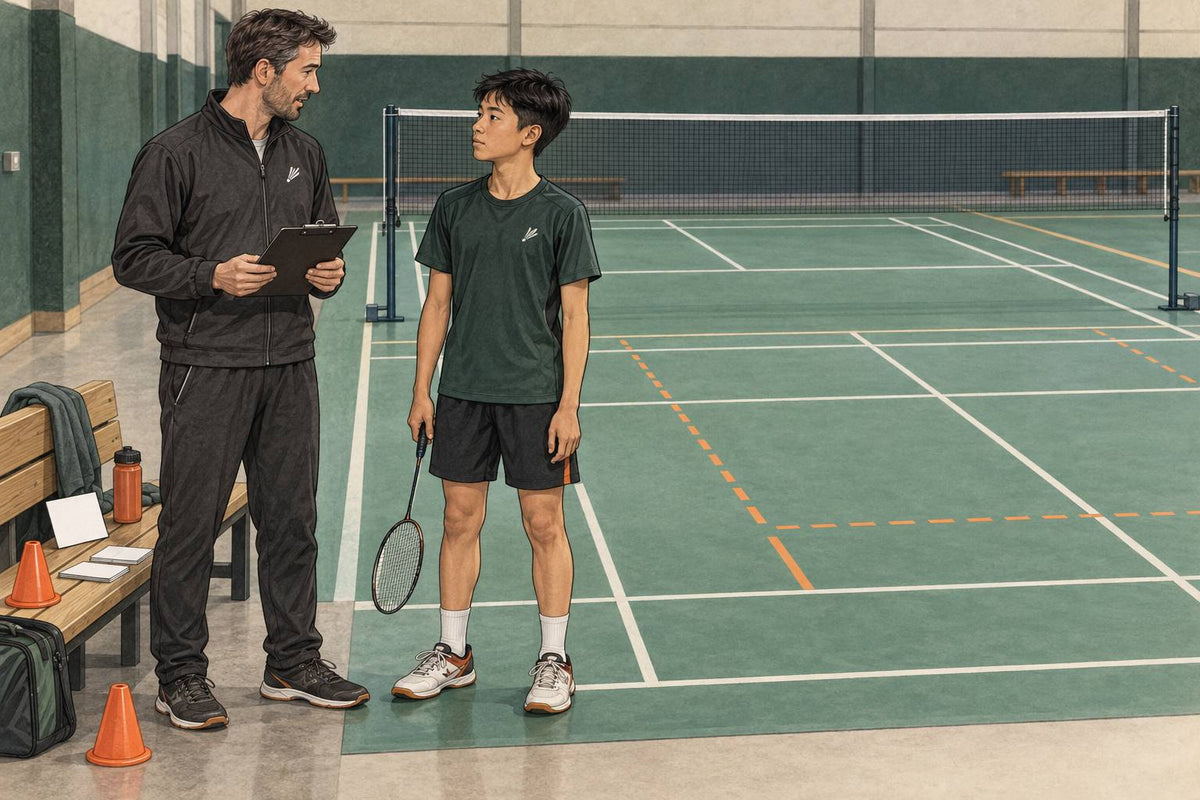
If your child is being tested for badminton, expect more than a coach watching who wins the afternoon games. Badminton talent identification testing usually looks for repeatable clues: how a young player moves, reacts, coordinates racket and shuttle, and develops physically over time. Across published youth programs, test batteries commonly include body measurements, agility or sprint work, jump power, reaction tasks, and eye-hand coordination. The important takeaway for parents and players is simple: one weak test does not close the door, and one strong score does not make a future champion. Scouts are looking for patterns that can be trained.
In This Guide
- Scouts Test Potential, Not Just Match Results
- Body Profile: Height, Limb Length, BMI, and Strength Clues
- Movement and Fitness Tests: Agility, Jumps, Sprints, and Endurance
- Reaction and Eye-Hand Coordination Tests
- The Newer Layer: Psychology, Sociology, and Development Fit
- Which Testing Emphasis Should You Choose?
Scouts Test Potential, Not Just Match Results

Badminton talent identification testing is not just a ranking list with stopwatches attached. A young player may win today because they started earlier, had better coaching, or matured faster. Scouts are trying to separate current results from future ceiling.
One Indian talent-identification model frames the pathway in four related phases: detection, talent identification, talent selection, and talent development. In plain language: first find promising athletes, then test whether their qualities fit badminton, then decide who enters a pathway, then keep developing them over time.
That is why modern programs use multifactorial batteries instead of judging only match scores. In Flanders, Belgium, a youth badminton battery compared elite, sub-elite, and novice players across anthropometric, physical performance, motor coordination, and psychological characteristics. Its discriminant analysis correctly cross-validated 80.0% of participants, describing classification of the sampled playing levels, not an 80% success rate for predicting future champions.
Body Profile: Height, Limb Length, BMI, and Strength Clues

Body-profile testing is the least glamorous part of badminton talent identification testing, but it gives scouts useful context. Common measures include height, weight, BMI, skinfold thickness, arm circumference, arm length, and other limb-related traits that may affect reach, leverage, and future strength development. Badminton Australia’s junior testing battery, for example, included height, weight, and skinfolds alongside court and fitness tests.
The point is not to reward the biggest child automatically. In an Indonesian model for 12-year-old boys, 8 anthropometric tests and 21 physical-condition tests were analysed, with BMI, total skinfold thickness, arm circumference, and arm length among the variables that helped distinguish talented from non-talented players. A separate Indonesian U13–U17 study found age and sex differences in BMI and anaerobic capacity, while aerobic capacity was similar among players. Malaysian findings add another clue: elite male players were taller, heavier, and stronger than sub-elite players. Scouts read these numbers as development signals, not final verdicts.
Movement and Fitness Tests: Agility, Jumps, Sprints, and Endurance

Movement testing tries to separate raw athletic tools from learned match craft. A scout may time side-to-side agility, 4-corner agility, zig-zag agility, linear and non-linear sprints, or badminton-specific on-court speed patterns to see how quickly a young player accelerates, brakes, changes direction, and recovers for the next shot.
Power and strength are usually checked with simple field tests: counter movement jump, vertical jump, standing long jump, hand-grip strength, push-ups, and plank holds. Endurance may be assessed with a multistage fitness test or shuttle-style running, especially when programs want a repeatable number rather than a coach’s impression.
Important caution: in a Malaysian systematic review, shuttle runs and on-court badminton-specific agility tests did not significantly separate elite and sub-elite male players, so scouts should not treat one movement score as proof of talent.
If you want to train one commonly tested quality, start with badminton agility ladder and cone footwork drills.
Reaction and Eye-Hand Coordination Tests


Reaction and coordination matter because badminton requires rapid perception and movement. The time available depends on the opponent’s contact, distance, shuttle flight and anticipation; a laboratory smash-speed record does not establish a fixed reaction deadline for every rally.
One Indonesian junior protocol used a whole-body reaction test: players stood on a contact mat, watched for a flash-lamp signal, then jumped off immediately; the recorded time ran until the player fully left the mat. In India, players around eight to fourteen years old were tested for reaction time alongside zig-zag agility, showing how speed of response is often paired with movement testing rather than judged alone.
Coordination tests stay deliberately simple. The Wall Toss Test has linked higher eye-hand coordination scores with better serving accuracy, reaction time, and shot precision. Racquet-sport batteries may also use a 30-second throw-and-catch test, where children throw a ball with one hand and catch with the other as many times as possible. For trainable reflex ideas, see our badminton reflex training guide.
The Newer Layer: Psychology, Sociology, and Development Fit

Modern badminton talent identification testing is not just a stopwatch-and-measuring-tape exercise. The Flanders battery folded in a specific psychological scale, PCDEQ2, alongside the physical measures already covered above. That matters because a young player’s progress also depends on how they learn, respond to pressure, manage setbacks, and stay engaged through long training blocks.
The Guangxi, China BTID study pushed the same idea wider, extending evaluation across anthropometry, physiology, psychology, and sociology. In plain terms: scouts may look at the athlete, the body, the mind, and the support environment together. These tests help coaches guide development; they do not guarantee future champions.
Which Testing Emphasis Should You Choose?
For badminton talent identification testing, choose the test mix by the decision, not by one impressive score.
| Choose this | If you need to... | Why |
|---|---|---|
| Broad battery | Compare players across levels | Flanders youth testing separated elite, sub-elite, and novice players across anthropometry, physical performance, motor coordination, and psychology. |
| Junior profiling | Account for maturation | Indonesia’s U13–U17 data found anthropometrics and anaerobic capacity differed by age and sex, while aerobic capacity was similar. |
| Reaction coordination | Check fast court response | Simple reaction and eye-hand coordination tests fit badminton’s split-second defensive demands and relate to shot precision. |
| Selection caution | Avoid fitness-only decisions | A Malaysian review found elite males were taller, heavier, and stronger, but some shuttle-run and on-court agility tests did not separate levels. |
Use broad screening first, then selection and development rather than a single pass/fail day.
Get 10% off your first order
Join the Badminton House list and we’ll email you a 10% welcome code — plus training guides, technique advice, and badminton updates.
By subscribing, you agree to receive Badminton House emails and can unsubscribe anytime.
Talent testing can guide development, but it should never replace patient coaching and regular court time. We play badminton ourselves, so if you are a parent, junior player, or coach trying to turn test results into next steps, contact us and tell us the player’s age, training load, and goals.
Ready to train with the right racket?
If this guide has you planning more court time, start with a racket that suits the player’s strength, swing speed, and stage of development.
Browse Badminton RacketsCheck live availability before choosing.

Leave a comment
This site is protected by hCaptcha and the hCaptcha Privacy Policy and Terms of Service apply.