
Last updated: August 2026 · Badminton House
Quick answer
Most club players are not slow; they are late. Test your hands once, fix the preparation fault that makes you late, then train it with a racket in your hand.
Default
Best choice: the on-court fast-feed drill. Half a court, one feeder, 4 bursts of 20 seconds with 40 seconds of rest. It is the only drill here that uses a racket, a grip change and a reset.
Test
Wall toss: 2 m from a wall, a tennis ball, 30 seconds, alternate hands, count the clean catches. Under 20 is the first number to move.
Skip
Reaction balls and grip strengtheners are warm-up toys. Neither puts a racket in your hand, so do not build the session around them.
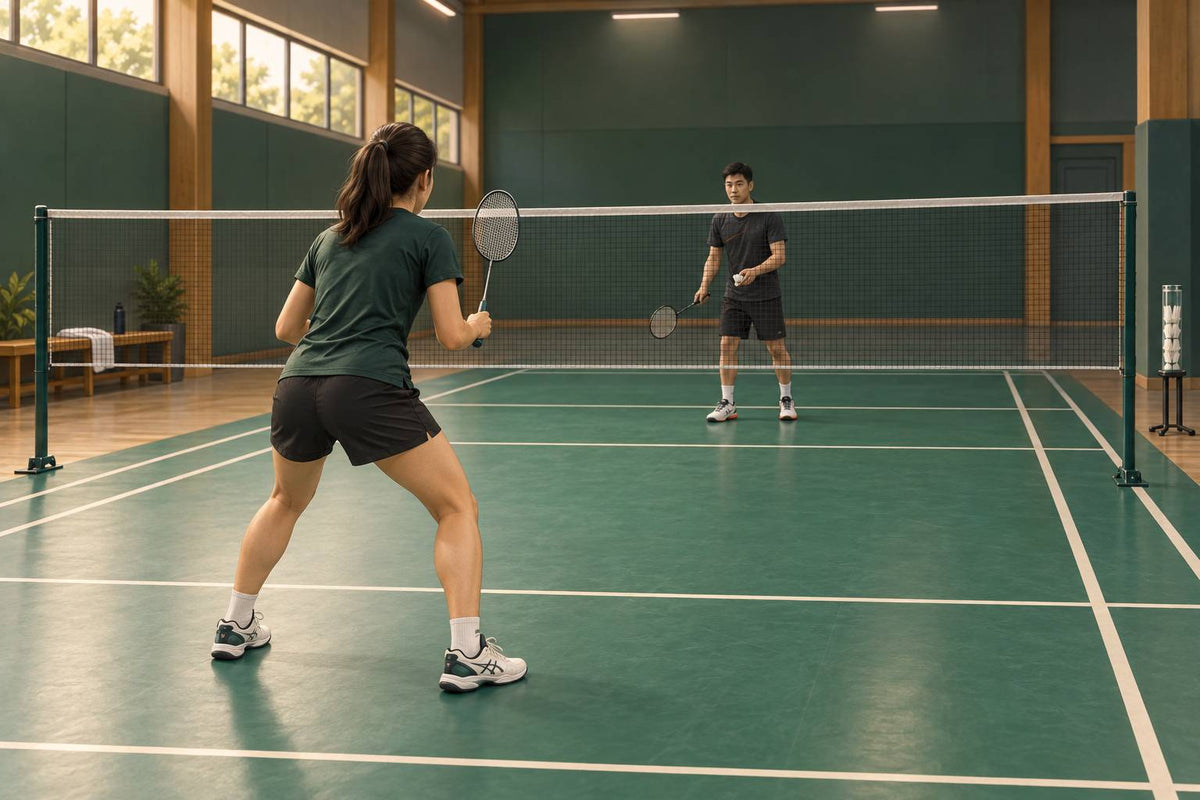
Fast hands in badminton means the flat drive at your hip gets blocked instead of shanked, and the second shuttle at the net finds your racket already back in front of you. This guide gives you a 30-second test with published ratings, a fault finder for the five reasons club players are late, one drill for each fault, and a four-week block that fits the few minutes of court you get on a Canadian club night.
In This Guide
What Fast Hands Actually Means
Every fast exchange is the same chain: read the opponent's racket, get your own racket to where the contact will be, then make a short hit and come straight back. At club level the hit itself is rarely the problem. Watch a player who is said to have slow hands in a drive rally and you usually see one of two things: the racket head is below the hand when the shuttle leaves the opponent's strings, or the grip is still a full forehand when the shuttle arrives at the backhand hip.
Both are preparation. Both are fixable in weeks, because nothing about you has to get quicker; the racket simply has to start closer to where the contact is going to be. That is why this guide spends more time on where your racket is before the hit than on how fast you can twitch.
Three links in the chain
- Read: the opponent's racket face and swing, not the shuttle. The shuttle tells you where it went; the racket tells you where it is going.
- Prepare: racket head above the hand, in front of the chest, grip already set for the side you expect.
- Contact: a short action from the fingers and forearm, then the racket goes straight back to ready.
The drills below work the middle link first, because that is where club players lose the most time. For the stroke itself, our flat drive technique guide covers the compact swing that fast hands depend on.
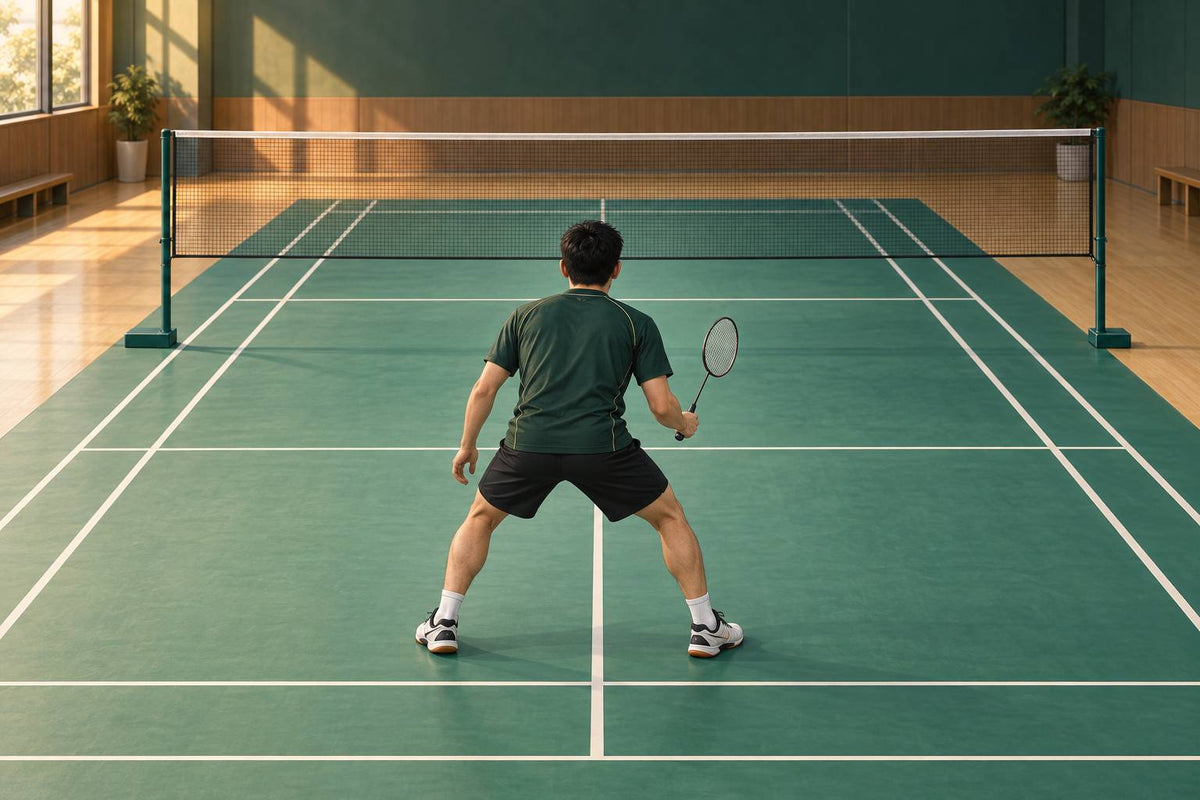
Ready but Not Rigid: The Position Fast Hands Start From

A tense hand is slow for a mechanical reason: the grip change that turns a forehand block into a backhand block happens in the fingers, and fingers that are already squeezing have nowhere to go. The racket face cannot turn, so the shuttle meets the frame or the wrong side of the strings.
- Fingers: enough contact to hold the racket, no squeeze until the hit.
- Wrist and forearm: free to turn the face either way.
- Shoulders: down. Shoulders that creep toward the ears take the arm with them and lengthen every swing.
- Racket: head above the hand, in front of the chest, face toward the net. From there a block is a few centimetres of movement instead of a swing.
Pressure comes at contact only: relax, squeeze, relax. Our grip pressure guide covers the cue, and the forehand-to-backhand grip switching guide covers the finger movement that makes the change possible in the first place.
Why Your Hands Are Late: Five Faults and the Fix for Each
Match what you notice in games to the row below before you pick a drill. Two of the five faults have nothing to do with reaction speed, and no amount of ball catching will touch them.
| What you notice | Usual cause | What fixes it |
|---|---|---|
| You see the drive coming and still hit it late, off the frame or into the net. | Racket head below the hand when the opponent hits, so the swing starts too far from the contact point. | Ready position with the head above the hand. Fast-feed drill with "racket up" as the only cue for the first two bursts. |
| Anything to the backhand hip jams you. | The grip is still a full forehand; the change only starts once the shuttle is read. | Pre-set a neutral, thumb-up grip in flat exchanges. Fast-feed bursts to the body only. |
| The first block is clean; the second shuttle beats you. | No reset. You watch your own shot instead of bringing the racket back. | Feeder sends the next shuttle before your first one lands. Count resets, not hits. |
| You move on the feint and get wrong-footed. | Watching the shuttle, or moving before the opponent's contact. | Watch the racket face. Feeder holds the shuttle and hits late at random. |
| Forearm burns and the hands slow down by the third game. | Squeezing the handle for the whole rally. | Relax-then-squeeze cue. Wall toss with the hand fully open between catches. |
If the first two rows are yours, you do not need a reaction ball; you need to change where your racket is before every hit. That is a habit, and habits are built with feeds, not toys.
Test Your Hands: The 30-Second Wall Toss

The alternate-hand wall toss is a standard hand-eye coordination test with a published protocol and rating scale, which makes it the one part of fast hands you can put a number on. It needs a wall, 2 m of floor and a tennis ball: the gym wall before club night, or a basement wall in January.
How to run it
- Mark a line 2 m from the wall and stand behind it, facing the wall.
- Throw the tennis ball underarm against the wall with your right hand and catch it with your left. Throw straight back with the left and catch with the right.
- Keep alternating for 30 seconds.
- Count only clean catches made with the opposite hand. A drop or a same-hand catch does not count; pick the ball up and keep going.
| Rating | Clean catches in 30 seconds |
|---|---|
| Excellent | more than 35 |
| Good | 30 to 35 |
| Average | 20 to 29 |
| Fair | 15 to 19 |
| Poor | fewer than 15 |
Ratings as published on the Topend Sports alternate hand wall toss test page. They are general-population ratings, not badminton norms; use them to place yourself, then compare against your own retest.
What the score means for your badminton.
- Under 20: your hands are a bottleneck as well as your preparation. Do the wall toss three times a week alongside the fast-feed drill and retest in week 4.
- 20 to 29: the average band. Fixing the preparation faults will give you more than raw hand speed will. Use the test as your week-1 and week-4 bookends and spend the sessions at the net.
- 30 and over: your hands are not the problem. If you still get jammed, it is grip, racket position or reading; go straight to the fault finder and the fast-feed drill.
As a drill: 3 rounds of 30 seconds with a minute of rest between them. Make it harder one change at a time: step in to 1.5 m, switch to a smaller ball, or have a partner call "left" or "right" as the ball leaves the wall so you catch with the hand they name. Keep the free hand open between catches; a fist between catches is the fifth fault rehearsing itself. Do not add difficulty until a round is clean.
If you would rather have a shuttle and a racket in the picture, our badminton wall rally drills guide builds from controlled taps to continuous drives against a wall.
Reaction Balls: A Warm-Up Toy, Not the Session

A reaction ball is a small rubber ball covered in knobs, so the bounce is genuinely unpredictable. Drop it, or throw it at the wall, and catch it after the first bounce. It is the most fun of the three drills and the furthest from a badminton exchange: no racket, no grip change, no reset, and the surprise comes from the ball rather than from a racket face you could have read.
Use it for two minutes in a warm-up. Catch with the dominant hand until a run is clean, then with the other hand, then put it away and spend the court time at the net.
The On-Court Fast-Feed Drill (and the Club-Night Version)
This is the drill that changes games, because it is the only one with a racket in your hand and another racket in front of you. Everything the fault finder points to is trained here.

Set-up
- Player: on the short service line, racket head above the hand, neutral grip.
- Feeder: across the net, a step behind the service line, a tube of shuttles in the non-racket hand. Feeds are flat and at shoulder height, hand-fed or racket-fed, to four targets: forehand side, backhand side, body, and a tight one just over the tape.
- Player's job: block or kill with a short action, then bring the racket back in front before the next shuttle.
- Feeder's job: the next shuttle leaves before the previous one lands. The pace of the drill is the feeder's, not the hitter's.
- Bursts: 4 to 6 bursts of 15 to 30 seconds with full rest between them. End the burst the moment the racket stops coming back up; late reps rehearse the fault.
Progression, one step at a time
- Fixed order (forehand, backhand, body, net) until every burst is clean.
- Random order. Now the grip has to be set before the feed, not after.
- Body only, aimed at the backhand hip. This is the row most club players fail in the fault finder.
- Hidden preparation. The feeder drapes a towel over the tape so you cannot see the feed until it clears, or holds the shuttle and hits late at random.
- Two feeders alternating, so the read has to switch as well as the hands.
Feeding this fast and this flat is a skill of its own; a feeder who lobs makes the drill useless. Our guide to feeding shuttles for drills covers the hand-feed and racket-feed you need here.
The club-night version
Most club nights in Canada are drop-in doubles: you have a court for a few minutes at the start of the evening, then the rotation starts and the court is never yours again. The drill fits that gap.
- Half a court, one feeder, one tube of nylon shuttles.
- 4 bursts of 20 seconds with 40 seconds of rest is 4 minutes. Swap roles and both of you are done in 8, warm, and first on the board.
- Nylon is fine here; nothing in this drill needs feather flight. Our shuttlecock collection has practice shuttles for it.
A Four-Week Fast-Hands Block
Hands respond to short, frequent work done fresh. Every session below is under 10 minutes and goes after the warm-up and before games, never at the end of a night when the hands are already slow. Two sessions a week is enough; three if two of them are the club-night version.
| Week | Wall toss | Fast feed | Focus |
|---|---|---|---|
| 1 | Test once and write the score down, then 3 rounds of 30 seconds | 4 bursts of 15 seconds, fixed order | Racket head above the hand |
| 2 | 3 rounds of 30 seconds, partner calls the hand | 4 bursts of 20 seconds, random order | Neutral grip before every feed |
| 3 | 3 rounds of 30 seconds at 1.5 m | 5 bursts of 20 seconds, body feeds and hidden preparation | Reset before the next shuttle leaves |
| 4 | Retest at 2 m and compare with week 1 | 6 bursts of 20 seconds, or two feeders | Play, and count how often you get jammed per game |
Track one number per session: wall-toss catches, or shuttles blocked cleanly in a burst. The retest tells you whether the hands moved; the count of jams per game tells you whether the preparation did, and that is the one that wins points.
For where this block sits among footwork, strength and match play, see our weekly badminton training plan.
Which Reflex Drill Should You Choose?
Pick the drill that attacks your row in the fault finder. If you already know what is coming, you are rehearsing a movement, not training a reaction.
| Choose this if... | Drill | Focus on |
|---|---|---|
| You want a number before you start, or it is winter and there is no court. | Wall toss | Clean catches, open hand between catches. |
| You get jammed in flat exchanges or lose the second shuttle at the net. | Fast-feed drill | Racket up, grip pre-set, reset before the next feed. |
| You keep moving on feints. | Fast feed with hidden preparation | Watch the racket face; hold until contact. |
| You have two minutes in a warm-up and a reaction ball in the bag. | Reaction ball | Non-dominant-hand catches, then put it away. |
Questions Players Ask
Do reaction balls improve badminton reflexes?
They improve catching an unpredictable bounce. Whether that shows up with a racket in your hand depends on your preparation, which the ball does not train. Rank it last and keep it to warm-ups.
How long before fast hands show in games?
Judge it on two numbers, not on feel: the week-4 wall-toss retest and your count of jams per game. Do not trust the sensation after one session; a good burst feels fast whether or not the racket position has changed.
Can I train fast hands alone?
The wall toss and the wall rally need nobody. The fast-feed drill needs a feeder, so trade: feed for four minutes, hit for four. The feeder is learning to read too.
Do grip strengtheners help?
They build squeezing strength, and fast hands need the opposite: a hand relaxed enough to change grip in the time the shuttle is in the air. If the handle slips in a fast exchange, the fix is grip size or a fresh overgrip, not a stronger squeeze.
Setting up for club night? Browse the full collection for shuttles and court gear, or send us a note through Contact Us if you are not sure which fault is yours.

Leave a comment
This site is protected by hCaptcha and the hCaptcha Privacy Policy and Terms of Service apply.