
Last reviewed: August 2026 · Written by the Badminton House player-led team
Quick answer
Do not build junior badminton training around rigid birthday-based “windows.” Strength, speed and aerobic qualities remain trainable across youth, and badminton skill should remain present throughout development. Adjust the emphasis, complexity and recovery to biological maturation, training experience, technical competence, current growth and how the individual is responding.
Start here
Best choice: assess the player’s training age, movement competence, recovery and goals before changing the plan.
All stages
Keep skill, strength, speed, aerobic work and coordination present in age-appropriate forms.
During growth
Monitor what actually changes, then adjust complexity, load or recovery without assuming every player follows the same pattern.
Parents and coaches often receive charts that assign one physical quality to each age: coordination now, speed next, strength after puberty and endurance later. The chart feels useful because it turns development into a tidy sequence. The problem is that young athletes do not develop on one shared calendar.
Two players with the same birthday may differ in biological maturation, badminton experience, movement skill, confidence and recovery. One athlete may also be technically experienced but new to structured strength training. Badminton training by age is therefore most useful when age supplies context while the individual supplies the decision.
This guide replaces rigid windows with a practical coaching framework. It does not diagnose puberty stage or predict adult potential. It helps you decide what to observe, what to train throughout development and when a plan should become simpler, more challenging or more recovery-focused.
Why do rigid trainability windows fail?
Rigid windows assume that a general ability becomes unusually trainable during a narrow age range and that missing that range creates a lasting disadvantage. Current evidence does not support using generic windows that way for youth strength, speed, aerobic fitness or other broad motor abilities.
A critical appraisal of sensitive periods found too few suitable controlled intervention studies to justify a systematic synthesis. It concluded that generic windows for general motor abilities are unclear and should not guide youth development as though they were established deadlines.
The BASES expert statement reaches a similar practical conclusion. It reports that most evidence does not support a maturational threshold and describes aerobic fitness, strength and speed as trainable before, around and after puberty. It advises coaches not to constrain young people through training plans built around supposed puberty-timed windows.
This does not mean development is irrelevant. It means development changes how coaches teach, dose and progress a quality rather than deciding whether the quality is allowed to appear at all.
Use emphasis, not exclusion. A young beginner may spend more time learning movement and racket skills, but that does not require removing strength, speed or aerobic development from the plan. Each quality can appear in a form suited to the player’s competence and readiness.
Four claims a coaching plan should avoid
- “Strength training should wait until puberty.”
- “Speed must be developed before a particular birthday.”
- “Coordination becomes permanently difficult to improve after puberty.”
- “Girls and boys need fixed, separate trainability calendars.”
Those statements turn incomplete population research into deterministic instructions. A better plan records what the player can do now, provides an appropriate stimulus and watches the response.
Chronological age is not biological maturation
Chronological age tells you how long a person has been alive. Biological maturation describes progress toward the mature state, while training age describes experience with a particular activity. These measures can differ substantially, so one birthday cannot fully explain readiness for a drill or training load.
The International Olympic Committee consensus describes youth development as individual, nonlinear and changing. It also warns that methods used to estimate maturity timing or status have limitations. Its practical direction is flexible, individualized development built around age-appropriate activity, technical competence, safety, enjoyment and recovery.
The NSCA long-term athletic development statement makes the same distinction: young people of the same chronological age can be at very different biological stages, and development does not follow one straight line. It treats development models as flexible guides rather than strict blueprints.
| Coaching lens | What it tells you | What it cannot decide alone |
|---|---|---|
| Chronological age | Calendar age and competition context | Maturity, competence or exact training readiness |
| Biological maturation | Progress through the broader maturation process | Badminton technique or experience with a specific exercise |
| Training age | Relevant practice and structured training experience | Current recovery, pain or response to a growth period |
| Current readiness | How the player moves, learns and recovers today | Long-term potential or a medical diagnosis |
Do not replace birthday bands with informal puberty diagnosis. Shoe-size changes, appearance or secondary sex characteristics are not appropriate coaching shortcuts for assigning a maturity stage. When formal maturation assessment is genuinely needed, it belongs with appropriately qualified professionals and suitable methods.
What should badminton players train at every stage?
Every stage can include badminton skill, strength, speed, aerobic work and coordination. Age-aware coaching changes the exercise form, instruction, complexity and progression. It does not reserve an entire quality for one narrow period or assume that development stops once a supposed window closes.
The American Academy of Pediatrics clinical report supports appropriately designed and supervised resistance training for children and adolescents. It emphasizes technique-driven progression and uses training age and resistance-training skill competency rather than chronological age alone to guide exercise selection and progression.
| Quality | Keep it present | Progress it when |
|---|---|---|
| Badminton skill | Racket control, movement quality, timing and decisions suited to experience | The player repeats the current task with control and understands the next cue |
| Strength | Supervised movement patterns and resistance suited to competence | Technique remains sound and the current work is tolerated and recovered from |
| Speed | Fast, controlled movement from simple starts toward badminton reactions | The player stays coordinated as decisions and court patterns become harder |
| Aerobic fitness | Enjoyable continuous or intermittent activity matched to present capacity | Recovery is appropriate and added work does not erase skill quality |
| Coordination | Varied movement, balance, rhythm and hand-eye tasks | The player controls the current pattern and is ready for more variability |
For a player with little training experience, the coach can make each quality simple, well supervised and enjoyable. A more experienced player can use greater resistance, faster decisions or more badminton-specific combinations when competence and recovery support that progression.
Our junior badminton coordination guide provides practical movement ideas. Use them as adaptable coaching tools rather than drills that expire at a particular birthday.
Build the plan around readiness and training age
A useful age-aware plan begins with five questions: what the player has practised, what they can perform with control, how they are recovering, whether growth or pain is changing movement, and what the current badminton goal requires. The answers determine progression more accurately than age alone.
- What is the player’s relevant training age? Count experience separately for badminton technique, structured strength work and other training tasks.
- What can the player perform well now? Watch technique under a realistic amount of repetition rather than judging one perfect attempt.
- How is the player responding? Review enjoyment, learning, fatigue, recovery and any change in normal movement.
- Has anything changed recently? Growth, a new school schedule, more competition or a different training environment may change the plan.
- What is the next useful challenge? Progress one element that advances the goal without overwhelming technique or recovery.
A same-age example
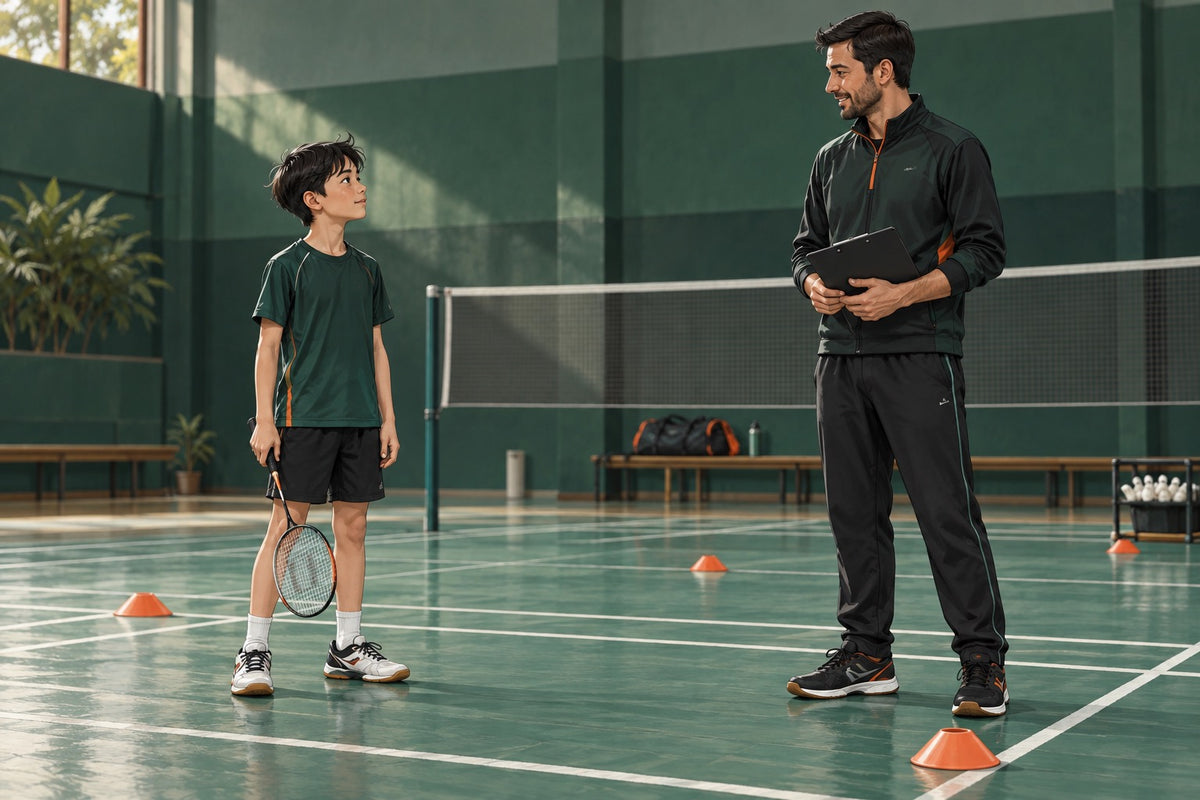
Imagine two 13-year-old players. Player A has several years of coached badminton, controls basic footwork and has recently begun supervised resistance training. Player B joined this season, is still learning how to stop and recover from a lunge, and reports that movement has felt unfamiliar during a recent period of rapid growth.
Their birthdays do not justify identical sessions. Player A may be ready for more complex badminton decisions while keeping strength work technically controlled. Player B may need simpler court patterns, more rehearsal and a conservative introduction to strength exercises. Both can still train skill, strength, speed, aerobic fitness and coordination. The form and dose differ because experience and current response differ.
This is why a squad plan needs room for individual adjustments. A coach can run one shared theme while changing task complexity, resistance, rest or decision demand for each player. Age helps organize the group; observation improves the prescription.
For another planning view, see our junior technique versus fitness guide. Treat its broad bands as prompts, then apply the maturity and readiness checks here to the individual player.
How should training change during rapid growth?
Rapid growth can coincide with temporary changes in coordination and greater growth-related injury burden in some youth athletes, but the response is not automatic or identical. Monitor the athlete in front of you, then modify the plan when movement, recovery or symptoms actually change.
The NSCA position statement notes that a growth spurt may temporarily disrupt motor control and coordination. A 2024 scoping review also found associations between growth, maturation and injury in elite youth pathways, including growth-related injuries around the adolescent growth spurt.
Those findings need restraint. The studies used varied methods and were dominated by male football and elite-pathway athletes. They do not show that every growing badminton player becomes uncoordinated or injured, and they do not support a fixed load reduction for every athlete.
| What you observe | Coaching response | Boundary |
|---|---|---|
| Movement remains controlled and pain-free | Continue the planned progression only if broader readiness and recovery checks also remain acceptable | Do not reduce training solely because of age |
| Familiar movement looks inconsistent | Simplify the task, restore control and review load and recovery | Do not label the player clumsy or assume the change is permanent |
| Pain, limping or persistent loss of function appears | Stop painful training and arrange appropriate clinical assessment | A coach should not diagnose a growth-related injury |
The IOC consensus advises against loading an injured area while it is painful or incompletely rehabilitated. That is a clearer safety boundary than guessing whether discomfort is “normal growth.” Persistent pain or altered function belongs with an appropriate healthcare professional.
Parents who need the injury-specific boundary can read our growth plate injury guide for young badminton players. Use that guide for symptom awareness, not self-diagnosis.
A practical checklist for parents and coaches
A strong age-aware program is easy to explain: every important quality remains available, progression follows competence and response, growth is monitored without amateur diagnosis, and pain is never reframed as a missed training opportunity.
- Keep a broad base. Include badminton skill, varied movement, strength, speed, aerobic activity and coordination in suitable forms.
- Track training age by task. A player can be experienced on court and still be a beginner in structured resistance training.
- Progress from demonstrated competence. Add resistance, speed or decision complexity after the current task is controlled.
- Watch the response. Learning, enjoyment, recovery and movement quality tell you whether the challenge fits.
- Observe growth without predicting from appearance. Respond to real changes instead of assigning a private maturity label.
- Avoid gender scripts. Do not use a fixed boys’ plan and girls’ plan as substitutes for individual assessment.
- Respect pain and incomplete rehabilitation. Stop painful loading and use appropriate clinical support.
Plan the next block in four lines
- Write the player’s current goal and relevant training experience.
- Record one technical quality and one physical quality that are ready to progress.
- Note any recent change in growth, movement, recovery or pain that affects the plan.
- Choose the smallest useful progression, then reassess the player’s response before adding more.
Age still matters for communication, group organization and age-appropriate coaching. It simply should not be asked to do the work of maturity assessment, training history and daily observation. The best developmental plan meets the young badminton player where they are now and keeps every future path open.


Leave a comment
This site is protected by hCaptcha and the hCaptcha Privacy Policy and Terms of Service apply.