
Last checked: August 2026 · Written by the Badminton House player-led team.
Quick answer: a heavy frame adds resistance, but it does not prove a power gain
A badminton training racket can make a swing feel slower or more demanding because total mass, mass distribution, and sometimes air resistance change. That may be useful as a controlled coaching contrast. It is not evidence that the racket will build smash power, make a normal frame faster, or suit every player.
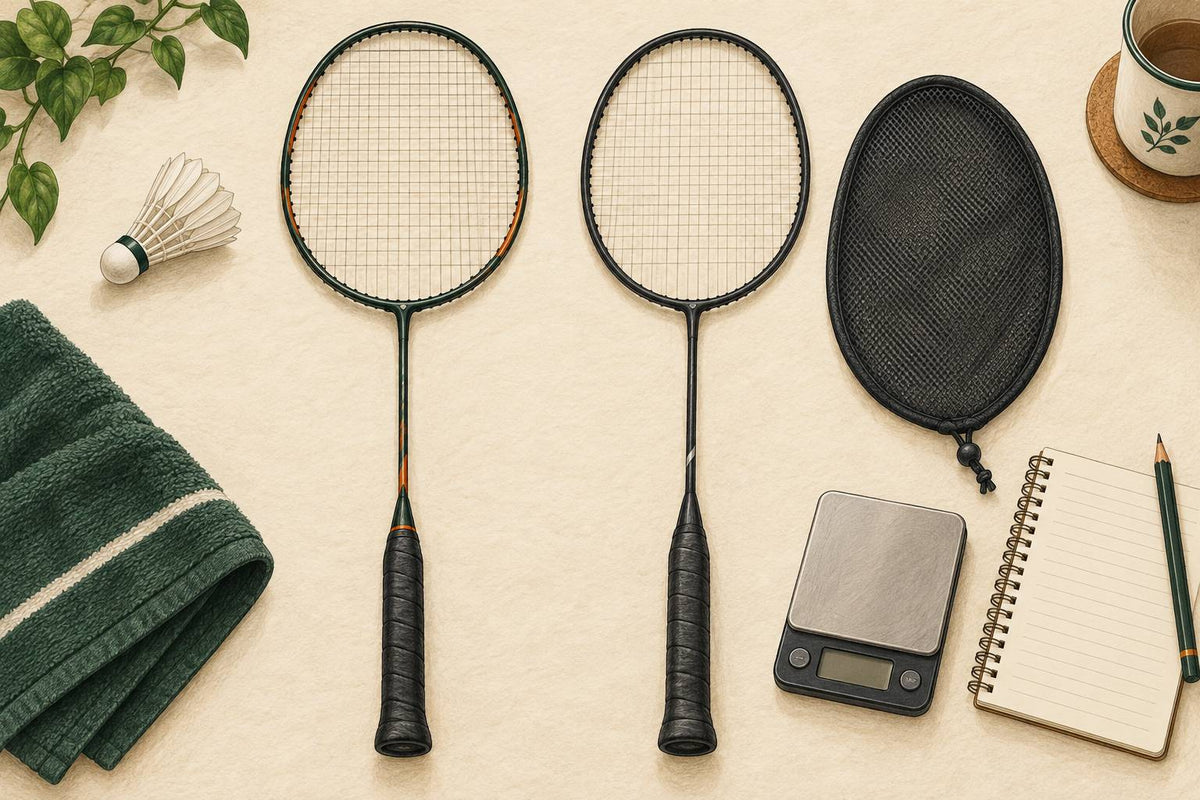
The phrase heavy training racket hides several different tools. One frame may simply weigh more. Another may move more of its mass toward the head. A third may use a mesh cover that increases drag without changing the frame in the same way. Those designs do not create one interchangeable training dose.
Use a training racket only when you can name the task it is meant to support and the observation that will end the set. If the answer is simply “more weight builds more power,” the plan is ahead of the evidence. Keep normal-racket practice in the session because match timing, manoeuvrability, and contact still have to work with the racket you actually play.
What changes when a badminton training racket feels heavy?
Three variables can change the feel: total mass, the distribution of that mass, and aerodynamic resistance. Swingweight describes resistance to rotation about an axis near the handle, so two rackets with similar total mass can still accelerate differently. A mesh cover adds another sensation by resisting motion through the air.
| Variable | What it describes | What not to assume |
|---|---|---|
| Total mass | How much the complete racket weighs. | That every racket of that weight swings alike. |
| Balance and mass distribution | Where the racket's mass sits relative to the hand. | That “head heavy” is a complete swingweight measurement. |
| Swingweight | The racket's moment of inertia about a handle-side axis. | That higher automatically means more shuttle speed. |
| Added drag | Extra air resistance from a cover or altered head. | That drag and added frame mass train the same thing. |
A real product illustrates the distinction. Yonex lists the ISOMETRIC TR 1 training racket at an average 118 grams and says its mesh cover adds air resistance. Those are manufacturer specifications and claims. They do not establish strength gains, a safe dose, or improved match performance.
What did badminton swingweight research actually find?
A badminton-specific study found that greater racket moment of inertia was associated with lower racket-head speed during a forehand smash, yet post-impact shuttle speed did not fall with it. The experiment isolated swingweight more than total mass, so it cannot be treated as a direct test of a heavy-racket training program.
The 2023 racket moment-of-inertia study tested 20 experienced players with five experimentally modified rackets spanning 85–106 kg·cm². Greater swingweight was associated with about 0.7 metres per second less racket-head speed for each 5 kg·cm² increase. The surprising part was that this did not translate into lower post-impact shuttle speed in the tested smashes.
That finding is useful because it resists two easy stories. It does not show that a heavier-feeling racket always produces a slower shuttle, and it does not show that adding resistance makes a player more powerful. The researchers broadly held racket mass constant while moving lead to change moment of inertia. A 118-gram training frame, a head-heavy retail racket, and a mesh-covered tool change more than the variable isolated in that experiment.
The paper also notes a tradeoff that matters beyond the smash: a configuration favourable for one measure may have negative consequences for defensive or net strokes that demand manoeuvrability and rapid head acceleration. That is a reason to evaluate more than one shot, not proof that a particular training racket damages technique.
Can a heavy badminton training racket build power?
The sources reviewed here do not establish that a heavy training racket builds badminton power. The laboratory study measured immediate strokes with altered rackets, not adaptation after weeks of training. The product page describes a tool, not an independent training trial. Any power claim therefore needs to remain a hypothesis rather than the promised outcome.
A coach may still use added resistance as a contrast task. The player can notice whether the swing becomes arm-dominant, whether the racket arrives late, or whether a relaxed sequence survives a modest increase in demand. Those are observations within the session. They are not proof of strength gain, and they do not require maximal smashing.
Useful question: “What should stay the same when resistance changes?” A reasonable answer is balance, clean sequencing, comfortable range, and controlled contact. If those disappear, the tool is no longer supporting that task.
Keep the distinction clear when comparing this tool with a badminton swing trainer. A weighted frame, flexible trainer, covered head, and normal racket can all create different feedback. Choose by the observation you need rather than treating every unusual racket as a power device.
How can you test a heavy frame without losing control?
Start with a normal-racket baseline, use the training frame for a short controlled task, and return to the normal racket immediately. Compare contact, timing, balance, comfort, and shot shape. End the experiment when mechanics change or symptoms appear. Do not wait for pain to become severe before deciding the load was too high.
- Name one task. Examples are relaxed overhead sequencing or compact drive preparation. Do not mix power, endurance, speed, and technique into one goal.
- Record a baseline. Use the normal racket first and note whether contact and balance are already consistent.
- Reduce speed. Begin with shadow movement or controlled technical strokes rather than maximal smashes.
- Watch the first change. Stop when the player grips harder, reaches, shortens comfortable range, loses the racket path, or cannot control the shuttle.
- Return to the match racket. Check whether normal timing is immediately available. More effort is not a passing score.
- Review later. Pain, unusual soreness, reduced movement, or altered mechanics after the session means the next exposure should not be increased.
This sequence is Badminton House practical guidance, not a validated dosage protocol. It deliberately avoids a universal repetition count, intensity percentage, or weekly schedule because the cited research does not supply one. Players returning from an upper-limb injury should discuss added resistance with the clinician or qualified coach managing that return.
If the real goal is a cleaner overhead sequence, work on the normal stroke first. Our forearm pronation and overhead-power guide explains the racket action without asking a heavy frame to fix timing by itself.
A training racket is optional equipment. Its best use is a controlled contrast that reveals something useful while the player remains comfortable and coordinated. If it becomes a contest to swing the heaviest frame, the exercise has lost the question it was meant to answer.

Leave a comment
This site is protected by hCaptcha and the hCaptcha Privacy Policy and Terms of Service apply.