
Last updated: July 2026 · Written by the team at Badminton House
Quick Answer: Is a Badminton Swing Trainer Worth It?
Do not buy one by default; use brief overload only if your technique is stable and your arm is fresh.
DIY
Best default: use an old frame or racket cover for short, controlled swings.
Buy
Consider a trainer only if you are experienced, pain-free and able to stop before timing changes.
Skip
Avoid heavy swings when tired, learning technique, or managing shoulder, elbow or wrist pain.
A badminton swing trainer can feel convincing within a few swings: the frame moves slowly, your forearm works harder, and your normal racket suddenly feels light. That sensation is not enough to justify buying one. A typical 4U playing frame weighs 80–84 g before strings and grip, while dedicated Yonex trainers average 118 g or 150 g, large jumps that can change the stroke you are trying to improve.
The practical question is not whether a heavy racket creates resistance; it clearly does. It is whether that resistance helps your match swing without blurring contact timing or loading a tired shoulder or elbow. This guide separates useful overload from heavy swinging for its own sake, then gives you a conservative way to test the idea before treating a trainer as necessary equipment.
In This Guide
What Does a Badminton Swing Trainer Actually Change?
A badminton swing trainer is a normal-shaped racket frame carrying substantially more mass than a playing racket. Yonex lists its ISOMETRIC TR1 at 118 g average and the TR0 at 150 g average. For perspective, common playing-frame classes are 3U at 85–89 g and 4U at 80–84 g, measured without strings or grip tape. Although those measurements are not perfectly like for like, the difference is large enough to change how the swing accelerates and feels.
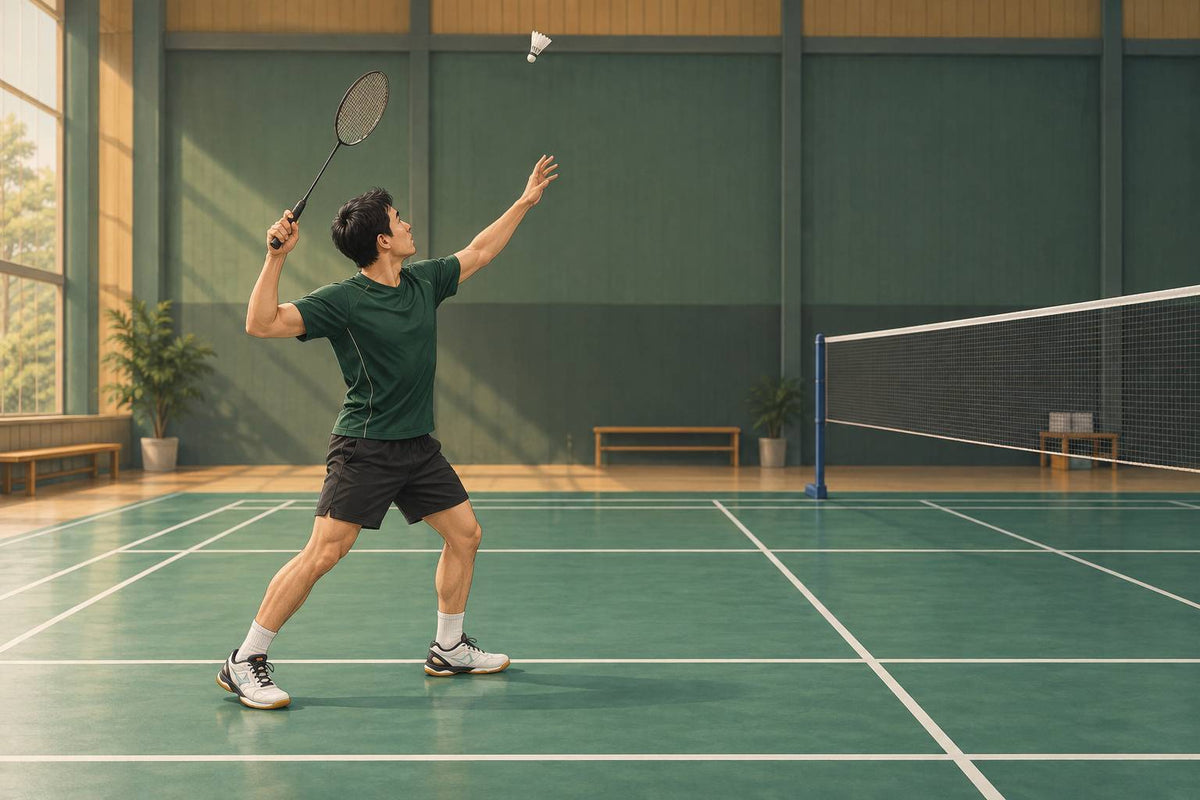
Manufacturers claim two training effects: strength development from the heavier frame and extra air resistance from a mesh head cover. The useful technical target, however, is not muscling the racket with your arm. An overhead stroke transfers motion through the legs, hips, trunk, shoulder, elbow and wrist, with speed building toward the racket. A trainer can make that sequence easier to feel, but only if the sequence remains intact. See the badminton kinetic chain power guide for the full movement pattern.
Does Swinging a Heavy Racket Make You Faster?
Not as a same-session shortcut. In weighted-bat studies, heavy warm-ups generally failed to increase the next standard-implement swing speed. One experiment found that measured speed fell even though participants reported that the normal bat felt lighter and their swing felt faster. That mismatch is the kinesthetic aftereffect: a convincing sensation, not proof of extra speed.
There is a more promising long-term signal, but it is indirect. Analogous implement research has reported gains after structured six- to eight-week programmes using overload and underload close to the competition implement, roughly 10–12% rather than extreme loading. Those findings come from other swinging sports, not trials of badminton trainer rackets, so they cannot establish that a badminton swing trainer will improve racket-head speed.
The loading gap matters. Commercial trainer frames at 118–150 g sit far above common playing-frame masses. In dry-swing research, the implement with the greatest moment of inertia altered swing pattern most while producing the smallest speed change. For most players, that makes very heavy trainer frames difficult to justify as a speed tool.
A Short Overload Protocol That Protects Your Timing
There is no validated badminton-specific repetition count for a swing trainer, so treat this as a tightly controlled technique exposure, not a volume challenge.
- Warm up normally first. Place overload work early in the session, while you are fresh.
- Set one conservative ceiling in advance. Perform only one brief block rather than adding repeated sets, and do not make it part of every session.
- Stop before the ceiling if form changes. End the block immediately if sequencing, acceleration, shoulder position or wrist position differs from your normal stroke, or if elbow or shoulder discomfort appears.
This stop rule matters because measured fatigue reduced smash speed from 188 km/h to 145 km/h while also changing shoulder and wrist angles. Once the stroke slows or reorganizes, you are rehearsing compensation rather than clean timing. For the broader load-and-fatigue explanation, read Why Heavy Rackets Cause Arm Fatigue.
Who Might Benefit—and Who Should Skip One?

A badminton swing trainer has a narrow use case: intermediate or advanced players with stable technique who can treat it as occasional overload practice, not a shortcut to instant racket speed. Beginners should build clean sequencing with their normal racket first. Youth and adolescents, fatigued players, and anyone with current elbow or shoulder complaints should skip heavy trainer frames because extra load can reinforce compensations when technique or tissue tolerance is already compromised.
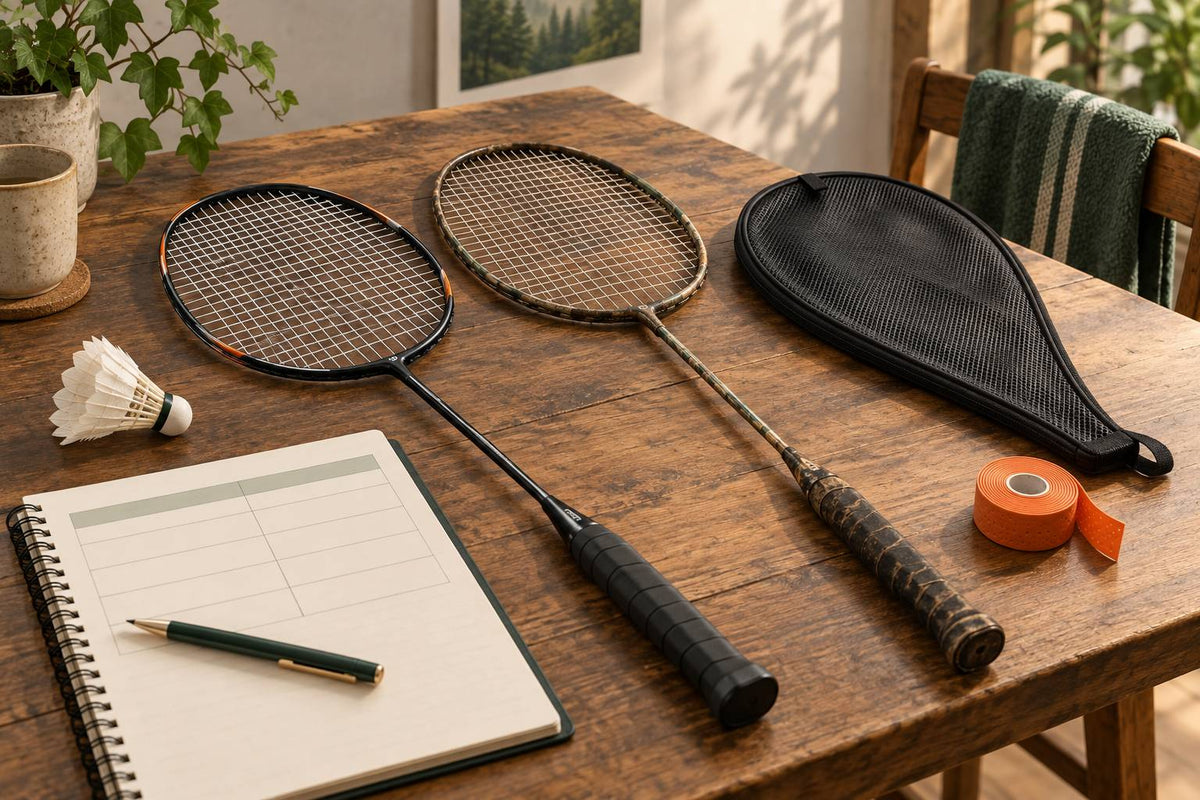
Before buying one, try the simpler alternatives. An ordinary racket cover reproduces the marketed air-resistance mechanism. An old frame that stays closer to your playing racket’s weight provides a more modest overload. One extra overgrip adds only about 3–4 g and mainly changes handle size and feel, so it is not a true trainer substitute.
The frame that actually matters is the one you play matches with: check live racket availability, or contact us for help choosing one.
Which Badminton Swing Trainer Should You Choose?
A dedicated trainer is not the automatic best choice. Match the tool to the smallest overload that accomplishes your specific training goal.
| Choice | Choose it if… |
|---|---|
| Dedicated trainer | You are an intermediate-to-advanced player deliberately programming short overload work. Official models average 118 g or 150 g. |
| Racket cover | You want air resistance without replacing your normal frame; this reproduces the trainer cover’s marketed swing-shaping mechanism. |
| Old playing frame | You want a modest overload close to match weight. Analogous evidence favours implements around 10–12% heavier. |
| Extra grip layer | You mainly want a thicker handle; one overgrip adds roughly 3–4 g and barely changes swingweight. |
| Skip all | You are already fatigued, have shoulder or elbow symptoms, or are an adolescent overhead athlete without qualified supervision. |
Get 10% off your first order
Join the Badminton House list and we’ll email you a 10% welcome code, plus training guides, technique advice, and badminton updates.
By subscribing, you agree to receive Badminton House emails and can unsubscribe anytime.
We play badminton too, so our advice starts with what will protect your timing and help your actual game, not what merely feels harder. If you are still unsure whether a swing trainer suits your technique, training history or current workload, contact us for practical guidance.
The frame that matters most is the one you trust in matches.
Compare playing rackets by weight, balance and flex.
Explore Badminton Rackets — Check Live Availability

Leave a comment
This site is protected by hCaptcha and the hCaptcha Privacy Policy and Terms of Service apply.