Last updated: June 2026 · Written by the team at Badminton House
Quick Answer: Badminton Forearm Pronation
For a stronger overhead, train relaxed-grip forearm pronation through contact first; racket choice can help later, but it cannot replace the kinetic chain.
Pronation
Best choice: rotate the forearm from a loaded position into pronation as your legs, trunk, shoulder, elbow, and fingers feed the swing; this is the main feeling to build for smash power.
Wrist
If your cue is “wrist snap,” reframe it: the wrist is not the power engine, and bending it hard usually blocks the cleaner forearm-and-finger whip.
Racket
A power-oriented frame can support an attacking swing, but technique comes first; Canadian players can compare options in our badminton rackets collection, with free shipping in Canada on orders $200+.
If your badminton smash feels weak, the problem probably is not that your wrist is too slow. Many players chase “wrist power” by bending the wrist harder, squeezing the handle tighter, or buying a heavier racket — then wonder why the shuttle still floats instead of driving down.
The better target is badminton forearm pronation: the fast inward rotation of the forearm through contact, supported by the legs, trunk, shoulder, elbow, wrist position, and fingers. Classic badminton biomechanics work even retired the old “wrist snap” idea, showing that overhead power strokes are made with forearm rotation rather than a simple wrist flick.
This guide is technique-first. A powerful racket can help once your timing is there, but the real engine is the sequence: load, rotate, contact cleanly, and let the fingers finish the hit. That matters whether you play club nights in Canada, train for tournaments, or just want your clear, drop, and smash to come from the same convincing overhead preparation.
Build power before you blame the racket. When you are ready to compare frames, browse our badminton rackets collection and choose based on weight, balance, and flex — with free shipping within Canada on orders $200+ when eligible items are available.
In This Guide
- Why “wrist power” is misleading
- What badminton forearm pronation actually does
- The overhead kinetic chain: legs, trunk, arm, forearm, fingers
- At contact, the racket and forearm should not be one straight line
- A simple drill progression to feel pronation
- The same mechanic supports smashes, clears, and drops
- Where rackets fit in: helpful, but not the real engine
- Which Should You Choose: Technique Focus or Racket Upgrade?
Why “wrist power” is misleading
If you have ever been told to “use your wrist” for a harder smash, the advice is probably pointing you in the right general direction — but using the wrong words. In badminton, the wrist is not the real engine. It is a joint. The muscles that create the fast twisting action sit in the forearm, and the final squeeze comes from the fingers.
That distinction matters because many players hear “wrist power” and start bending or flicking the wrist by itself. That usually makes the stroke weaker, tighter, and less consistent. A better cue is: relax the grip, prepare the racket, then rotate the forearm through contact. The motion feels more like turning a doorknob quickly than slapping the shuttle with a loose wrist.
Smash power is technique-first. If you want the full stroke breakdown after this pronation guide, read our companion How to Improve Badminton Smash guide.
The Canadian connection is worth noting. One of the classic biomechanics papers that helped retire the “wrist snap” explanation came from Bryson Sport Consultants in Ancaster, Ontario, Canada, and examined overhead power strokes performed by Canadian nationally and provincially ranked players. The key idea was simple: powerful overheads are built from forearm rotation, not an isolated wrist snap. You can read the paper here: biomechanics paper on badminton overhead power strokes.
This does not mean the wrist is “unused.” In a good overhead action, the wrist changes position as part of the sequence, and the fingers add the last tightening action at the strike. The problem is the phrase “wrist power” makes players chase the visible end of the movement instead of the source of it.
- Misleading cue: “Snap your wrist harder.”
- Better cue: “Rotate your forearm faster while staying relaxed.”
- Best feeling: the racket head whips through because the arm, forearm, grip, and fingers are timed together — not because the wrist bends on its own.
For Canadian club players, this is good news. You do not need a “strong wrist” before you can hit a better smash. You need cleaner timing, a relaxed hold, and the right forearm rotation pattern — then your racket and string setup can support the power you are already creating.
What badminton forearm pronation actually does

In plain language, badminton forearm pronation is the inward rotation of your forearm through the hitting action. Think of turning a doorknob, not flicking your hand up and down at the wrist.
Simple feel cue
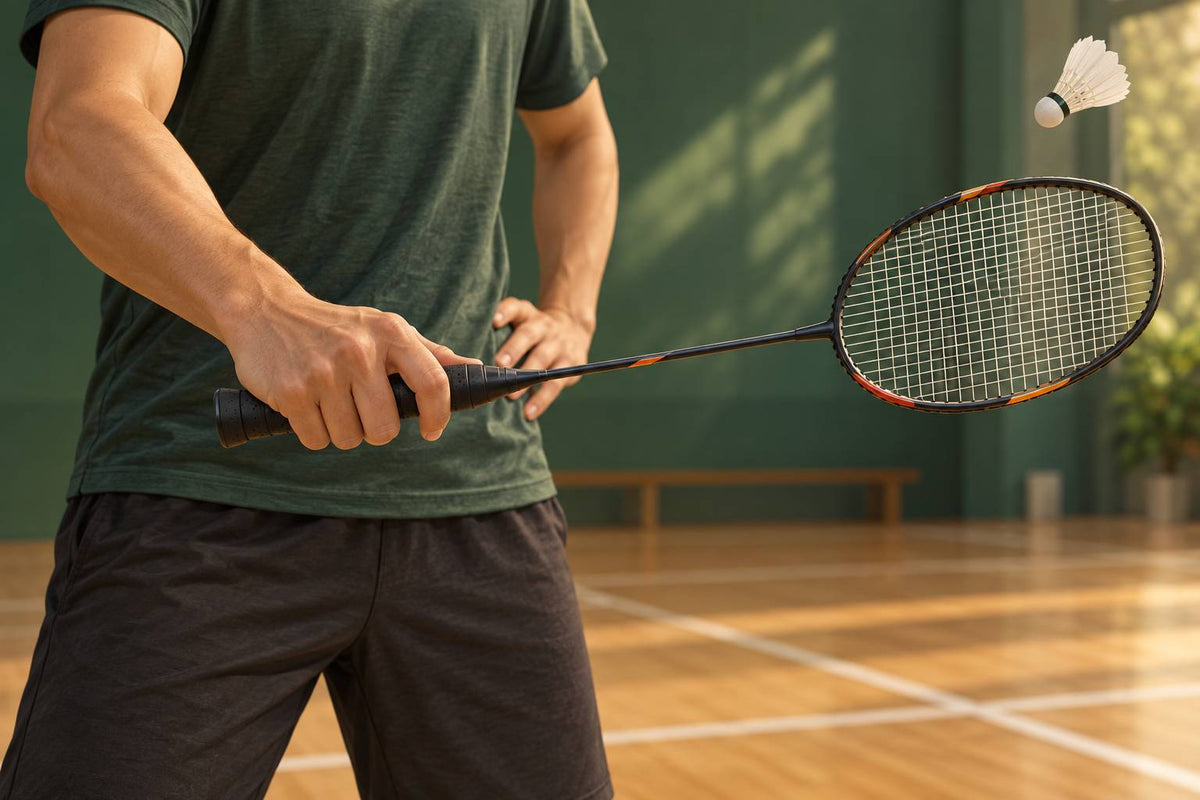
Hold your racket in a forehand grip, keep the hand relaxed, then rotate the forearm so the racket face turns through the shuttle. The movement should feel like rotation through the forearm, not a bent-wrist slap.
That distinction matters because the forehand smash is not powered mainly by a little wrist bend. Classic badminton biomechanics identified shoulder medial rotation and forearm pronation at the radio-ulnar joints as principal movements in the forehand smash. In one classic analysis, shoulder rotation plus radio-ulnar pronation accounted for 53% of the final output in the smash.
So when a coach says “use your wrist,” the useful translation is usually: keep the grip relaxed enough that the forearm can rotate quickly, then let the fingers tighten at the right moment. If you only bend the wrist, the racket face may move, but you are missing the stronger rotational action that helps create racket-head speed.
- Wrist bend: the hand folds forward or backward. This can help position the racket, but it is not the main engine of a powerful overhead.
- Forearm pronation: the forearm rotates inward, turning the racket face through the shuttle with a whip-like action.
- Finger squeeze: the fingers add the final control and acceleration when timed with the rotation.
If your grip is too tight, pronation gets blocked and the stroke feels like a push. For the grip side of this, see our badminton grip and racket-hold guide; the same relaxed-hold idea supports better smashes, clears, and drops.
The overhead kinetic chain: legs, trunk, arm, forearm, fingers

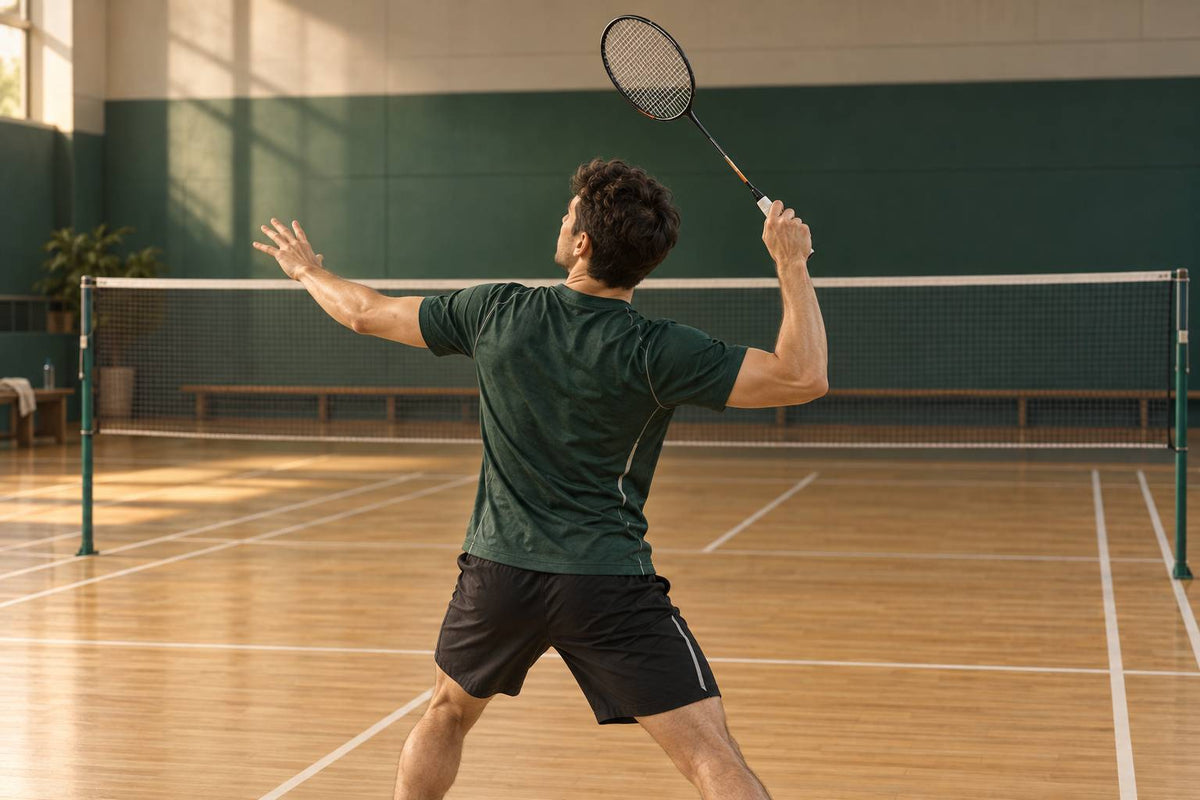
A powerful overhead is not one isolated joint firing hard. It is a chain: the legs start the push, the trunk rotates, the upper arm and elbow accelerate the racket path, then badminton forearm pronation and the fingers release the racket head through the shuttle.
That sequence is why “just snap your wrist” is such a poor cue. The wrist is involved, but it is not the engine by itself. In a well-timed overhead, the motion unfolds in coordinated order in roughly a second: the wrist extends, the forearm pronates, the wrist flexes, and the fingers snap. If one part fires too early, the whip gets short-circuited; if everything arrives together, the racket head feels fast without needing a huge arm swing.
Think of the smash as a relay, not a punch
- Legs: create the first drive upward and forward so the stroke is not all shoulder.
- Trunk: rotates to pass momentum into the hitting side, similar to the movement pattern seen in other overhead sports.
- Arm and elbow: bring the racket into the hitting path and extend toward the shuttle.
- Forearm: rotates from a loaded position into pronation, adding the late “whip” that turns the racket face through contact.
- Fingers: finish the release by tightening at the striking moment, adding control and a final burst of racket-head speed.
The feeling should be loose-to-fast, not tense-to-forced. Many players lose speed because they grip too hard from the start, lock the forearm, and then try to manufacture power with a last-second wrist bend. A relaxed handle lets the forearm rotate and the fingers finish the stroke. If your grip feels rigid, revisit the badminton grip and racket-hold guide before adding more smash reps.
For Canadian club players training in busy drop-in sessions, this is also a useful way to self-diagnose. If your legs are late, you will reach and arm the shuttle. If your trunk stays square, the shoulder has to do too much. If your grip tightens early, the forearm cannot rotate freely. The best smashers look compact because the chain is timed, not because one joint is doing everything.
To build the first half of that chain away from match pressure, pair technique work with simple lower-body and trunk power training. The badminton explosive power training guide is a good companion for the legs-and-trunk side, while this pronation work sharpens the final release through the forearm and fingers.
At contact, the racket and forearm should not be one straight line

A useful coaching cue for badminton forearm pronation is this: at impact, the racket shaft and your forearm should form a clear angle, not one locked, perfectly straight line. That angle helps you keep the racket moving like a whip instead of pushing the shuttle with a stiff arm.
If the racket and forearm become one rigid line too early, many players compensate by squeezing the handle and trying to “snap” the wrist. That usually kills the last bit of racket-head speed. The better feeling is a relaxed forehand grip, forearm rotation through contact, and then a short finger squeeze as the strings meet the shuttle.
Grip cue: hold the racket securely, not tightly. If your knuckles are white before the swing starts, your fingers cannot add that final control at impact. For the grip basics, see how to hold a badminton racket.
Why the angle matters
The racket is an extension of the kinetic chain, but it should not feel bolted to your arm. The shoulder and forearm rotation create speed; the fingers provide the last control and power at the striking moment. Keeping a slight angle between the shaft and forearm gives your hand room to release the racket head instead of forcing the whole arm to arrive as one stiff piece.
Think of throwing: you do not throw a ball by locking your hand, forearm, and upper arm into a straight board. Badminton is smaller and faster, but the idea is similar. The racket head must be allowed to lag, then catch up, then square through the shuttle.
Relaxed grip first, finger squeeze last
The relaxed grip is what makes this possible. Before contact, your hand should feel loose enough that the racket can rotate cleanly with the forearm. At contact, the fingers tighten briefly to stabilize the face and add the final punch. After contact, release the tension again so the follow-through stays smooth.
- Too tight: the racket face feels fixed, the swing feels heavy, and the shot often becomes a push.
- Too loose at contact: the racket face can wobble and the shuttle may spray off-line.
- Right feeling: relaxed preparation, fast forearm rotation, brief finger squeeze, then release.
Grip thickness also affects this feel. If your handle is built up too large, it can be harder to use the fingers quickly; if it is too small or slippery, you may over-squeeze for security. For setup choices, compare overgrip, replacement grip, and towel grip in our badminton grip guide.
Use the bottom of the handle for a longer lever
For overhead power shots, holding the racket near the bottom of the handle gives you a longer lever. That does not mean hanging on with two fingers or losing control; it means placing the hand low enough that the racket can travel through a bigger arc before impact.
This is one reason technique should come before chasing a heavier or more expensive racket. A head-heavy attacking frame can help the right player, but the engine is still the sequence: relaxed preparation, forearm pronation, clean contact angle, and finger squeeze. For Canadian players comparing gear in CAD, remember that racket choice supports the motion — it does not replace it.
A simple drill progression to feel pronation
The easiest way to learn badminton forearm pronation is to remove the big swing first. If you try to fix it during a full-power smash, your old habits usually take over: tight hand, stiff arm, and a forced “wrist snap.” Start smaller so you can feel the racket head whip from forearm rotation.
The goal is not to squeeze harder. It is to unlearn the death grip, keep the racket loose, and let the forearm rotation turn the racket face through contact. If your grip feels locked, revisit the basics in our badminton grip how-to guide.
Step 1: Pronation shadow drill
Stand still with the racket in your hand and keep the racket loose. Do not add shoulder movement yet. Your only job is to rotate the forearm so the racket face turns flat, like you are turning a doorknob.
- Start relaxed: hold the racket without crushing the handle.
- Keep the swing small: avoid using a big shoulder swing to “fake” the power.
- Turn, don’t bend: the useful feeling is forearm rotation, not a floppy wrist bend.
- Finish with the face flat: the racket face should rotate into a striking position instead of arriving open or sliced.
A good cue is: edge, turn, flat. Feel the racket move from a narrower edge-on position into a flat hitting face. If your forearm is not rotating, you will usually compensate by pushing with the shoulder or flicking the wrist.
Step 2: Stick smash feeds
Once the shadow motion feels clean, move to simple stick smash feeds. The coach feeds the shuttle high, and you use only forearm rotation — no big swing — to hit steep shots. Listen for a crisp contact sound.
| Cue | What it should feel like | Common mistake |
|---|---|---|
| Loose hold | The racket head can accelerate instead of feeling locked to your hand. | Death-gripping the handle before the shuttle arrives. |
| Forearm turn | The racket face rotates through the shuttle, like a quick doorknob turn. | Trying to slap the shuttle by bending the wrist. |
| Crisp sound | Contact sounds clean because the face is flat and the racket head is moving fast. | A dull contact caused by pushing, slicing, or squeezing too early. |
| Steep direction | The shuttle travels downward without needing a full-arm smash motion. | Swinging bigger instead of rotating cleaner. |
Keep the drill honest: if your shoulder takes over, return to the shadow version. If your hand tightens before contact, reset the grip. The “whip” feeling comes from relaxed preparation followed by fast forearm rotation and a coordinated finger finish, not from muscling the shuttle.
When this starts to feel natural, blend the same action back into your normal overhead preparation. The drill is small, but the habit is big: relaxed hand, rotating forearm, clean contact.
The same mechanic supports smashes, clears, and drops
Badminton forearm pronation is not a “smash-only” trick. The same overhead engine shows up in your smash, clear, and drop: prepare the racket in a similar way, load the forearm, then let the rotation and finger squeeze finish the shot. What changes is the outcome you ask from the swing — full acceleration and steep angle for a smash, length and height for a clear, or a softer contact for a drop.
That similar preparation matters because it makes your overheads harder to read. If your opponent can tell from your backswing that a drop is coming, the technique may be clean but the shot becomes much less dangerous. A better goal is to make the first part of your overhead look the same, then change the racket-face control, contact feel, and follow-through late.
Practical cue: use one overhead preparation, then decide late. Smash through the shuttle, send the clear deep, or soften the hand for the drop — but do not build three completely different-looking swings.
For drops specifically, the same preparation helps sell the threat of a smash or clear before you take pace off the shuttle. If you want to connect this pronation idea with touch and disguise, read our badminton drop shot technique guide. For the more power-focused side of the same overhead family, pair this section with our badminton smash improvement guide.
The big takeaway: train pronation as part of your whole overhead pattern, not as a separate “smash move.” Once the preparation becomes consistent, your clears, drops, and smashes start supporting each other — and that is when opponents have to wait longer before committing to a defensive response.
Where rackets fit in: helpful, but not the real engine
A better racket can support your smash, but it cannot replace badminton forearm pronation. Racket head speed comes from the angular velocity of the arm-racket chain and the length of that chain. In plain club-court language: you still need the legs, trunk, shoulder, elbow, forearm rotation, and finger squeeze to arrive in the right order.
That is why two players can use the same attacking racket and produce very different results. The player who stays relaxed, loads from slight forearm supination, and rotates sharply through contact will usually get more out of the frame than the player who grips tightly and tries to bend the wrist harder.
Technique first, racket second. Check current badminton racket availability, but treat the racket as a multiplier for good mechanics—not the source of the smash by itself.
How a racket can help without doing the work for you
- Balance changes the timing feel. A head-heavy racket can feel more committed through an attacking swing, while a faster-feeling frame can be easier to recover with after the shot.
- Shaft stiffness changes feedback. A stiffer shaft rewards cleaner timing; if your contact is late or tense, it can feel demanding rather than powerful.
- Grip position changes leverage. Holding lower on the handle creates a longer lever for overhead power, but only if the grip stays relaxed enough for the forearm and fingers to finish the motion. If that part feels unclear, read our badminton grip guide.
- String and frame condition still matter. A cracked frame, dead strings, or poor tension choice can make good technique harder to feel. For tension context, see our badminton string tension guide.
Relevant examples: Astrox power frames
The Yonex Astrox 100 ZZ Kurenai, Dark Navy is an on-topic example for this discussion because it is a head-heavy, stiff attacking racket. The Yonex Astrox 100VA Game Grayish Beige is another relevant example as an even-balance, stiff all-court frame. Treat them as technique examples first, then check the live racket collection if you are shopping.
| Racket example | Why it fits the topic | Availability |
|---|---|---|
| Yonex Astrox 100 ZZ Kurenai, Dark Navy | Head-heavy, stiff attacking racket designed for offensive play | check live availability |
| Yonex Astrox 100VA Game Grayish Beige | Even-balance, stiff all-court frame with a slim shaft | check live availability |
For current options, start with our badminton rackets collection. Badminton House offers free shipping within Canada on orders $200+ when eligible items can be checked for live availability, which is useful for Canadian players building a racket, string, and grip setup together.
View Rackets — Current Availability
10% off first order · Free shipping on $200+ · 14-day returns
If your goal is a heavier smash, the best gear decision is the one that lets you swing fast, stay loose, and time the pronation cleanly. Once that mechanic is working, racket balance and shaft feel become useful tuning tools rather than a substitute for technique. For more racket-selection context, compare head-heavy vs head-light balance and stiff vs flexible shafts.
Which Should You Choose: Technique Focus or Racket Upgrade?
If your goal is more overhead power, choose the training focus before the equipment focus. Rackets can support your swing, but the real engine is still the sequence: legs, trunk rotation, elbow extension, forearm pronation, then fingers through contact.
| Choose this focus | Best if... | Why it helps | Next step |
|---|---|---|---|
| Forearm pronation | You have been trying to create “wrist snap” or bend the wrist harder. | The wrist is a joint, not the power source. Smash power comes from forearm rotation and finger contribution at the striking moment, with pronation acting as the final whip-like release. | Use the doorknob-style shadow drill first, then add a short stick-smash feed without a big shoulder swing. |
| Kinetic chain | Your stroke feels arm-only or you lose power when you are late to the shuttle. | The overhead sequence starts from the legs, moves through trunk rotation, extends the elbow, then releases through forearm pronation. Trunk rotation is part of the same movement pattern seen in powerful overhead actions. | Pair pronation practice with footwork and explosive movement work. See our badminton explosive power guide. |
| Grip and handle position | Your hand feels locked, tight, or “death-gripped” through the swing. | A relaxed grip helps the forearm whip. Holding the racket near the bottom of the handle also creates a longer lever for power. | Review the forehand grip and relaxed hold in our badminton grip guide. |
| Same prep for overheads | Opponents read your smash, clear, or drop too early. | Coaches advise similar preparation for smash, clear, and drop so the shot is harder to anticipate. The pronation mechanic supports all three overheads, not just the smash. | Connect this mechanic with your drop shot and smash technique work. |
| Racket support | Your technique is already coordinated and you want a frame that supports your preferred style. | A head-heavy racket can help maximize momentum for attacking play, while an even-balance stiff frame can support both attacks and defensive returns. The racket helps the chain; it does not replace it. | Check the badminton rackets collection for current availability. |
Technique-first buying note. If you want to compare power-oriented rackets after working on pronation, start with the live badminton racket collection and check current pricing and availability there. Your biggest smash gain still comes from cleaner badminton forearm pronation, not from buying a stiffer frame too early.
Get Canadian badminton gear advice + availability updates
Join the Badminton House list for buying checklists, availability updates, and practical gear advice for Canadian players.
By subscribing, you agree to receive Badminton House emails and can unsubscribe anytime.
If you take one thing onto court, make it this: power is a coordinated throwing action, not a wrist trick. We play badminton too, so if you are trying to match your racket, string tension, grip setup, or training plan to your smash mechanics, contact us and we will help you think it through in plain badminton language.
10% off first order · Free shipping on $200+ within Canada · 14-day returns · Canadian badminton specialty shop


Leave a comment
This site is protected by hCaptcha and the hCaptcha Privacy Policy and Terms of Service apply.