
Last checked: August 2026 · Written by the player-led team at Badminton House
Quick answer
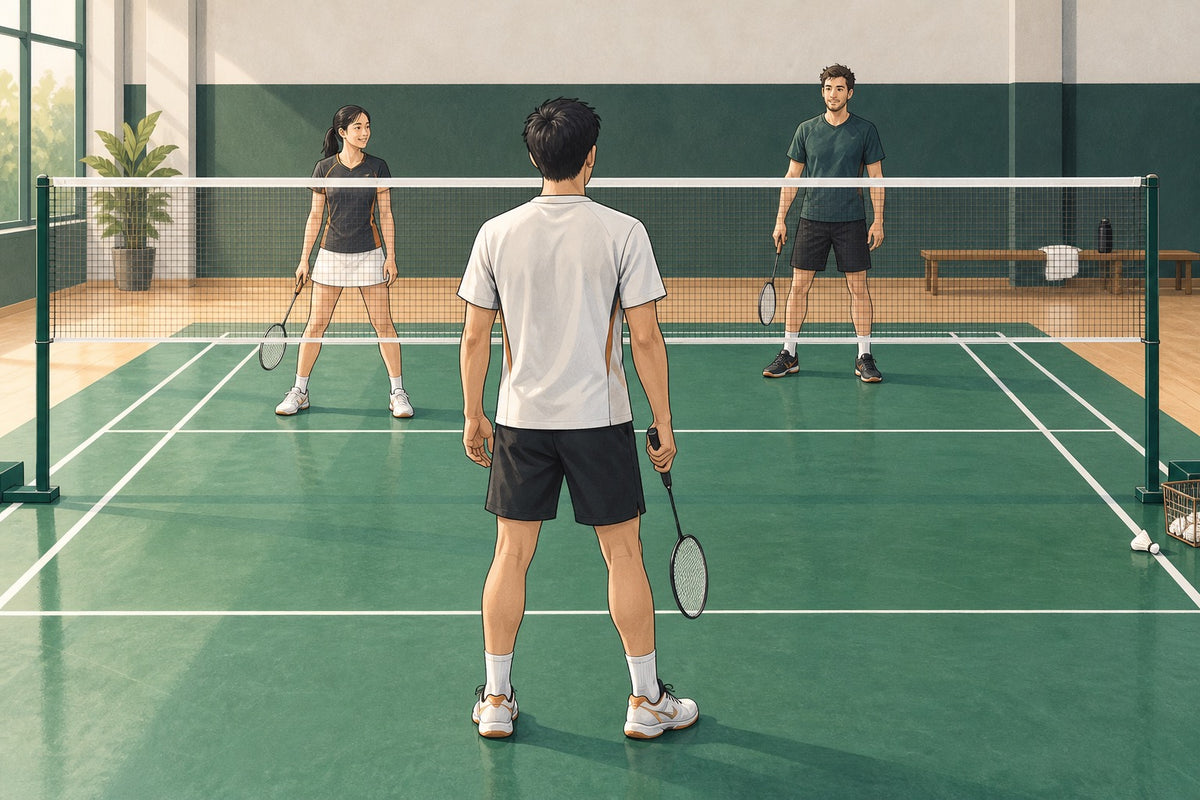
Three people can play continuously with a cooperative 2v1, solo-lane game, full-court target handicap, front-back zone game, rally-loser rotation or king-of-court mini-games. These are club house rules, not official BWF match formats. Explain the court, serve, score and rotation before the first rally.
Best for keeping all three active: cooperative 2v1 or the front-back zone game.
Best for simple scoring: rally-loser rotation or king-of-court to 3.
Best for a stronger solo player: solo lane versus full pair or a shorter target score.
The official BWF Laws of Badminton define a match as opposing sides of one or two players. That means a three-total-player game needs declared local rules. It can borrow rally scoring and service-court parity, but the Laws do not supply a 2v1 serving sequence or an official handicap.
Agree on five house rules first
- Court: point to the exact singles, half-court or lane boundaries.
- Serve: name the server, receiver and permitted service box. If you use score parity, right is even and left is odd.
- Score: say whether points belong to a side or to individuals and name the target.
- Rotation: decide whether roles change after a rally, a mini-game or a fixed block.
- Balance: choose one adjustable handicap and review it after a short trial.
Use one active shuttle, keep the waiting player in a marked safe place and clear loose shuttles before play resumes. Where two players share one side, use front-back zones or clear lane responsibilities to reduce collisions. The BWF Shuttle Time manual uses half-court 2v1 activities and emphasizes role rotation, separation and shuttle control in groups.
Badminton House default for formats 2–4: award the rally point first, then the rally-winning side serves next. The solo player serves and receives for the solo side. Before each mini-game, the pair names one server for every pair-service turn and one receiver for every solo-service turn. The server uses the right service court when that side’s score is even and the left when it is odd; the receiver—the pair’s named receiver or the solo player—stands diagonally opposite. This is a house sequence, not the BWF doubles serving order.
Six badminton formats for three players
1. Cooperative half-court 2v1
Court: one straight half-court lane. The pair uses front and rear zones; the solo player covers the opposite lane. Start: after every error, the solo player restarts with a gentle straight feed; this cooperative restart is not a competitive service. Score: count consecutive returns rather than points. Rotate: change the solo player after one agreed block, then swap the pair’s front and rear roles.
Keep the shuttle below a hard attacking pace until spacing is reliable. Make it easier with a shorter lane and a high return requirement. Make it harder by asking the pair to alternate front and rear contacts, not by feeding faster than the group can control.
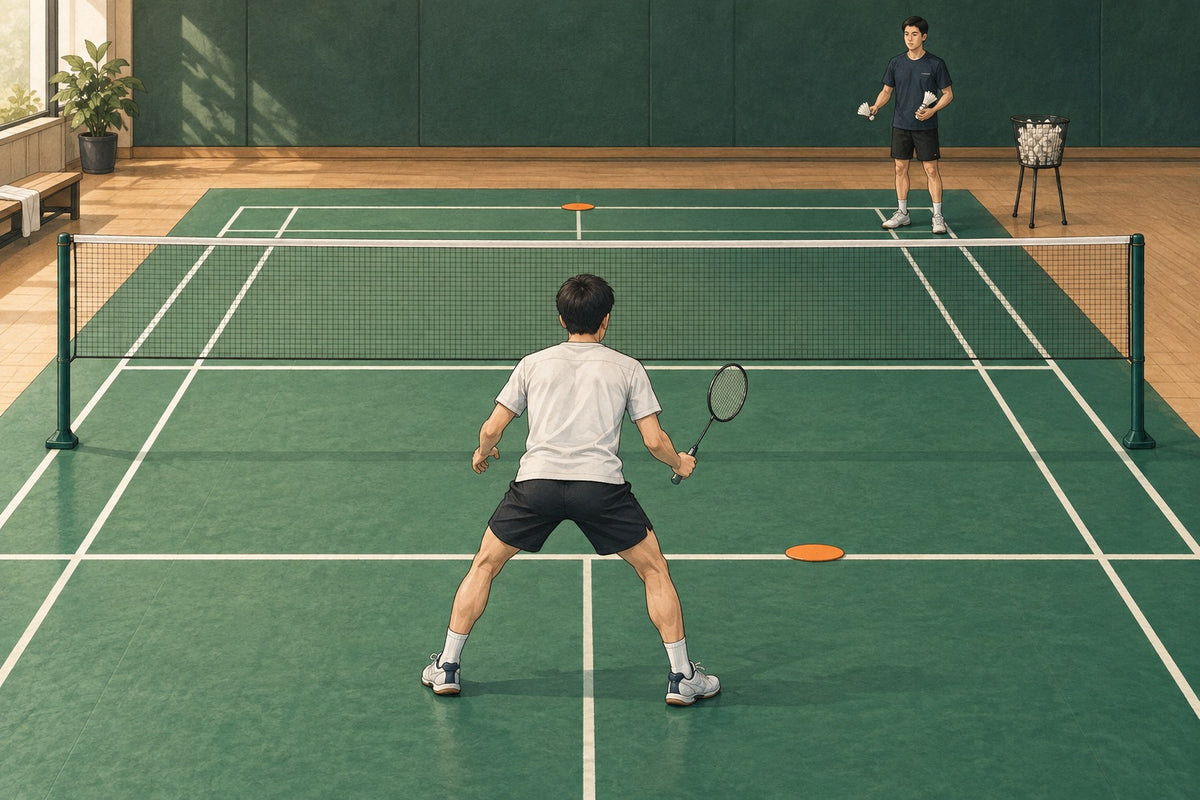
2. Solo lane versus full pair
Court: the solo player defends one longitudinal half-court lane. The pair covers the full opposite singles court but must land every return inside the solo lane. Serve: use the Badminton House 2v1 sequence above. Score: rally scoring to 5. Rotate: each player takes one solo round.
This gives the solo player less court while the pair manages more space and accuracy. If the pair dominates, ban downward attacks or widen the solo lane. If the solo player dominates, let the pair use the full target width. Treat those as adjustable house constraints, not objective measures of fairness.
3. Full-court target handicap
Court: standard singles court, one player versus two. Serve: use the Badminton House 2v1 sequence above. Score: rally scoring, but give the solo side a shorter target—such as 5 while the pair needs 7. Rotate: everyone plays one solo game.
The exact targets are a starting experiment. If one role wins every game comfortably, change only one number. Do not import the full standard doubles serving sequence: official doubles assumes two players on each side, which this format does not have.
4. Front-back zone game
Court: full singles court. Agree an imaginary front–rear boundary, such as the short service line: one pair player owns the area from the net to that boundary and the other owns the area behind it. The solo player covers the opposite side. Serve: use the Badminton House 2v1 sequence above. Score: first to 5. Rotate: after either side first reaches 3 points, swap the pair’s front and rear roles; rotate the solo role after the mini-game.
The agreed boundary assigns primary responsibility; it does not remove the need to call, yield and avoid overlapping swings. If the front player rarely receives a playable shuttle, use the house rule that the solo player sends one shot short during each three-shot sequence. If the pair is too strong, restrict the rear player to clears and drops.
5. Rally-loser rotation
Court: half-court singles. Start: the rally winner serves; use right for an even personal score and left for an odd one. Score: every rally winner earns one individual point. Rotate: the loser exits and the waiting player enters, so nobody waits more than one rally.
First to 7 individual points wins the round. If one player strings together too many fast wins, require that player to land beyond the short service line or begin each rally as receiver. Keep the entry point away from the active hitting lane.
6. King-of-court mini-games
Court: half-court singles. Serve: the challenger serves first at 0–0; after each rally, the rally winner serves next from the right or left court according to that player’s even or odd score. Score: reset to 0–0 for each mini-game and play first to 3. Rotate: normally, the loser rests, the waiting player challenges and the winner remains king. When a player earns a second consecutive mini-game win, that winner rests instead; the loser remains as king and the waiting player becomes challenger.
For a large ability gap, let the newer player start each mini-game at 1–0 or use a larger target court. Review after two games. A handicap should create more competitive rallies, not embarrass a player or disguise unsafe speed.

Which three-player format should you choose?
| Need | Start with | Avoid |
|---|---|---|
| Warm up together | Cooperative half-court 2v1 | Hard attack before spacing is clear |
| One much stronger player | Solo lane or target handicap | Assuming one score works forever |
| Fast social games | Rally-loser rotation | Waiting inside the playing area |
| Short competitive rounds | King-of-court to 3 | Unlimited winner-stays streaks |
UK Coaching’s STEP model supports changing court space, task rules, equipment, participant numbers and roles to adjust challenge. It also warns against assuming one change always works in the same direction. Make one balancing change, play a short sample and ask whether rally quality improved.
Use our 2v1 defensive drill when the goal is structured training with work and rest. Use the club court-rotation system when several courts and larger queues need organizing. For exactly three people on one court, the best format is the one whose house rules everyone can repeat before the next serve.

Leave a comment
This site is protected by hCaptcha and the hCaptcha Privacy Policy and Terms of Service apply.