
Last checked: August 2026 · Written by the player-led team at Badminton House
Quick answer
Use one straight half-court lane, one mover and one feeder. The mover plays a net shot, recovers through a central base, plays a rear-court shot and recovers again. Start without a shuttle, then add separate feeds, a cooperative rally and finally one rear-court choice. Do not progress because the clock says so; progress when the last six cycles include at least five balanced positions or contacts, recoveries through base and, in shuttle versions, controlled targets.
Start: called shadow movement, with time to stop in every position.
Build: feed-and-stop, then a cooperative continuous rally.
Advance: add one clear-or-drop decision only after the pattern stays organized.
This is one specific two-point badminton pattern, not a universal drill definition. A Danish badminton course documents a half-court exercise in which a mover travels to the long forehand corner, returns through the middle with a split step and then handles a short forehand feed. The same resource gives short/long feed-and-stop and live-feed variants, plus a backhand-side version.
The four-step ladder, exact work/rest doses, five-of-six move-up rule, two-cycle step-back rule and 60-minute timetable below are Badminton House programming built from those documented components and the BWF progression principle. They are practical session choices, not federation standards.
How do you set up the front-and-back drill?
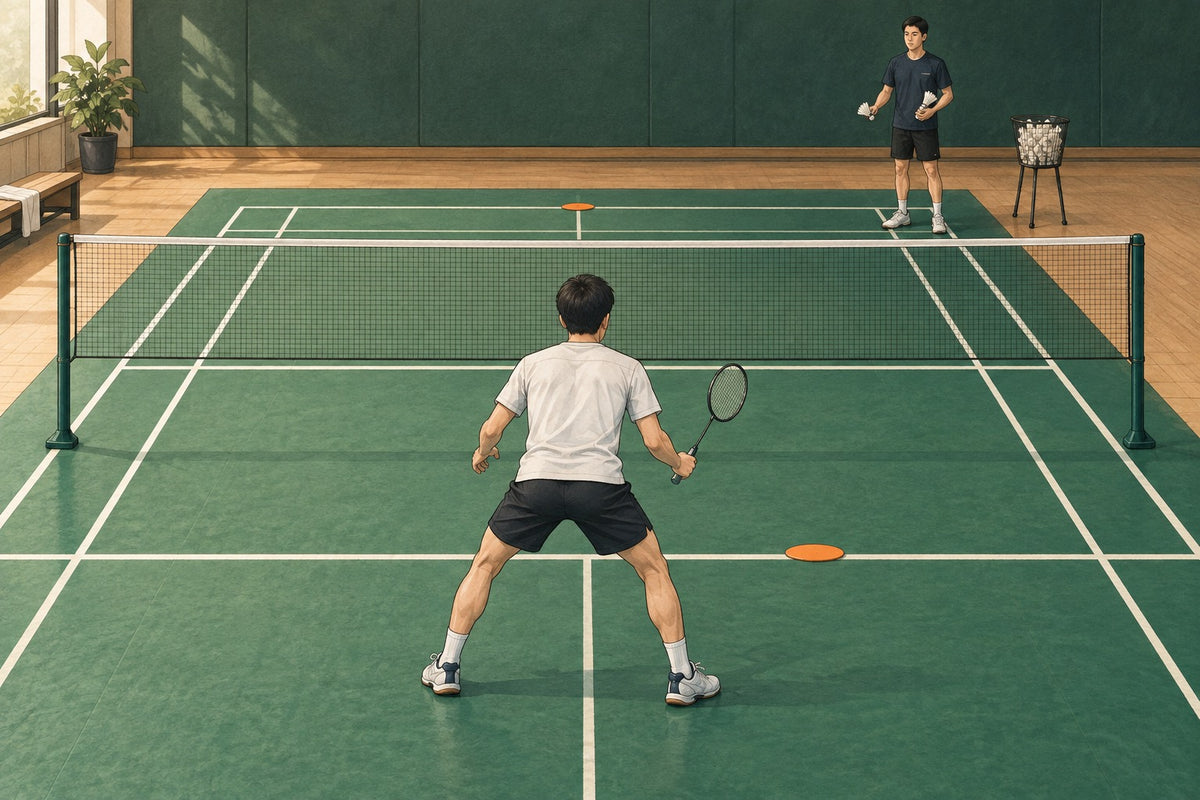
Choose one straight half-court lane. Put the mover’s base slightly behind the middle of that lane, not on a permanent floor mark. The front target is a balanced net contact; the rear target is an overhead contact in the back corner. One complete cycle is front contact, recovery through base, rear contact and another recovery through base.
- Define the lane. Use one side of the centre line so the mover does not drift across a neighbouring court.
- Choose one shot pair. Begin with a net shot and rear-court drop. Do not add smash, clear, cross-court targets and scoring at once.
- Place the feeder safely. For separate feeds, stand where the throw or serve can resemble the intended flight without occupying the mover’s route. For the cooperative version, feed from the opposite net area.
- Agree on the reset. A feed starts only after the mover has recovered and can see the feeder. Stop immediately if a loose shuttle enters the lane.
The BWF Level 1 coaching manual says feeds should create realistic opportunities, come from a safe position, resemble the relevant flight and arrive slowly enough for preparation and reflection. It also identifies loose shuttles as a trip hazard. A faster feed is not automatically a better feed.
Backhand-side note: moving the pattern to the backhand half of the court does not require every rear contact to be a backhand overhead. Depending on the player and shuttle, round-the-head movement may be the appropriate solution.

What are the four front-and-back drill versions?
| Version | Player and feeder jobs | Local dose | New demand |
|---|---|---|---|
| 1. Called shadow | Partner calls “front” or “back”; mover marks each contact and recovers without a shuttle. | 2 × 40 seconds; 40 seconds rest | Route and balance |
| 2. Feed and stop | Alternate a short underarm toss and a long serve. Mover plays a net shot and rear-court drop; both reset after every feed. | 2 sets of 6 cycles; 60 seconds rest | Contact and shuttle flight |
| 3. Cooperative continuous | Use one live shuttle. Feeder gives controlled net and lift replies; mover keeps the front–rear sequence alive. | 2 × 45 seconds; 60 seconds rest | Recovery under continuity |
| 4. Rear decision | Begin cooperatively; at the rear, the mover chooses drop or clear and the rally continues or plays out. | 2 × 45 seconds; 60–75 seconds rest | One decision without losing the route |
That order follows the broad progression in the BWF manual: shadowing, feeding, predictable rally and then unpredictable rally. BWF says players should become reasonably competent at the current level before progressing, while the pace of progression depends on learning. It does not prescribe these exact work periods or say that every player must finish all four in one session.
The original short/long patterns can be reviewed in the 2017 GI badminton course. Keep the distinction clear: those documented exercises support the movement and feeding concept; the table above is our practical way to teach it.
When should you make the drill harder?
Move up when at least five of the last six cycles contain every applicable quality: balanced front and rear contact positions, recovery through the chosen base before the next feed and, in shuttle versions, a shot sent toward the intended target. This five-of-six threshold is our coaching protocol, not a federation rule.
Slow the feed or return to the previous version after two consecutive cycles with late reaching contact, an unstable landing, a missed recovery or loss of target control. A harder version is useful only if it preserves the skill you are training.
Move up: five of the last six cycles are balanced, recover through base and, in shuttle versions, reach the stated target.
Hold: movement is organized but one target remains inconsistent; repeat the same setting.
Step back: two consecutive cycles become late, reaching, unstable or directionless.
Do not assume unpredictability is always superior. A study of only 12 youth-elite players found movement differences among hand feeding, multifeeding and match play, including deeper lunges and lower contact in the less predictable condition. The study is useful as a warning that feed type changes the task, not proof of one best method for every age or level.
For a separate way to test pace, use our tempo-versus-technique guide. Change pace after the movement is stable, rather than using speed to hide an unresolved route.
How does the drill fit a 60-minute two-player booking?
Use the hour as a menu, not a requirement to clear every level. Both players alternate mover and feeder roles within each block. If either player has not met the quality gate, repeat the same version or finish there.
| Minutes | Block | Decision |
|---|---|---|
| 0–8 | Movement warm-up | Prepare stops, lunges, turns and recovery steps. |
| 8–13 | Set up and demonstrate | Agree on lane, base, targets and safe feed positions. |
| 13–20 | Version 1 | Earn shuttle introduction. |
| 20–30 | Version 2 | Build repeatable contact and recovery. |
| 30–40 | Version 3 | Keep only if the live rally preserves the route. |
| 40–50 | Version 4 or repeat | Add the decision only if earned. |
| 50–56 | Backhand-side version | Use the highest version each player can control. |
| 56–60 | Cool down and log | Record the first repeated quality loss for next time. |
Instead of claiming that everyone loses technique in the same order, note what actually changes: lower contact, reaching at the net, turning late, skipping the recovery, drifting across the lane or missing the intended target. That observation sets the starting version and pace for the next session.
One-line session rule
Keep the route constant, add only one new demand and stop the set while the mover can still show the movement you intended to train.
If the base recovery itself remains unclear, return to our badminton footwork basics before extending the lane or adding decisions.

Leave a comment
This site is protected by hCaptcha and the hCaptcha Privacy Policy and Terms of Service apply.