
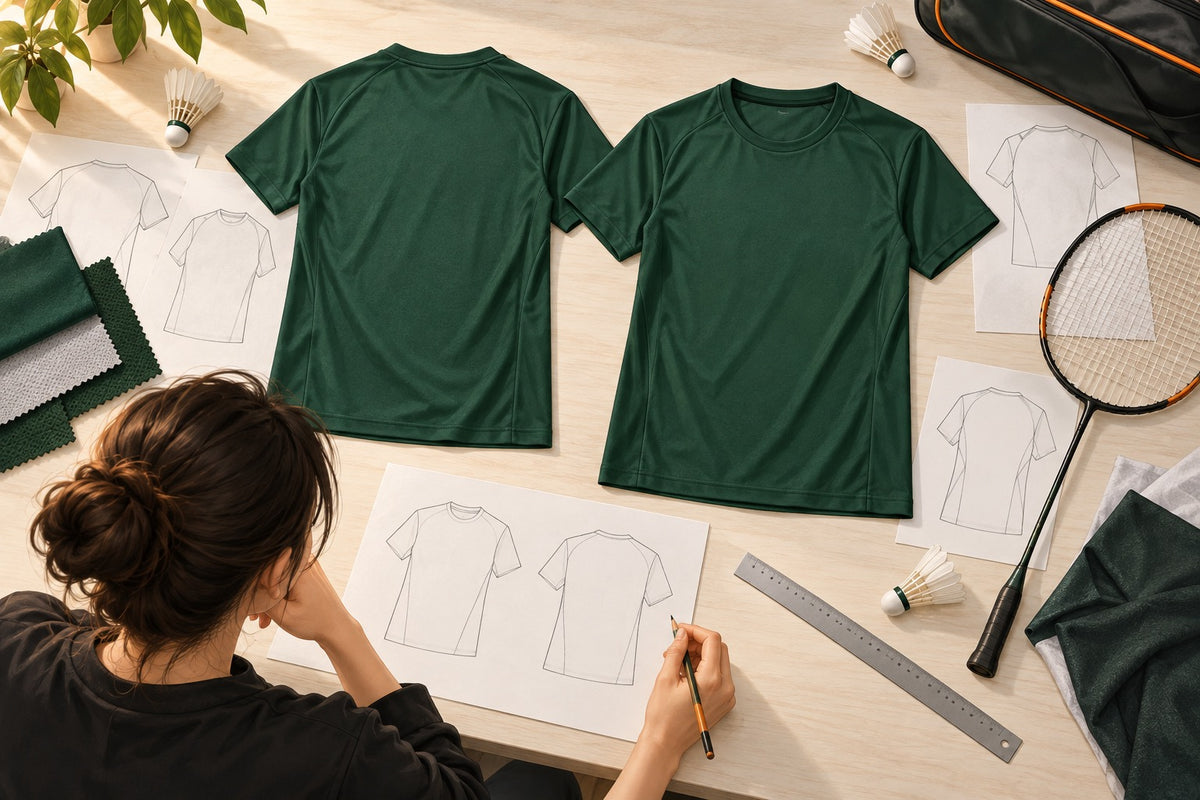
Last checked: August 2026 · Written by the player-led team at Badminton House
Quick answer: check the event before printing
There is no universal badminton tournament shirt template. Name size, country lettering, back numbers, logo positions and advertising limits depend on the governing rulebook, event category or stage, prospectus and event-specific instructions.
Ask the organiser two questions:
- Which rulebook, event category or stage, and prospectus control this exact kit?
- Will the organiser or referee review the exact front-and-back artwork—including manufacturer marks, sponsors, name, country and number—before production?
Current BWF regulations provide precise lettering and advertising rules for BWF-sanctioned competition, but they do not provide a general shirt-number size. Domestic bodies may publish different layouts and measurements. That is why dimensions copied from another tournament’s shirt can be wrong even when the shirt looked official.
The governing distinction appears in the BWF General Competition Regulations, version 7.0. Those regulations define their international scope, while national tournaments run according to regulations adopted by the relevant BWF Member association. A BWF tournament prospectus must also refer to the applicable clothing and advertising regulations.
Different clothing question: this guide covers artwork and markings. For BWF colour and doubles-matching requirements, read our tournament clothing colour guide. For fit and fabric, use what to wear for badminton.
Which clothing rules control your tournament?
Start with the named event, not with a generic level label. “Provincial,” “state,” “national” and “sanctioned” do not create one worldwide set of print dimensions.
| Typical setting | What normally controls | What to obtain before print |
|---|---|---|
| Casual club or unsanctioned event | The organiser’s notice, club rules and venue conditions. | Written confirmation of any required name, team identity, number, logo or footwear condition. |
| Regional or national association event | The responsible association’s current rulebook plus the event prospectus or regulations. | The exact edition, event amendments and an artwork contact. |
| BWF-sanctioned international event | Current BWF GCR, the referenced clothing summary, relevant event or tour rules and tournament prospectus. | The event category and stage, current documents and organiser or referee direction. |
Badminton House lookup order: identify the governing body, identify the event category and stage, read the prospectus, then check later organiser or referee instructions. This is a practical research order, not an additional competition rule.
What does BWF require for names and country lettering?
For BWF-sanctioned competition, GCR 23.2 to 23.6 control visible lettering. Whether a name or country is required for a particular event and stage depends on the referenced summary and event documents; neither item should be described as mandatory at every badminton tournament.
| BWF artwork item | Current GCR requirement when used |
|---|---|
| Letter style | Capital Roman-alphabet letters in a single colour that contrasts with the shirt. A two-panel back may use two lettering colours to retain contrast. |
| Patterned shirt | Lettering should sit on a contrasting panel. |
| Player name | Letters 6–10 centimetres high. The name must match the registered last name or a permitted abbreviation, with registered first-name initials optional. |
| Country name | Letters 5 centimetres high, using the full English country name or an Olympic-approved abbreviation. |
| Position | Lettering should be horizontal, or as close to horizontal as practical, near the top of the shirt. |
| Top-to-bottom order | Player name, then country name, then advertisement, where each is present. |
These are BWF figures, not a universal local-shirt specification. A domestic association may use a different arrangement, add team or regional text, require a number or omit a BWF field. Apply the set named by the event.
How do BWF logo and advertising limits work?
Do not count only paid sponsors. Under current BWF rules, a national flag or emblem counts as an advertisement in the standard shirt-position limit, and a permitted advertisement may be a manufacturer emblem or a sponsor. A manufacturer mark is therefore not automatically outside the artwork audit.
| Area | Current BWF rule |
|---|---|
| Nine standard shirt positions | At most one advertisement in each listed sleeve, shoulder, collar or chest position; no more than five advertisements total, each no more than 20 cm². National flags and emblems count. |
| Additional bands | One advertisement may sit in a uniform-width band no more than 10 cm wide on the front and one no more than 5 cm wide on the back. |
| Socks and shoes | Each sock may carry two advertisements of no more than 20 cm². Shoe advertising is accepted when that make and model is available on the open market. |
| Other clothing | Other articles and visible underclothing have separate limits; visible underclothing must not display advertising. |
| Prohibited content | Advertisements cannot carry political or religious messages or non-commercial personal slogans. Tobacco and electronic-cigarette advertising is prohibited. |
Measure the finished artwork, not the file name or the blank bounding box supplied by a sponsor. Also check whether the controlling event documents impose a tighter limit. Separately, under GCR 24.2.4, BWF may limit otherwise permitted shirt advertising when it clashes with tournament sponsors or broadcasters, infringes local law or is considered offensive.
What size should a badminton shirt number be?
There is no universal answer. The current BWF General Competition Regulations, Sections 20–24, do not provide a shirt-number dimension. Do not attach a 15-centimetre number to a shirt and call it a BWF requirement.
A current domestic example shows why the controlling body matters. Article 24 of the BAJ Badminton Rule Book 2026 tournament rules permits the following within Badminton Association of Japan domestic competition rules:
| BAJ domestic artwork item | 2026 provision |
|---|---|
| Rear text | Up to three rear text areas. Each area is 6–10 cm high in total—even when set on multiple lines—and no more than 30 cm wide. Do not mix different categories within one area. Rear text and the rear number use one common colour, except the permitted ad-band treatment. |
| Rear number | When used, centred below the text, no more than 15 cm high, no more than 7 cm wide per digit and no more than two digits. |
| Front number | When used, below the chest, matching the rear number, no more than 8 cm high, no more than 4 cm wide per digit and no more than two digits. |
| Standard shirt marks | One mark in each of nine named positions; each no more than 20 cm², except one may be no more than 50 cm². Manufacturer marks are included. |
This is a working English summary of the Japanese rule, not a universal template or an official English translation. BAJ’s current referee and rules page identifies the 2026 documents and warns that the tournament regulations contain domestic provisions; international competition must use the applicable international rules.
Use BAJ measurements only when the event actually adopts or references those BAJ provisions. Their value here is to demonstrate that number and text layouts can be jurisdiction-specific.

What should be checked before sending shirts to print?
Badminton House pre-print rule: do not approve artwork until you can answer both questions below.
Question 1
Which rulebook, event category or stage, and prospectus control this exact kit?
Question 2
Will the organiser or referee review the exact front-and-back artwork—including manufacturer marks, sponsors, name, country and number—before production?
Badminton House artwork protocol: inventory every visible mark, measure the finished artwork, and keep a front-and-back proof with the controlling document and event contact’s response.
- Write the scope on the proof. Record the governing body, event, category or stage, rulebook version and prospectus date.
- List every visible element. Include player, country, club or team text; numbers; sponsor and manufacturer marks; flags and emblems.
- Label every position. Use front, back, left and right from the wearer’s perspective and show sleeves, shoulders, collars, chest and lower garments separately.
- Add finished measurements. Record letter and number dimensions, logo area, band width and spacing in the units used by the controlling rule.
- Send the exact proof. “Three small sponsor logos” does not reveal size, position or manufacturer marks.
- Keep the response and final version together. Make sure the printed file is the reviewed version rather than a later revision.
A written response records the guidance you received; it does not override a later referee decision. For BWF-sanctioned tournaments, the current GCR says the referee’s decision under Regulations 20–24 is final.
Do not plan to cover an unwanted mark at the venue. The BWF GCR says it is not acceptable to tape over or pin on advertising, or otherwise modify clothing, to make it comply.
What other visible kit belongs in the check?
Under BWF Regulation 20.1, player clothing for these rules includes more than the shirt and lower garment. The definition covers items worn or carried on the field of play, including socks, shoes, headbands (including headscarves and turbans), towels, wristbands, bandages and medical supports. Include their visible marks in the audit.
That definition regulates clothing and advertising; it does not by itself prove that a particular brace, medical support, head covering or jewellery item is medically eligible or approved for every event. Take any separate equipment or safety question to the named organiser or referee.
The current BWF clothing sections cited here do not state a universal “non-marking shoe” rule. A venue or event may require non-marking indoor footwear, so check its documents separately and use our non-marking badminton shoe guide for that identification task. Once the shirt is settled, our tournament bag checklist covers the wider packing job.
The safe print decision is document-specific: identify who governs the event, measure every visible element against that source, and obtain event guidance on the exact artwork before committing to production.
References
- Badminton World Federation. BWF Statutes, Section 5.1: General Competition Regulations. Version 7.0, in force 8 November 2025.
- Badminton Association of Japan. BAJ Badminton Rule Book 2026 — Tournament Operation Regulations. Revised April and May 2026.
- Badminton Association of Japan. Current referee and rule-document index.

Leave a comment
This site is protected by hCaptcha and the hCaptcha Privacy Policy and Terms of Service apply.