
Last checked: August 2026 · Written by the player-led team at Badminton House
Quick answer
Battledore and shuttlecock was the cooperative bat-and-shuttle game played across Europe and Asia for centuries before badminton existed: two paddles, one feathered shuttlecock, and a shared count of how many hits you could string together before it hit the ground. It had no net, no marked court, and no way to win a point off an opponent, only a number to beat together. Badminton kept the shuttlecock and the underarm feel of the old strokes, then added the net, the bounded court, and a competitive scoring system that turned a shared pastime into a sport with a winner and a loser.
Start with what the game actually was
Read the equipment and the counting culture first, then see exactly what badminton kept from this older game and what it had to add on top of it.
What Battledore and Shuttlecock Actually Was
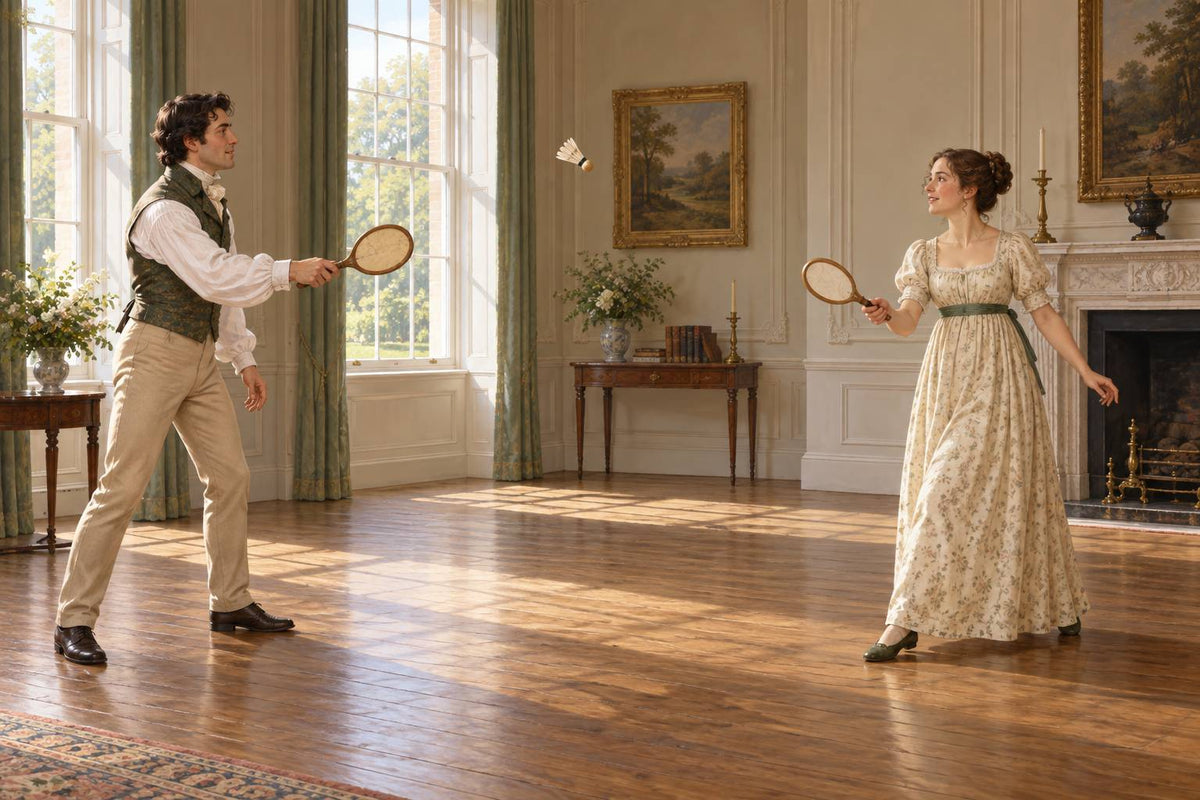
Battledore and shuttlecock was a cooperative bat-and-shuttle game, not badminton with the net and scoring stripped away. Two or more players used small paddles called battledores to keep a feathered shuttlecock off the ground for as long as possible, counting shared hits rather than competing to win points from each other.
The game is far older than any English country house. Games built around batting a shuttlecock back and forth go back roughly 2,000 years and were popular across India, China, Japan and Siam long before English children picked up a battledore, according to the 1911 Encyclopaedia Britannica's account. In England specifically, the pastime was already being played by peasants in the medieval period, and by the late 16th century it had become a popular children's game. By the 17th century, under the French name jeu de volant as well as battledore, it had also become an upper-class pastime in many European countries, a documented run of centuries that most players who only know the modern net sport never hear about.
The words themselves are relatively recent next to the game. "Shuttlecock" enters the written record in the 1570s, and "battledore" took on its bat-and-shuttlecock sense in the 1590s, well over a century before the added net and scoring gave the modern sport its own name, per a century-by-century word history. Today the phrase mostly survives in museum labels and school history units, but an ordinary garden rally with a child, paddles out, no score kept, is closer to this original game than to anything played on a marked badminton court.
The Equipment: Battledores and Shuttlecocks
A battledore was a small racket made of parchment or rows of gut stretched across a wooden frame, closer to a hand drum than a modern string bed. A shuttlecock was a light cork base with trimmed feathers fixed around the top, batted, not thrown, between players.
Parchment and gut are the same materials used in old drumheads and early strung instruments, pulled tight across a small wooden frame shaped like a paddle. That construction gave a battledore some spring off the face, which mattered for a game built on keeping the shuttlecock alive: a soft, controlled tap off a springy face kept a rally going far longer than a hard, flat swing would.
The cork base gave a shuttlecock enough weight to fly true, while the trimmed feathers slowed it and kept its nose pointed forward in the air, the same forward-pointing flight a feathered shuttle still relies on today. What it did not have was a fixed standard. Cork size, feather count and trim varied from one maker's workshop to the next, so no two shuttlecocks behaved quite the same way, and a worn or lopsided one simply got replaced. Exactly how the shuttlecock itself came to exist is not fully settled; one long-standing theory holds that corks originally used to store loose feathers, quills for writing among them, became a popular object to throw and then to bat, and the shuttlecock followed from there.
A battledore was not always a plain practice tool, either. One surviving Victorian pair, dated to around 1880, shows how decorative the equipment could get: wooden handles wrapped in leather embossed with a chain pattern, traces of gold leaf still visible, and a maker's sticker reading "Warranted Best Vellum." Equipment like that was made to be kept and shown off, not just batted around until it wore out.
How a Session Was Played, and the Counting Culture Around It
A session had one goal: keep the shuttlecock airborne with your partner for as many consecutive hits as you could manage, then talk about the number afterward. There was no serve, no boundary and no way to end a rally except letting the shuttlecock fall, so the tally itself became the sport's bragging right.
That shared-tally structure changed what the players actually wanted from each other. In a competitive rally, a good shot puts your opponent under pressure. In battledore and shuttlecock, a good shot was one your partner could comfortably return, because a shuttlecock on the ground ended the count for both of you at once. Skill showed up as control and touch rather than power or placement against another person.
Shuttlecock-and-paddle play was not unique to Europe and Asia, either. Various traditional shuttlecock games were played independently by North American Indigenous peoples, including the Kwakwaka'wakw, Akimel O'odham, Coast Salish and Zuni, often with a feathered shuttle made from corn husk or twigs and sometimes a wooden battledore, in a documented account of these regional games. Each region built its shuttlecock from whatever was on hand (corn husk in the Southwest, twigs and branches on the Northwest Coast), which is a strong sign the basic idea (a light, feathered object that a paddle or hand can keep aloft) was reinvented independently more than once rather than spreading from a single source. These were parallel traditions in their own right, not a stop on the road to English badminton.
The game's back-and-forth rhythm also escaped the court entirely and became a figure of speech. Nineteenth-century writers described a rallying argument or a political back-and-forth as "battledore and shuttlecock," comparing the two sides to a shuttlecock volleyed between paddles with neither side able to end it. One 1841 newspaper line put it directly: "Battledore and shuttlecock's very good game, when you arn't the shuttlecocks and two lawyers the battledore," a joke that only lands if the audience already knew the game well enough to picture it.
What Carried Into Badminton, and What Got Added
Badminton kept two things from the older game: the shuttlecock itself and the underarm, controlled contact needed to lift it cleanly. It added three things the older game never had: a net to clear, a marked and bounded court, and a competitive scoring system that turns a rally into a point, a game and a match.
The carryover is easy to spot in an ordinary garden today. Two people keeping a shuttlecock going with paddles, refusing to let it touch the ground, are playing a close cousin of the old game, right down to the soft, lifting underarm contact that both games reward over a hard flat swing. Coaches still use that same cooperative keep-up drill to teach beginners touch before anyone introduces a scoreboard.
The table below separates what stayed from what was bolted on.
| Element | Battledore and shuttlecock | Modern badminton |
|---|---|---|
| Object in play | Feathered shuttlecock on a cork base | Same idea, now built to a uniform standard |
| Stroke style | Soft, underarm, lifting contact | Underarm lift still taught first, before overhead power |
| Net | None | Added, giving the rally something to clear and attack over |
| Court | Open floor or lawn, no lines | Added, marked and bounded, turning open space into in or out |
| Scoring | A shared tally of hits, no winner | Added, converting rallies into points, games and a result |
None of those three additions were small tweaks. A net forces a downward, attacking option that a net-less keep-up rally never needs. A bounded court turns "still in the air" into "in or out," which is the difference between a shared pastime and a sport with a rulebook. A scoring system turns the shuttlecock's flight from a joint achievement into a contest with a loser, which is the single biggest shift between the two games. This site's sourced history of the first badminton rules covers exactly when and where those additions were written into law, from Poona through the 1893 Portsmouth rulebook.


Leave a comment
This site is protected by hCaptcha and the hCaptcha Privacy Policy and Terms of Service apply.