
Last checked: August 2026 · Written by the player-led team at Badminton House
Quick answer
A racket is legal by its frame and string-bed dimensions, not by its weight, balance or tension. Lead tape, overgrips and vibration dampeners are explicitly allowed when reasonably sized and placed. A second string bed or a deliberately uncrossed string grid is not. Retail frames from major brands are already built inside these limits, so the real risk sits in what a player adds afterward.
Start with The size limits that make a racket legal
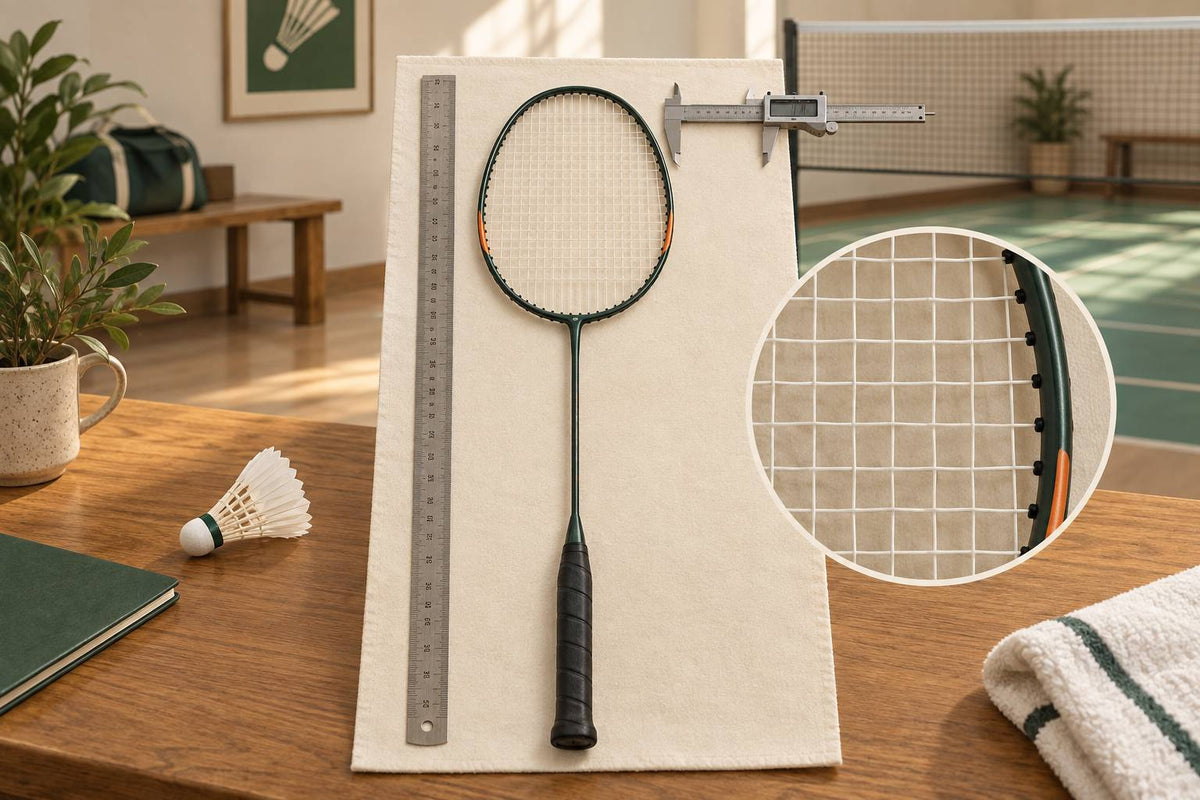
Measure the frame and string bed first, then run each modification you've added through the pass, borderline or fail table below.
Related reading: Is My Badminton Racket Legal? — the full frame and string-bed rundown. This guide focuses on ruling case-by-case on the modifications players actually add.
The size limits that make a racket legal
A racket is legal only when its frame is no longer than 680 mm and no wider than 230 mm, and its stringed area is no longer than 280 mm and no wider than 220 mm. Strings may reach into the throat only if that extension does not exceed 35 mm wide and the total stringed length does not exceed 330 mm.
Racket parts have specific names under the rules. The handle is where you grip, the stringed area is where you're meant to hit the shuttle, the head bounds that stringed area, and the shaft connects handle to head. A throat is optional; some frames run the shaft straight into the head with none.
Two numbers you won't find in the rulebook are racket weight and balance. The BWF Laws of Badminton set no separate limit on weight, balance point, shaft stiffness, grip size or string tension. A 3U frame and a 5U frame, or a head-heavy build and a head-light one, are equally legal at any weight or balance point as long as the frame and string bed stay inside the size limits above.
The string bed itself has one construction rule worth knowing before you tune anything: it must be flat, and the strings must cross, either alternately interlaced or bonded where they meet. There is no requirement that the pattern be denser at the centre than anywhere else; that older wording is not part of the rule you are checking your racket against today.

Which racket modifications are legal
Lead tape, extra overgrips and vibration dampeners are legal because they serve a permitted purpose and don't change the frame's shape. A doubled or extra string bed fails because the stringed area must stay a single flat layer. An unusual-looking string pattern is fine as long as the strings still cross and interlace or bond where they meet.
Every case below turns on the same two tests: does the addition serve one of the four purposes the law allows (limiting wear, limiting vibration, distributing weight, or securing the handle by cord), and does the racket still fit inside its 680 mm by 230 mm frame once the addition is on? For exact placement and how much weight to add where, see our racket lead-tape balance guide.
| Modification | Verdict | Why |
|---|---|---|
| Lead tape at 3 and 9 o'clock, or inside the handle | Legal | Distributing weight is one of the four purposes the law names for attached objects, provided the strip is reasonably sized and placed. |
| Extra overgrips or a modest grip build-up | Legal | Protecting the handle from wear is a permitted purpose. Re-measure overall frame length after adding layers or a butt cap. |
| A vibration dampener in the string bed | Legal | Limiting or preventing vibration is named directly as a permitted purpose. |
| An unconventional but still crossed string pattern (mixed colours, different gauges for mains and crosses) | Legal | Current law drops the old centre-density requirement. Only "flat" and "crossed, interlaced or bonded" matter now. |
| A second or doubled string bed | Illegal | The stringed area must be one flat layer. A second layer isn't flat, and stacking strings isn't one of the four permitted attachment purposes either. |
| A deliberately uncrossed or non-flat string grid | Illegal | Fails the flat, crossed-string construction test directly, whatever the spacing looks like. |
String tension itself carries no legal ceiling under Law 4. The only tension limit that matters is the one stamped on your own frame, and pushing past it is a durability question, not a legality one; see what your racket's max tension rating actually means before asking a stringer to go higher.
What to do if your racket looks non-standard
Mainstream frames from major brands are built inside these limits already, since a racket that failed Law 4 could not be used in sanctioned play. The real risk sits in what a player bolts on afterward. If a modification or an unusual frame still looks doubtful, measure it and ask a referee or your stringer before you play.
Two things that often worry players are not legality questions at all. A racket's paint job, colourway or sponsor decals do not matter, because the BWF's separate clothing and equipment regulations define what a player wears or carries on court, and they name one specific exception: the racket. Cosmetic branding sits entirely outside Law 4. There is also no public list of pre-approved racket models to check a frame against.
If a frame is close to a limit or uses an unfamiliar construction, the tournament referee can rule on the spot. Beyond that, the BWF itself will rule on any compliance question, either on its own initiative or on application by any party with a genuine interest, including a player, technical official, equipment manufacturer or member association.
Before your next match, run three checks: measure the frame and stringed area against the numbers above, confirm every attachment serves one of the four permitted purposes, and re-measure overall length if you've built up the grip or added a butt cap. If a number still sits close to a limit, ask before you play rather than after a call goes against you.



Leave a comment
This site is protected by hCaptcha and the hCaptcha Privacy Policy and Terms of Service apply.