
Last checked: August 2026 · Written by the player-led team at Badminton House
Quick answer
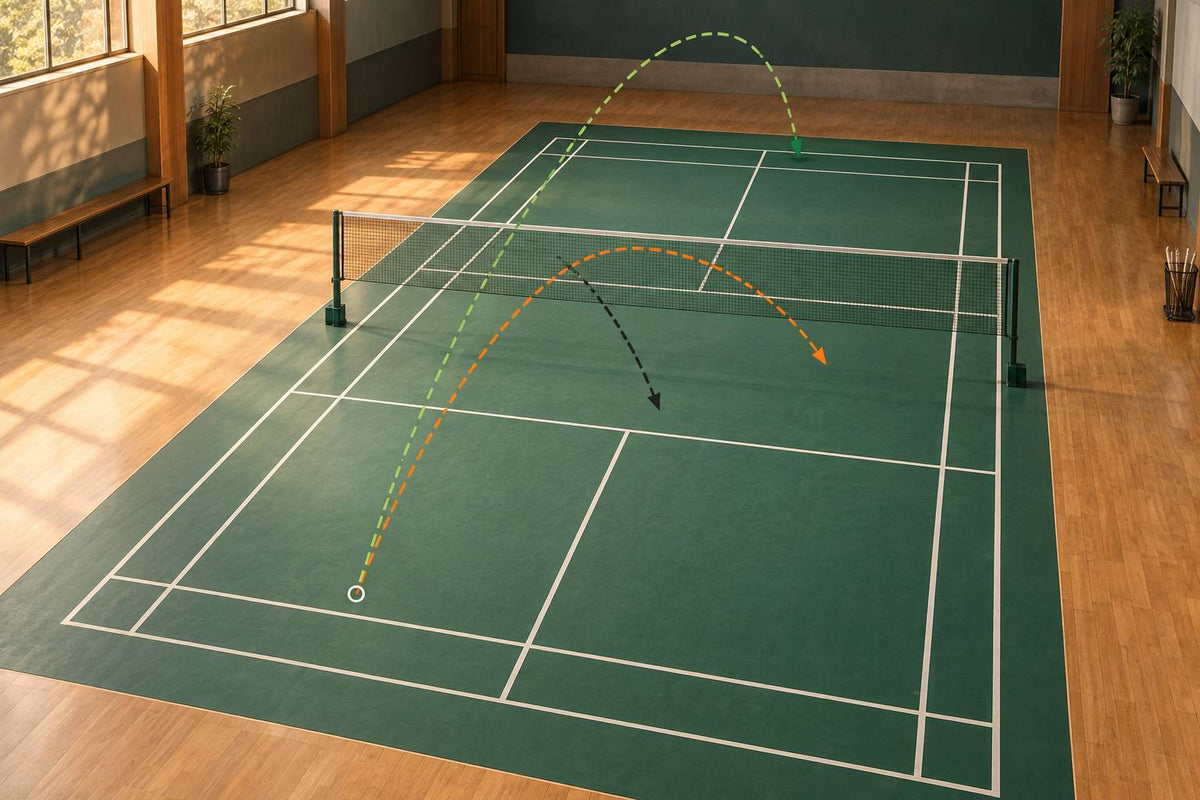
Clear and drop share BWF-taught overhead foundations, but a drop is a controlled push to the front court while a clear uses a fuller hit to the rear. A seven-player elite-male study found shot-specific upper-limb differences across clear, drop, and smash, not a universal mechanics table.
Start with What clear and drop share overhead
Use the three overhead shots as different intentions rather than one shared swing recipe. A clear and a drop have distinct BWF-taught targets; the cited motion study found shot-specific patterns in its elite-male sample, so use the comparison to choose intent, not to impose exact mechanics.
- Pick one intended landing region before the rally: rear court for a clear or front court for a drop.
- Keep smash observations separate from clear and drop observations rather than assuming one preparation solves all three.
- Practise the chosen shot with a controlled feed, then name whether the target and recovery matched the intention.
- Add pace or a second option only when the player can explain the target, contact, and recovery without an invented universal mechanics rule.
Related reading: Badminton Shot Types Explained: A Complete Guide — for a broader map of badminton shot names and purposes.
What clear and drop share overhead
BWF Shuttle Time teaches common overhead foundations: a basic grip, backswing preparation, forearm rotation, and contact above and in front of the shoulder. The BWF manual presents these elements in its overhead-stroke teaching sequence. The manual provides a teaching principle, not a fixed protocol. BWF Shuttle Time Manual

The shared overhead foundations are a starting point, not a conclusion. Basic grip, preparation, forearm rotation, and contact above and in front of the shoulder describe common teaching elements; they do not erase the source-backed clear, drop, and smash intentions described below.
Their different tactical purposes
The BWF teaching sequence distinguishes a clear from a drop by the intended hit: the drop is a controlled push toward the front court, while the clear uses a fuller hit toward the rear court. BWF Shuttle Time Manual
| Shot | Source-backed purpose or finding | Do not infer |
|---|---|---|
| Clear | BWF teaching describes a fuller hit toward the rear court. | One universal swing pattern. |
| Drop | BWF teaching describes a controlled push toward the front court. | Guaranteed deception or match success. |
| Smash | BWF teaching describes an attacking downwards shot to try to win the rally or force a weak return; the study reports patterns only in seven elite men. | Exact mechanics for every player. |

For the reader’s next decision, begin with the intended opponent movement. A clear is taught as a fuller hit toward the rear, while a drop is a controlled push toward the front. That is a useful target-based distinction before adding individual mechanics or speed.
Why smash mechanics need separate evidence
BWF teaching describes a forehand overhead smash as an attacking shot struck down from the attacking zone to try to win the rally or force a weak return. The motion study reports shot-specific upper-limb patterns only in seven elite men, so it does not supply a universal mechanics rule. BWF Shuttle Time Manual and overhead-motion study

BWF teaching describes the smash as an attacking shot struck down from the attacking zone to try to win the rally or force a weak return. The cited motion study found shot-specific upper-limb differences among smash, clear, and drop in seven elite male players; it cannot set exact mechanics or a guaranteed outcome for every player.
Choose the question before comparing mechanics
A three-row practice card can keep tactical intention separate from individual mechanics. In the clear row, write the intended rear-court destination. In the drop row, write the intended front-court destination. In the smash row, write the specific observation being discussed rather than copying an exact body position from either of the other rows. Then add a second line beneath each row for the feedback source: a controlled feed, a coach’s observation, or a player’s own video. This layout prevents a useful common foundation from becoming a single swing recipe. Basic grip, preparation, forearm rotation, and contact above and in front of the shoulder can remain the shared teaching frame, while the practice question stays tied to the intended shot. If the player is unclear about the target, simplify the task before adding more mechanical detail. If the target is clear but the observation needs discussion, keep that discussion particular to the shot rather than assuming that a feature from a clear must be reproduced for a drop or smash. The elite-player motion analysis adds a useful caution to this process: its shot-specific upper-limb findings belong to its small, specific sample. They are not a table of exact rotation, contact, weight transfer, speed, or follow-through amounts for everyone. A local practice can still be deliberate without pretending to be universal. Change one variable at a time, such as the intended destination or the feedback method, and describe the next attempt in the same terms. This gives a coach and player a clear conversation: which target was chosen, what was observed, and what individual feedback is needed next?
A useful on-court comparison can be deliberately small. Start with one intended flight—rear court for a clear or front court for a drop—and watch the shared overhead foundations named in the teaching material. Then note the shot that was intended, rather than scoring the player against a universal body-position chart. If a smash, clear, or drop looks different, the motion study gives a reason to expect shot-specific upper-limb patterns, but it does not say that one player’s visible difference is technically correct or incorrect. A second observer can therefore describe the purpose and common foundation without inventing precise angles, a deception cue, or a performance forecast. This makes the comparison useful for a next attempt while keeping the conclusion within the teaching sequence and the small study’s scope. In other words, the comparison begins with what the shuttle is meant to do, not with a demand that every overhead stroke share one visible shape. That order preserves the teaching purpose while leaving the study’s shot-specific findings in their measured context. Its stroke differences are not a universal assessment template for individual players or a prescribed progression for practice.
Source-bound context
A useful video review asks one question per clip. On the first controlled feed, record whether a clear was intended to travel toward the rear court. On the second, record whether a drop was intended to travel toward the front court. On the third, keep the smash as its own shot rather than asking the clip to prove that all three overheads share one exact movement. Choose one visible feature to observe across the clips, such as preparation or high reach, and keep the camera view consistent. The notes can then show a target and one observation for each shot without turning a small motion-analysis sample into a universal technique score. If the player changes the target or the observation, make that the next comparison instead of carrying a conclusion from one shot into another. A partner can make this practical by using a short observation sheet with three rows—clear, drop, and smash—and two fields on each row: intended flight and the one feature being watched. The sheet does not need to grade the player or measure every joint. It simply prevents the three shots from being discussed as though they were the same task. After the player and partner can describe the first comparison, they can make one new decision: keep the shot and change the cue, or keep the cue and change the intended flight. That controlled change gives the next feed a clear purpose without claiming that the observed shape proves deception, power, or match success. The review therefore creates a next action that remains specific: choose one shot, one target, one observation, and one controlled change for the following feed.
Questions the cited sources do not settle
- A universal table of exact contact points, rotation amounts, weight transfer, speed, and follow-through positions.
- A promise that similar preparation will create deception or improve match results.
What to do next
Record the intended flight and one observed feature, then change only one of them on the next controlled feed.



Leave a comment
This site is protected by hCaptcha and the hCaptcha Privacy Policy and Terms of Service apply.