
Last checked: August 2026 · Written by the Badminton House player-led team.
Quick answer: what is the eight corner footwork test?
It is a local court-coverage test: touch eight fixed targets around your half-court, return through the same centre box after every touch, and record total time plus a quality note for each direction. Compare only with your own matched retests.
The test turns “my footwork feels slow” into a repeatable observation. It can show that one direction takes an extra adjustment step or loses balance. It cannot grade talent, diagnose the cause or compare players fairly when their routes and timing methods differ.
This Badminton House circuit is adapted from published eight-direction badminton test design, but it is not a validated copy of the sensor system. The value comes from keeping your own setup unchanged. Use our badminton footwork basics guide first if the movement patterns still need teaching.
What does the test measure?
It measures how quickly you can cover eight defined directions while obeying a centre-return rule. A 2023 badminton agility-system paper describes eight main court directions: left, middle and right at the front and rear, plus left and right at mid-court. Its sensor-driven test sends players from a centre point to targets and back.
The published system uses randomized light-and-sound targets and reaction-time hardware. This article instead fixes the route and uses flat markers, a phone video and a stopwatch. Therefore, your score is a personal local baseline—not the study’s score and not a federation norm.
Context matters. A systematic review of badminton lunge biomechanics reports variation with playing level, direction, footwear and testing instructions. That is why this guide gives no recreational, club or elite time bands. The honest comparison is the same player, same setup and same rules.
How do you place the centre and eight targets?
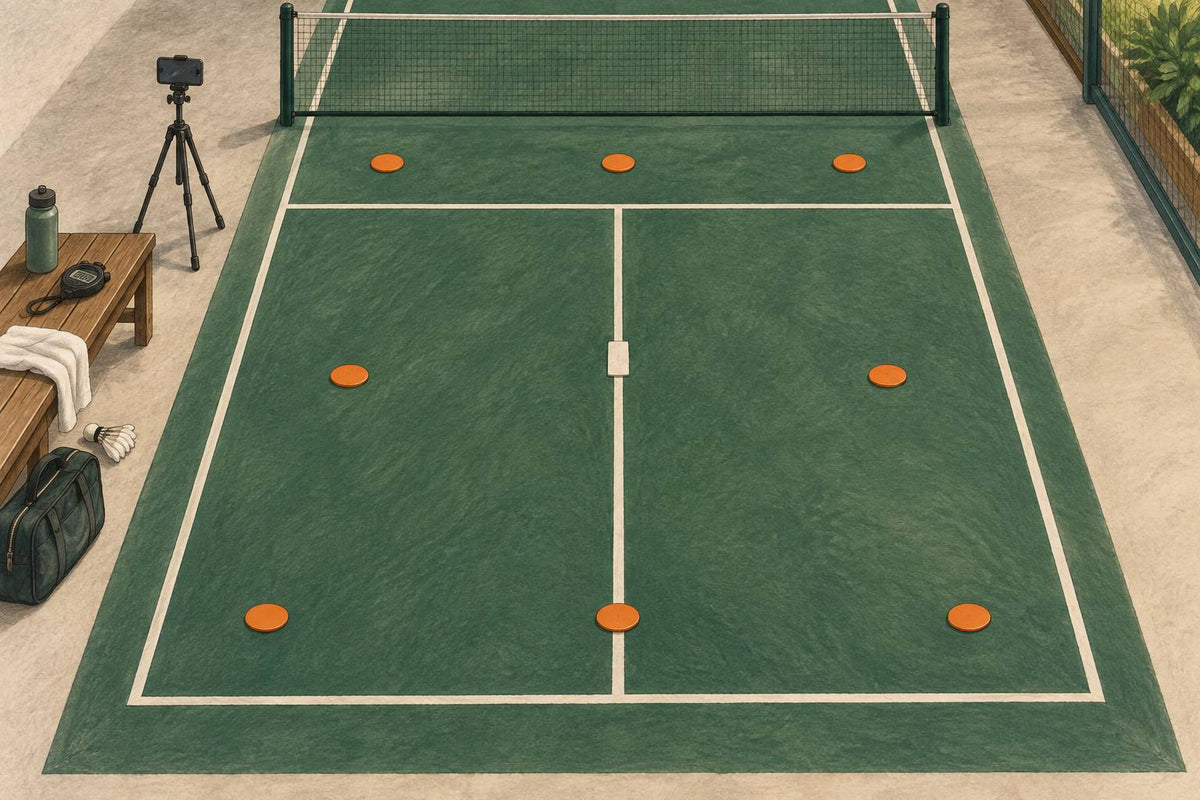
Use one indoor singles half-court. Put a tape rectangle about 50 by 30 centimetres on the centre line, halfway between the net and back boundary. This is the test’s fixed centre box; it is not a claim that the same spot is ideal during every rally.
Use flat tape dots or thin floor markers, never tall cones in the travel path. Place every outside target about 30 centimetres inside the relevant line so the racket can touch it without the player stepping onto another court.
| Targets | Placement | Route order |
|---|---|---|
| Front 3 | Left, centre and right just behind the short service line | 1 front-centre, 2 front-right, 8 front-left |
| Middle 2 | Left and right inside the singles sidelines, level with centre | 3 mid-right, 7 mid-left |
| Rear 3 | Left, centre and right just inside the back boundary | 4 rear-right, 5 rear-centre, 6 rear-left |
Photograph the markers from above or measure their distance from the lines. Use the same racket, court, shoes and route at the retest. Have one observer film from a safe side position and another time only if enough people are available.

What is the exact test protocol?
Warm up progressively before testing. Walk the route once so the marker order is known, then complete one submaximal rehearsal. The timed trials are fixed-route movement, not a reaction test.
- Begin with both feet inside the centre box and the racket in one hand.
- Start the stopwatch on the first visible movement toward front-centre.
- Touch the flat target with the racket head, then return so both feet pass through the centre box.
- Continue in the numbered route, returning through centre before every next departure.
- Stop when both feet return to the centre box after target eight.
- For this local protocol, rest five minutes, then perform one more timed trial. Keep the faster valid trial and both quality records.
A badminton footwork intervention used a shuttle-run circuit that returned via a centre-court base and gave six minutes between shuttle runs; see the published footwork study. The MDPI apparatus study used three-to-five-minute round intervals. Those studies show different testing choices; neither validates this exact local two-trial route.
Invalid trial: reject the time if a target is missed, the order changes, the racket hits a tall obstacle, or either foot fails to pass through centre. Do not invent a time penalty; rerun only after full recovery.
How do you score each direction?
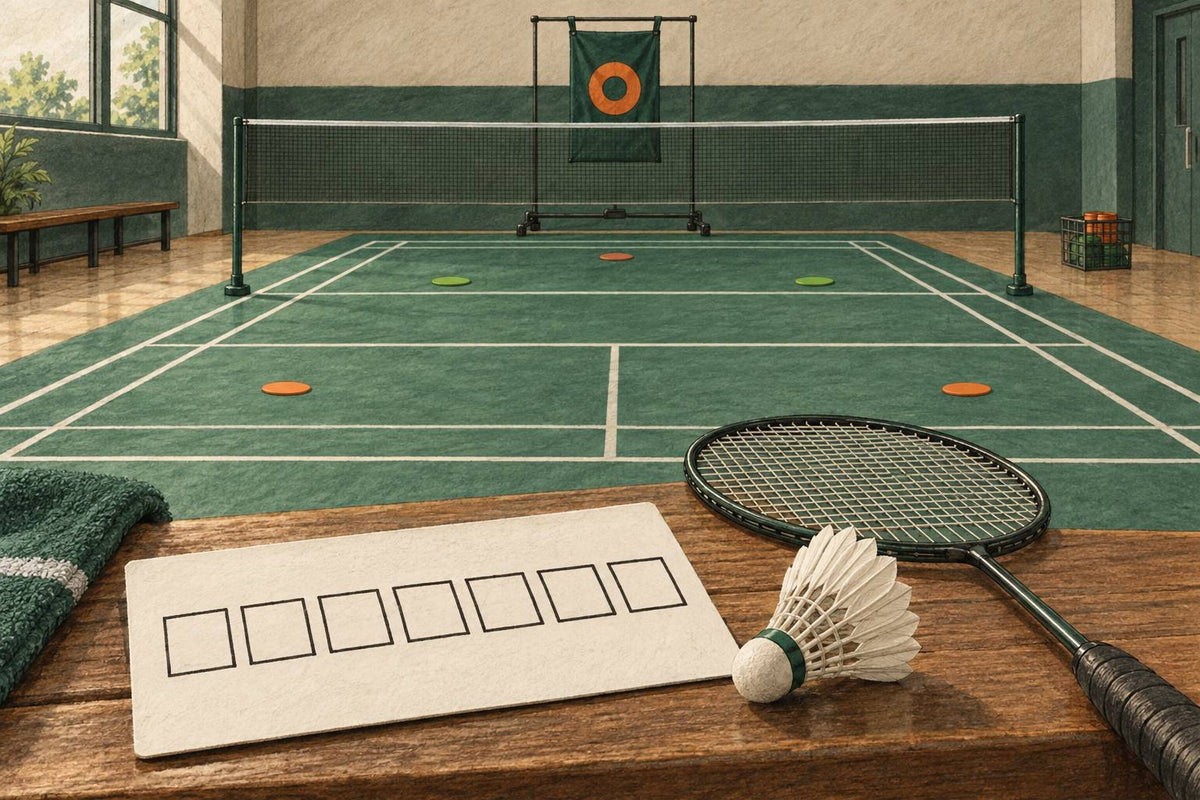
Write the total stopwatch time first. Then review the video one target at a time and mark three visible checks: complete target touch, complete centre return and controlled change of direction. If your video player shows timestamps, record the time from centre departure to the next centre return for each target.
| Direction | Split | Touch / centre | First visible issue |
|---|---|---|---|
| Front-centre | ___ s | Pass / fail | ________________ |
| Front-right / front-left | ___ / ___ s | Pass / fail | ________________ |
| Mid-right / mid-left | ___ / ___ s | Pass / fail | ________________ |
| Rear-right / rear-left | ___ / ___ s | Pass / fail | ________________ |
| Rear-centre | ___ s | Pass / fail | ________________ |
A slower split does not identify the cause. Note only the first visible event: an upright start, extra adjustment step, shortened touch, delayed turn or unstable recovery. If the same pattern remains across two trials, use it as the next coaching question.
How should you train and retest?
Choose one direction, not the full test, for the next technique block. Rehearse the first visible issue at a controlled pace, then place it back into ordinary footwork and rally practice. Repeating the complete circuit at maximum speed every day mostly changes fatigue and familiarity.
Retest after a planned training block—four to eight weeks is a practical interval—using the saved photograph, route and timing method. Compare total time, valid touches, centre returns and paired left-right splits. A similar time with fewer control faults is meaningful progress.
Test while reasonably fresh. Stop for pain, dizziness, unusual shortness of breath or loss of footing. Clear the adjacent court before each trial and never place markers where another player can run onto them.
The best result is not the lowest number anyone has posted online. It is a valid, repeatable score that directs one useful practice choice and can be reproduced when you return to the same court.

Leave a comment
This site is protected by hCaptcha and the hCaptcha Privacy Policy and Terms of Service apply.