
Last checked: August 2026 · Written by the Badminton House player-led team.
Quick answer: how does the four-player badminton game work?
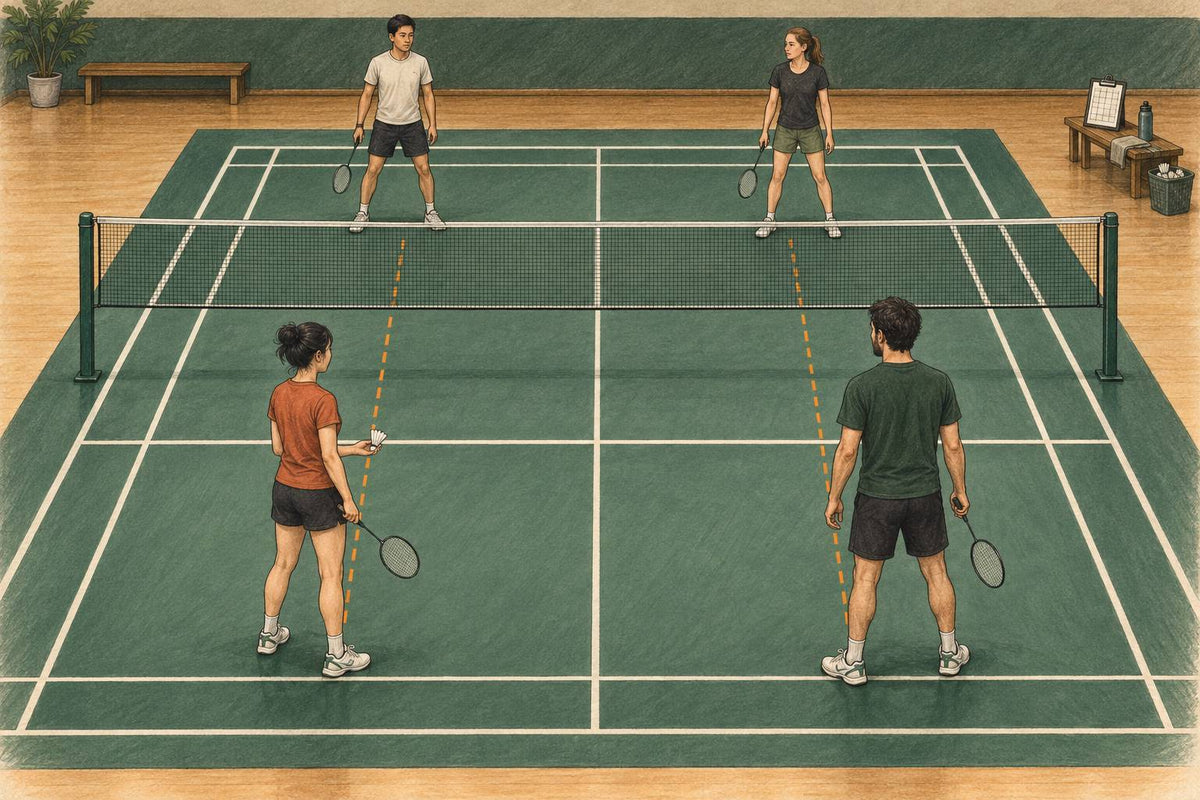
Put two players on each side of the net, divide each side into two long half-court lanes, and give every player five lives. A player loses a life when the shuttle lands in their live lane or when they hit it out or into the net. Eliminated lanes become dead ground, and the last player with a life wins.
This is a Badminton House practice game, not an official BWF scoring format. It fills the gap between a casual knock-up and a full doubles match: four people stay involved, there is only one shuttle, and every player has an individual area to protect. The BWF Laws of Badminton define doubles as two players per side, but they do not prescribe this lives game.
The format works only when the lane, life-loss and dead-ground calls are agreed before play. Use the version below for the first game. Change a rule only after everyone can explain the default.
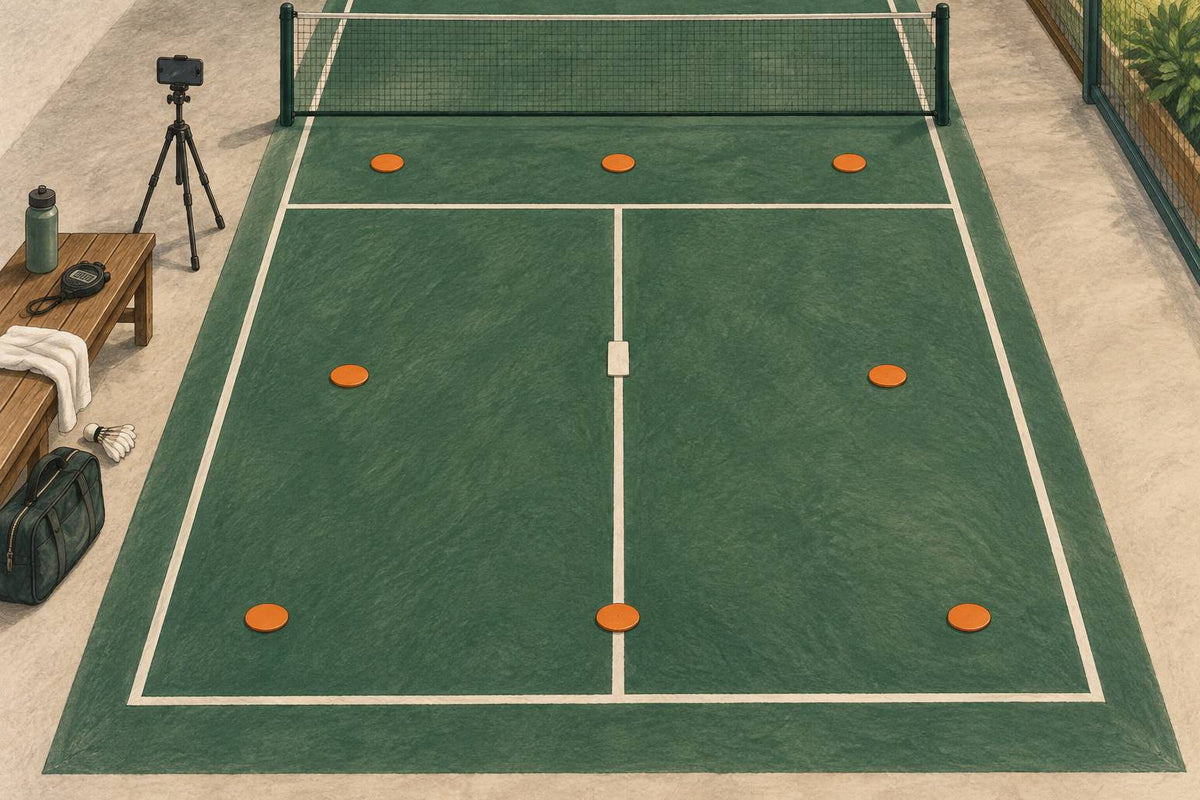
Related practice: compare this individual-lane game with half-court badminton drills, court target zones, and pressure training drills.
What are the rules of the four-player lives game?
Each player owns one lengthwise half of their side, begins with five lives, and loses one life for a landing or hitting error assigned to them. When a player reaches zero, their lane becomes dead ground. A dead-ground landing ends the rally without removing another life.
- Set the court. Put two players on each side. One guards the left long lane and one the right long lane. Use the centre line where it is painted and agree on an imaginary continuation to the net. Nobody crosses that lane boundary during a live rally.
- Give everyone five lives. Write four names and five marks on paper or use a scoreboard. Visible lives prevent memory disputes.
- Start with a neutral feed. A live player sends a gentle underarm feed into an opponent’s live lane. This is a practice start, not an official service-court procedure.
- Remove a life for an error. If the shuttle lands in your live lane before you return it, you lose one. If you hit into the net or outside the court, you lose one. Touching the shuttle makes you responsible for that return; a shuttle landing in dead ground follows rule 5.
- Make eliminated lanes dead. At zero lives, step safely off court. A shuttle that next lands in that vacant lane ends the rally, but nobody loses a life. The player who made the last legal hit starts the next neutral feed.
- Separate the final two. If the last two live players are on the same side, the player with more lives moves to the lane directly opposite their current lane; use a quick toss if tied. Continue until one player remains.
| Outcome | Call |
|---|---|
| Shuttle lands in a live lane | The owner loses one life. |
| Player hits the net or outside the court | The hitter loses one life. |
| Shuttle lands in dead ground | End and replay; no life is lost. |
| Players disagree on a line | Replay immediately; do not remove a life. |

How do you run the game cleanly on one court?
Begin with two minutes of cooperative hitting so players learn their lanes before lives matter. Run the first game without smashes, then decide whether the second game needs normal shot choices. The first pass teaches boundaries; the next can add tactical pressure.
- Use clear calls. The lane owner calls “mine” before contact, and lives are updated only after the rally ends.
- Keep feeds neutral. Start near the middle of a live lane, not on a boundary or at the body.
- Reset quickly. One mark is removed and the next feed begins. A dead-ground landing gets a simple “dead” call and replay.
- Keep bodies in their lanes. Do not reach or step through the centre into another player’s space. Stop immediately if a loose shuttle or person enters the court.
- Collect together. Wait until play stops, put rackets down, then retrieve loose shuttles.
A five-life game often fits a short practice block, but its duration depends on rally consistency. If the first game runs too long, use three lives next time. If someone is eliminated before learning the format, restart rather than leaving that player idle.
Which variations work for mixed levels?
Change one constraint at a time. A shorter life count changes duration, a no-smash rule changes pace, and a straight-only rule changes direction. Stacking all three makes it difficult to tell what players are learning.
| Variation | Rule | Use |
|---|---|---|
| Three lives | Keep every other rule unchanged. | Short session or quick rematch. |
| No smash | A smash costs the hitter a life. | Mixed levels and first-time groups. |
| Straight only | The shuttle must stay in the same lengthwise lane. | Control before cross-court choice. |
The BWF Level 1 coaching manual recommends progressing from predictable to less predictable practice. That supports changing this activity deliberately; it does not make this particular lives format official.
What does the four-player game train?
The format makes four habits visible: covering a narrow lane, keeping a shot inside a clear corridor, recognizing the seam between two defenders, and protecting a corner without a partner entering your space. These are intended practice effects of the rules, not proof that one game replaces technical coaching.
- Lane coverage: you must move early and recover within one long strip instead of drifting across the court.
- Straight control: a straight clear, drop or drive stays in a readable corridor; a loose cross can expose your own lane.
- Seam awareness: the boundary between two live lanes may create hesitation, but the target is useful only when the shot remains controlled.
- Pressure: a lost life gives immediate feedback while still leaving more than one attempt.
Finish by asking each player which shot protected their lane and which choice cost a life. That turns a lively four-player game into a repeatable practice rather than random hitting.

Leave a comment
This site is protected by hCaptcha and the hCaptcha Privacy Policy and Terms of Service apply.