
Last checked: August 2026 · Written by the Badminton House player-led team.
Quick answer: how does the badminton zone game work?
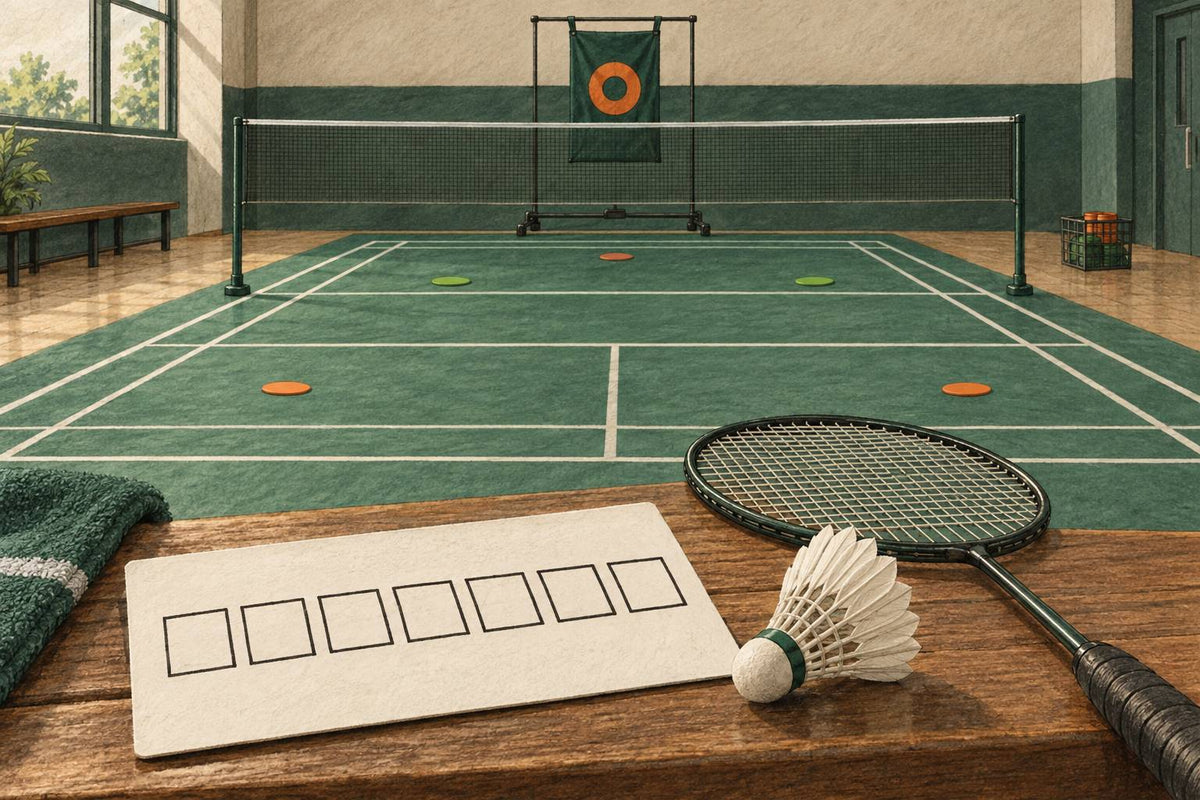
Play normal rallies while trying to capture seven target categories. Capture a ground zone by landing there. If a side wins three rallies in a row without a new landing capture, it may choose one uncaptured zone. The seventh is a safe body-target category represented by a marker whenever possible. The first player or pair to capture all seven wins.
This is a Badminton House practice format, not an official BWF scoring system or court subdivision. Its value is the record it creates. Instead of remembering only the final score, you finish with a map of the lengths and lanes that appeared in your rallies—and the targets that never did.
7 zones
Three tramline categories, three centre-depth categories and one controlled body-target category.
Capture
Land in an uncaptured area, or, after three consecutive wins without a new landing capture, choose one.
Review
Record which zones came naturally and which needed the three-rally route.
Safety rule: the body zone never authorizes a head shot or a deliberate smash at a person. Prefer a bib, cone or hanging marker at safe torso height; otherwise count only a soft, controlled torso-level contact that both players agreed to before starting.
What are the seven target zones?
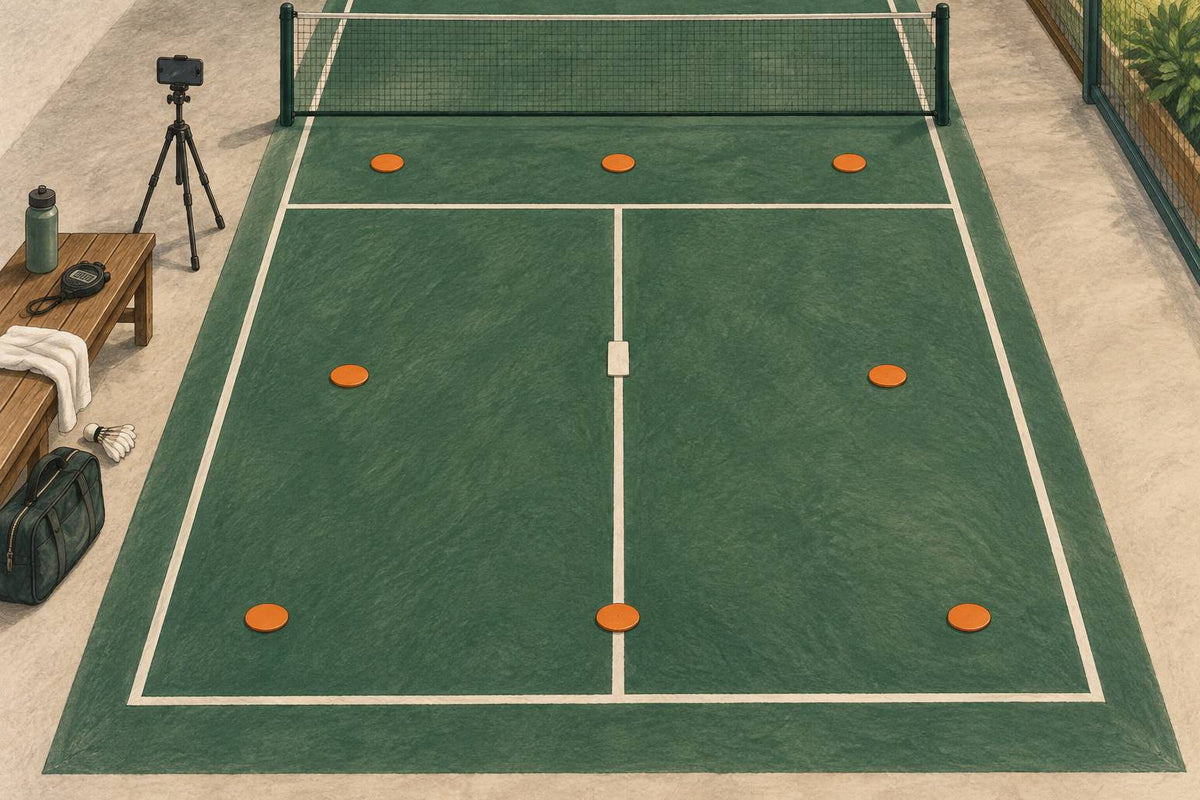
Viewed from the hitter toward the receiver's court, the map uses six floor-target categories and one body-target category. Some categories contain mirror areas on the left and right, but both mirrors count as the same named capture unless stated otherwise.
- Front tramline: either small outside-lane box just beyond the receiver's short service line. Landing in the left or right mirror captures this one category.
- Deep left tramline: the rear outside-lane target on the receiver's left, viewed from the hitter.
- Deep right tramline: the matching rear outside-lane target on the receiver's right.
- Front centre: the central channel from the net toward mid-court, excluding the front tramline boxes.
- Mid centre: the central channel around mid-court.
- Back centre: the central channel toward the rear boundary.
- Body zone: a controlled torso-height marker target, or an agreed soft body-directed shot when no marker is practical.
The overlay is intentionally simple rather than geometrically exact. Use flat, removable markers and agree which visible court lines separate front, middle and back before the first serve. Do not cover official lines or use tape unless the venue permits it.
The actual badminton court remains the rectangle defined by its boundary lines, and the lines are part of the areas they define. The official lines are 40 mm wide under the BWF Laws of Badminton. The seven-zone overlay adds practice targets; it does not change whether a shuttle is otherwise in or out.
Use our court dimensions and lines guide if the group needs to identify the short service line, centre line and tramlines before marking the targets.

How do you play the seven-zone capture game?
Start with seven empty boxes for each player or pair. Play ordinary rallies. After each rally, mark a new capture only if the winning side met one of the two capture routes: a clear landing in an uncaptured zone, or a third consecutive rally win with no new landing capture.
- Choose singles or doubles. Each player or pair receives its own seven-box capture sheet. For singles, move the tramline targets inside the singles sidelines before play; keep their capture labels so all seven categories remain reachable within the legal court.
- Agree the map. Point to every target, place any permitted markers and decide how a line touching two practice zones will be called. A replay is simplest.
- Serve and play normal rallies. Use the scoring and service order your group normally follows; the capture sheet is a second layer.
- Capture by landing. If the rally-winning shuttle lands clearly inside an uncaptured ground zone, mark that zone and reset that side's streak to zero.
- Capture by streak. If a side wins three rallies consecutively without a new landing capture, it chooses one uncaptured zone and resets its streak to zero. Reset the streak to zero whenever a side captures a zone by landing.
- Keep captured areas live. Every normal court target remains legal. A repeat landing wins the rally but does not create another capture.
- Finish at seven. The first player or pair to mark all seven boxes wins the zone game.
A third consecutive win may also land in an uncaptured ground zone. Mark that landing zone and reset the streak; do not award a second capture.
| Rally result | Capture result |
|---|---|
| Lands in a new zone | Mark that zone and reset the streak. |
| Lands in an already captured zone | No new zone; advance the rally streak. |
| Third consecutive rally win with no new landing capture | Choose one uncaptured zone, then reset the streak. |
| Disputed practice-zone line | Replay; award no capture. |
How do you run the body zone safely?
Treat the body zone as a target category, not a licence to strike someone. The safest version replaces the person with a visible marker. Hang a bib or soft target at torso height behind a controlled feeding position, or place a cone where a body block would normally occur. A clean touch captures the category.
If two experienced adults choose to use a live receiver, agree on a soft pace, torso-only area and enough distance to react. The head and neck never count. A smash or deliberately forceful shot at the player never counts. Stop the body-zone version immediately if either person is uncomfortable.
For juniors, beginners or mixed-confidence groups, use the marker-only version. It teaches the idea of directing a controlled flat shot through a defender's space without making a person's body the object of the drill. Our flat-drive technique guide covers the stroke itself.
What does the capture sheet reveal?
The useful result is not simply who reached seven. Mark each capture with “L” for a landing or “3” for the three-rally route. At the end, you can see which targets appeared naturally and which had to be claimed without hitting them.
- Captured early by landing: this area already appears in your normal choices.
- Captured late by landing: the opportunity may be uncommon or your accuracy may drop under pressure.
- Captured only through a streak: this is a candidate for the next target drill.
- Repeatedly disputed: enlarge or remark the zone before drawing a tactical conclusion.
A missing target is not automatically a technical weakness. Your opponent may not have supplied the right shuttle, or the rally may not have created the opening. Ask three questions: Did I see the target? Did I choose it? Could I control the shot when it appeared?
Turn one answer into a short follow-up rather than replaying the whole game immediately. Use a predictable feed to the missing target, add movement, then return to an open rally. Our practice-session plan shows where that block can fit.
Which zone-game variation should you use?
Keep the default for experienced singles players who can identify all seven categories. Simplify the map or constrain the rally when the full version produces arguments instead of target decisions.
| Variation | Change | Best use |
|---|---|---|
| Five-zone beginner | Remove body; combine both deep tramlines into one capture. | Faster decisions and fewer boundaries. |
| Doubles shared sheet | Partners share seven boxes and call the capture together. | Pair communication and target awareness. |
| Landing only | Remove the three-rally route. | Accurate players who want a stricter test. |
| One-side audit | Only one player records captures for five minutes, then roles switch. | Coaching observation without a race. |
Choose one map, explain it in under a minute and keep it unchanged for the game. The format works when the capture sheet makes target selection easier to see—not when the overlay becomes harder to understand than badminton itself.

Leave a comment
This site is protected by hCaptcha and the hCaptcha Privacy Policy and Terms of Service apply.