
Last checked: August 2026 · Written by the player-led team at Badminton House
Quick answer: expensive vs cheap badminton racket
Pay for a verified fit, not a price badge. A higher tier can offer a different material stack, shaft response and frame design, but it is not automatically more powerful or better suited to your swing. Compare weight, balance, flex and swingweight first, then test matched rackets on court.
Default: choose the least expensive authentic racket that gives you the weight, balance, flex and handling you can identify as useful.
Lower-priced: sensible for a first racket, backup or player whose preferences are still changing.
Premium: worthwhile when you can name the specific design difference you want and confirm it through a matched court test.
The useful difference between an expensive and cheap badminton racket is rarely “good carbon versus bad carbon.” Modern composite rackets pass through material cutting, molding, drilling, assembly, painting and inspection. The details within that chain can change, but retail price does not reveal the layup recipe, numerical tolerances or how the finished racket will match your timing.
Treat price as a prompt to inspect the specification, not as a performance score. If two rackets feel different, identify whether the cause is static weight, balance, shaft flex, swingweight, grip or strings before crediting the price gap.
Start with fit: use our badminton racket selection guide to choose weight, balance and flex before comparing tiers.
What racket manufacturing actually involves
A composite badminton racket is the result of a production sequence, not one magic material label. Carbon material is cut for a target specification, shaped under heat and pressure, drilled, assembled, painted, finished and inspected. Price can reflect choices within that process, but the finished colour does not disclose the structural recipe.
Yonex’s current account of its Taiwan factory shows carbon material being cut into specification-specific shapes, molded with heat and pressure, drilled for the string pattern, assembled, painted and checked during finishing. The company also says its Taiwan manufacturing process and quality checks mirror its Niigata site. That makes two points clear: production control matters, and a Taiwan-made Yonex racket is not automatically an inferior or lightly inspected product. See the manufacturer’s racket-production sequence.
| Production detail | What it may change | What price alone cannot prove |
|---|---|---|
| Material selection and cut shapes | The manufacturer’s target for frame and shaft behaviour | An unpublished fibre percentage or automatic power gain |
| Molding under heat and pressure | The final frame and shaft form | A cross-brand durability ranking |
| Drilling and assembly | String pattern and completed racket construction | That every specimen has an identical swingweight |
| Paint, decals and appearance checks | Finish quality and visual presentation | Better shuttle speed or a better match for your swing |
A premium racket may therefore include a more specialized material list or design brief. It may also carry a more elaborate finish. The honest boundary is that public product pages seldom reveal the complete layup or a numeric frame-to-frame tolerance, so those details should not be invented from marketing terms.
Compare exact model specifications, not tier names
The cleanest way to see what a higher tier changes is to compare versions within one manufacturer and one racket family. Hold the obvious labels constant, then inspect the material list, shaft flex and named construction features. Do not assume that every brand uses the same tier ladder.
Yonex currently lists both the Nanoflare 1000 Game and Nanoflare 1000 Z in 4UG5, with a head-light balance and the same 20–28 lb stringing advice. The differences appear deeper in the specifications. The Game model’s official page lists medium flex and a graphite, high-modulus graphite and Nanocell Neo material stack. The official 1000 Z page lists extra-stiff flex and a different set of named materials.
| Published specification | Nanoflare 1000 Game | Nanoflare 1000 Z | Buying implication |
|---|---|---|---|
| Model designation | NANOFLARE 1000 GAME | NANOFLARE 1000 Z | A useful family comparison, not a universal quality grade |
| Weight and grip | 4UG5 | 4UG5 | The broad weight code does not explain the whole feel |
| Balance | Head light | Head light | Two head-light rackets can still swing differently |
| Shaft flex | Medium | Extra stiff | The premium version is not simply the same feel with more power |
| Named materials | Graphite, HM Graphite, Nanocell Neo | HM Graphite, Nanometric DR, M40X, EX-Hyper MG | Verify the exact model’s material list instead of trusting “full carbon” alone |
This comparison does not prove that one version will suit you better. It shows what a defensible comparison looks like: same family, current manufacturer specifications, no live-price claim and no invented material percentages. Your next step is to decide whether the changed flex and handling are useful for your stroke.
Why premium does not automatically mean more power
Racket performance is an interaction between the frame and the player. A design can change how quickly the head moves, where the shuttle contacts the strings and how much effective mass reaches impact. That prevents any honest conversion from price or one specification into a guaranteed smash-speed gain.
A peer-reviewed experiment tested 20 experienced players with five equal-mass rackets whose swingweights were deliberately changed. As swingweight increased, average racket-head speed decreased, while the study detected no significant effect on post-impact shuttlecock speed. The authors also cautioned that a setup suited to the smash could have different consequences for defensive and net strokes. Read the full racket moment-of-inertia study.
That result is not a rule that heavier-swinging rackets preserve everyone’s smash speed. It came from experienced players performing forehand smashes with customized test rackets. Its useful lesson is narrower: static mass, swingweight, impact location and racket-head speed interact, so “more expensive means more powerful” is not an evidence-based buying shortcut.
Compare swingweight when two rackets share a 3U, 4U or 5U label but do not move alike. Our badminton racket swingweight guide explains why mass distribution can matter more than the printed weight class alone.
- For attacking strokes: record clean-contact depth and placement, not only the loudest smash.
- For defence: compare late blocks, drives and changes of direction under pressure.
- For the forecourt: check whether interceptions feel early and controlled rather than merely light in the hand.
- For a full session: note whether timing stays stable after fatigue instead of judging five fresh swings.
Five racket price claims to reject
Reject any racket comparison that turns an unpublished material recipe, tolerance or finish into a precise performance verdict. Manufacturer specifications can document named materials, flex, weight and stringing advice. They do not support anonymous fibre percentages or a universal claim that every premium frame is faster, stronger or more consistent.
- “This frame contains a precise percentage of premium carbon.” Require a source for the exact model and percentage. A list of named materials is not a composition-by-mass disclosure.
- “Premium rackets always have tighter tolerances.” Ask for the numeric tolerance and measurement method. If neither is published, weigh and compare the actual specimens you may buy.
- “More paint quality means more performance.” Paint and decals are real manufacturing work, but appearance does not reveal the molded layup or your on-court result.
- “A professional uses it, so it is the best version for me.” Athlete use does not reproduce your swing speed, timing, strings, grip or event demands.
- “Country of manufacture is a complete quality score.” Factory location often follows a product line. For Yonex specifically, the cited factory account describes brand-controlled production and inspection in Taiwan; verify another manufacturer’s process separately. See our Yonex manufacturing-origin guide for that separate comparison.
You can still value a cleaner finish, a particular factory or a flagship material story. Just separate preference from proof. The court decision should rest on the exact model, authentic sourcing and a repeatable test rather than a broad claim about all expensive or lower-priced rackets.
Where the practical returns stop
The premium becomes worthwhile when its specific difference improves a repeatable part of your game without creating a larger compromise elsewhere. The return stops when you are paying for a tier name, material slogan or finish while the racket’s flex, swingweight or balance fits you less well.
| Choose | Best fit | Evidence to require |
|---|---|---|
| Lower-priced authentic racket | First racket, backup or player still discovering a preferred specification | Correct weight, balance, flex, grip and safe stringing range |
| Mid-tier racket | Committed player who knows the broad specification but cannot name a useful flagship-only feature | Stable timing across clears, drives, defence and net play |
| Premium racket | Player seeking a specific flex, material stack, geometry or handling result | A matched court test that produces a repeatable benefit important to that player |
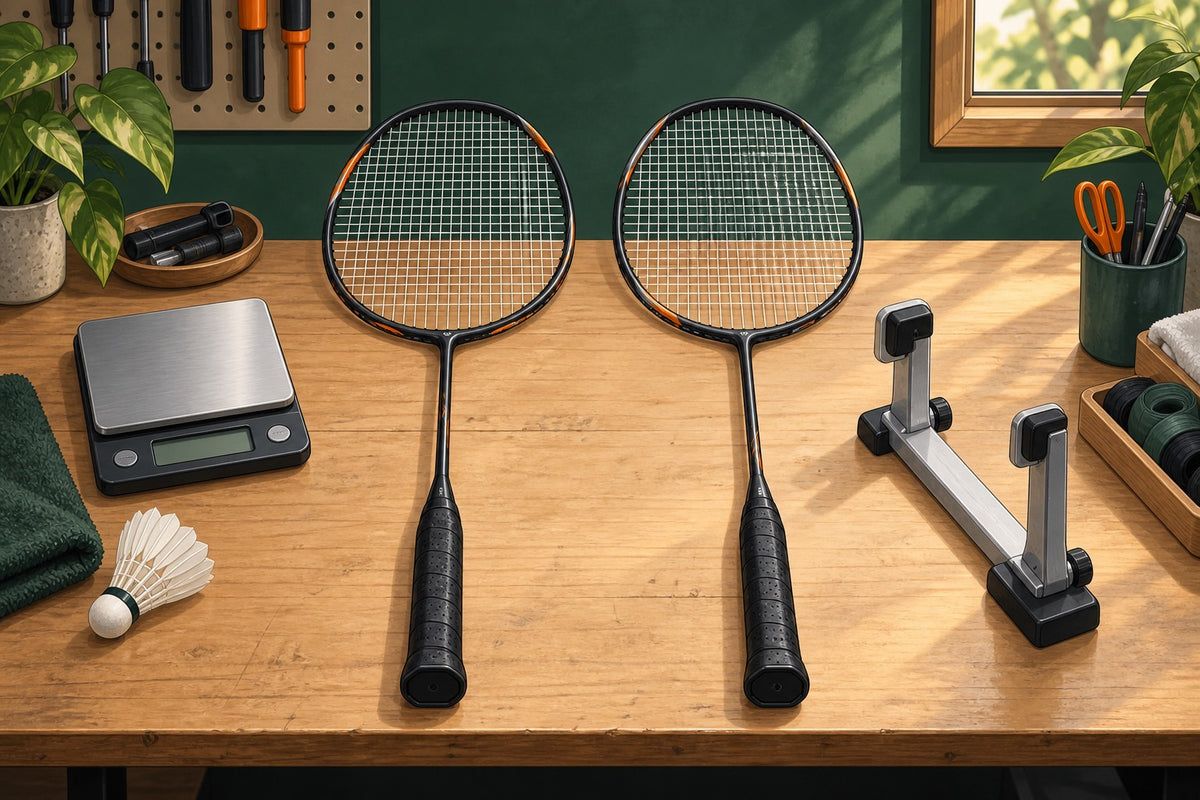
Run a matched A/B test
- Match the setup: use the same string model, tension, grip thickness and shuttle wherever possible.
- Alternate rackets: switch several times rather than completing every trial with one before touching the other.
- Test four jobs: rear-court length, flat exchanges, defensive reactions and forecourt interceptions.
- Separate clean hits from misses: do not let one spectacular shot outweigh a repeated timing problem.
- Repeat on another day: keep the premium only if the useful difference returns.
- Inspect duplicate frames: if you need two matching rackets, compare the actual weight, balance and swing feel instead of assuming the tier guarantees a match.
For a Canadian purchase, compare the total delivered cost, return terms and warranty support from an authorized seller after the on-court fit decision. A lower sticker price is not a saving if the specification is wrong or the source cannot support the product.
If you cannot identify a repeatable advantage, keep the better-fitting lower tier. If the premium version consistently improves the shots and handling that matter to your game, the extra design specialization has a practical purpose. That is a fit-and-evidence verdict, not a universal price ceiling.
Compare rackets without the price shortcut
- Write down your preferred weight, balance and flex.
- Name the exact premium feature you expect to use.
- Browse badminton rackets and compare current specifications before choosing a tier.

Leave a comment
This site is protected by hCaptcha and the hCaptcha Privacy Policy and Terms of Service apply.