
Last checked: August 2026 · Written by the player-led team at Badminton House
Quick answer
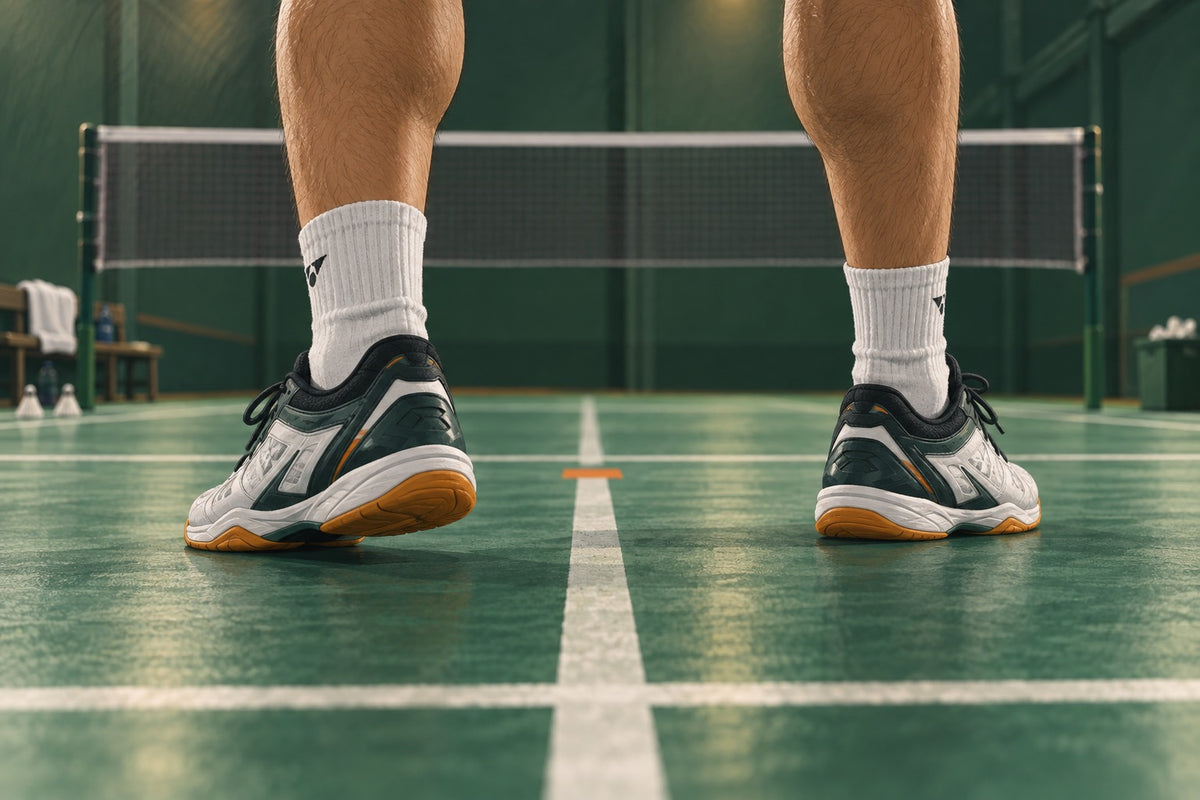
For a right-hander, place the target-side foot slightly forward for either forecourt corner and the opposite-side foot slightly forward for either rear corner. The foot that touches down fractionally first helps bias the initial push; it is not necessarily the later lunge or hitting foot.
Right-hander: right-front corner → right foot forward; left-front → left forward; right-rear → left forward; left-rear → right forward.
Left-hander: mirror every left-right cue. Keep the same forecourt-versus-rear-court logic.
Boundary: this is a contextual bias, not a pose to hold. No single split-step position covers every direction equally.
“Which foot lands in front?” sounds like a one-foot question, but two details matter: which foot sits slightly nearer the net and which foot contacts the floor a fraction earlier. Separating those details turns a vague stance cue into a usable first push.
This guide assumes you already understand when to split. If the landing happens too early or too late, fix that first with our split-step timing guide. The reference below deals only with landing geometry and the first push, using known corner cues in practice before applying smaller contextual biases in rallies.
“Front foot” and “first foot” mean different things
A useful directional split step has two different labels: the foot set slightly nearer the net and the foot that touches down a fraction earlier. They are not always the same. The first describes the visible stagger; the second helps organize the initial push toward the shuttle.
The BWF Level 1 Coaches’ Manual says it may be best to coach a two-footed landing for balance while noting that, in real movement, one foot nearly always lands before the other. Its directional rules are:
- Move right: the left foot contacts first.
- Move left: the right foot contacts first.
- Move backward: the foot nearer the net contacts first.
- Move forward: the rear foot contacts first.
The timing difference can be tiny. Do not turn it into a one-foot landing or stamp one shoe down. Think “almost together, with one side ready to push,” while your upper body stays between the feet.
The BWF manual also warns that no split-step position lets a player move equally well in every direction. Experienced players bias the landing toward likely replies. That is why the right stance changes with your base position, the opponent’s options and the quality of your previous shot.

Right-handed four-corner split-step reference
For a right-hander facing the net, use the target-side foot slightly forward for a forecourt bias and the opposite-side foot slightly forward for a rear-court bias. The earlier-contact foot sits opposite the intended movement. This is a starting reference; swap left and right for a left-hander.
| Target corner | Foot slightly in front | Foot contacting first | First-movement cue |
|---|---|---|---|
|
Right forecourt Forehand side |
Right | Left, which is also the rear foot | Push from the left toward right-front, then connect the approach. |
|
Left forecourt Backhand side |
Left | Right, which is also the rear foot | Push from the right toward left-front, then connect the approach. |
|
Right rear court Forehand side |
Left | Left, which is also the front foot | Push from the left as the hips begin turning toward right-rear. |
|
Left rear court Backhand or round-the-head side |
Right | Right, which is also the front foot | Push from the right as the hips begin turning toward left-rear. |
This table combines the BWF manual’s horizontal and front-to-back rules; the source does not prescribe one frozen four-corner template. Keep the stagger shallow. If one foot is so far forward that you must gather or swap the feet before moving, the stance has stopped helping.
Avoid forcing an exact toe angle. Keep the feet available under the body, then allow the toes and hips to turn with the first movement. For a rear corner, that means beginning the body turn as you push—not standing fully side-on before the opponent’s direction is clear.
Do not confuse the split-step lead with the finishing foot
The split-step foot that looks forward is not automatically the foot that finishes the approach. A forecourt movement may include a chasse, running step or pivot before the racket-leg lunge, while rear-court patterns may finish with different take-offs and landings. Name each phase separately.
For example, a right-hander moving to the left forecourt can land with the left foot slightly forward, push from the right, travel toward the shuttle and still finish a standard forecourt approach with a right-foot lunge. The left-forward split stance does not instruct the player to lunge on the left.
The same separation matters at the rear. The table identifies the first push only. Whether you then use a chasse, cross-behind step, pivot, jump-out, scissor action or backhand route depends on distance, time and the stroke available. The BWF manual explicitly presents movement patterns as personal and situation-dependent rather than exhaustive.
Use three names: split-step bias → approach steps → finishing action. If a cue jumps straight from the landing stance to the final lunge foot, it has skipped the part where most footwork choices happen.
For the complete movement chain around those phases, use our badminton footwork basics guide. This corner reference stays deliberately narrower.
Teach the positions with a freeze-and-push drill
Teach the geometry slowly before asking for reaction speed. First freeze the landing, then add only one push, then connect two approach steps, and only after that use an unpredictable four-corner call. The drill succeeds when the bias starts movement without an extra correction step—not when the stagger looks dramatic.
A small force-plate study of eight elite collegiate men using assigned footwork in six directions found that the leg opposite the travel direction produced greater horizontal push-off force. That supports training the first push as the key outcome, although the controlled sample does not prove one stance is best for every player. See the 2016 split-step kinetics study.
Phase 1: freeze the bias
- Place one marker in each corner direction around the player’s normal base.
- Call a corner early enough for the player to make a shallow split-step landing and freeze.
- Check the front foot against the table, then confirm that the body remains between the feet.
- Reset without lunging or completing the route. The only lesson is the landing bias.
Phase 2: add one push
Call the corner later, let the player land and take one controlled first step toward the marker. Score two details: did the correct side initiate the push, and did the body travel directly toward the corner without a foot swap? Slow the call if either answer is no.
Phase 3: connect the approach
Add the next one or two approach steps. At the forecourt, name the final lunge foot separately from the split-step lead. At the rear court, allow the hips to turn as the route develops rather than forcing the whole turn into the landing.
Phase 4: remove the prediction
Use four random calls at a pace that preserves the landing and first push. Later, replace the call with a feeder’s racket action or controlled shuttle. A player who guesses before the signal is practising anticipation, not a responsive split step.
Three corrections that usually simplify the drill
- Audible one-two landing: reduce the delay until both contacts sound almost simultaneous.
- Extra gathering step: shrink the stagger and keep the torso between the feet.
- Correct feet, wrong direction: score the push and travel line, not the appearance of the frozen pose.
Context beats a fixed corner pose
Use a directional landing only when the rally makes one reply or one pair of replies more likely. When the opponent still owns the whole court, use a more neutral landing. The better question is not “Which stance is correct?” but “Which first push must remain available from this position?”
A 2025 match-video study of world-class men examined only movement to the forehand rear court. It found split-step positions clustered near base and linked differences in one player’s positioning pattern to where preceding shots were played. That narrow result cannot validate a universal four-corner template, but it reinforces the connection between technique and rally context.
Return toward neutral when your previous shot leaves several replies equally available, when you are still recovering as the opponent strikes, or when a stronger stagger repeatedly creates a correction step. Bias more clearly only when position and shot quality genuinely narrow the likely response.
The four-corner table is therefore a rehearsal tool, not a commandment. Learn what each landing makes easier, then let the rally decide how much of that bias you use. For more work on turning the landing into direct movement, continue with our badminton first-step drills.

Leave a comment
This site is protected by hCaptcha and the hCaptcha Privacy Policy and Terms of Service apply.