
Last updated: July 2026 · Written by the team at Badminton House
Quick Answer: Club Feather Shuttles
Canadian clubs should test 2-3 feather shuttle grades at the speed that suits their hall, then buy the one with the lowest cost per playable game.
Test first
Best choice: order sample tubes before a case, then track flight, breakage, and player feedback.
Speed
Use local court testing because temperature, altitude, and hall conditions change flight.
Grade
Pick the lowest grade that still gives consistent flight for the session type.
Buying feather shuttlecocks for a club is different from buying a tube for yourself. You are balancing cost, consistency, player expectations, storage, and reorder timing across dozens or hundreds of games.
This guide focuses on the club workflow: how to test speed, compare grades, judge cork and durability, store tubes in Canadian conditions, and decide when to bulk order. For the broader material comparison, read feather vs nylon shuttlecocks.
How Should a Club Buy Feather Shuttles?

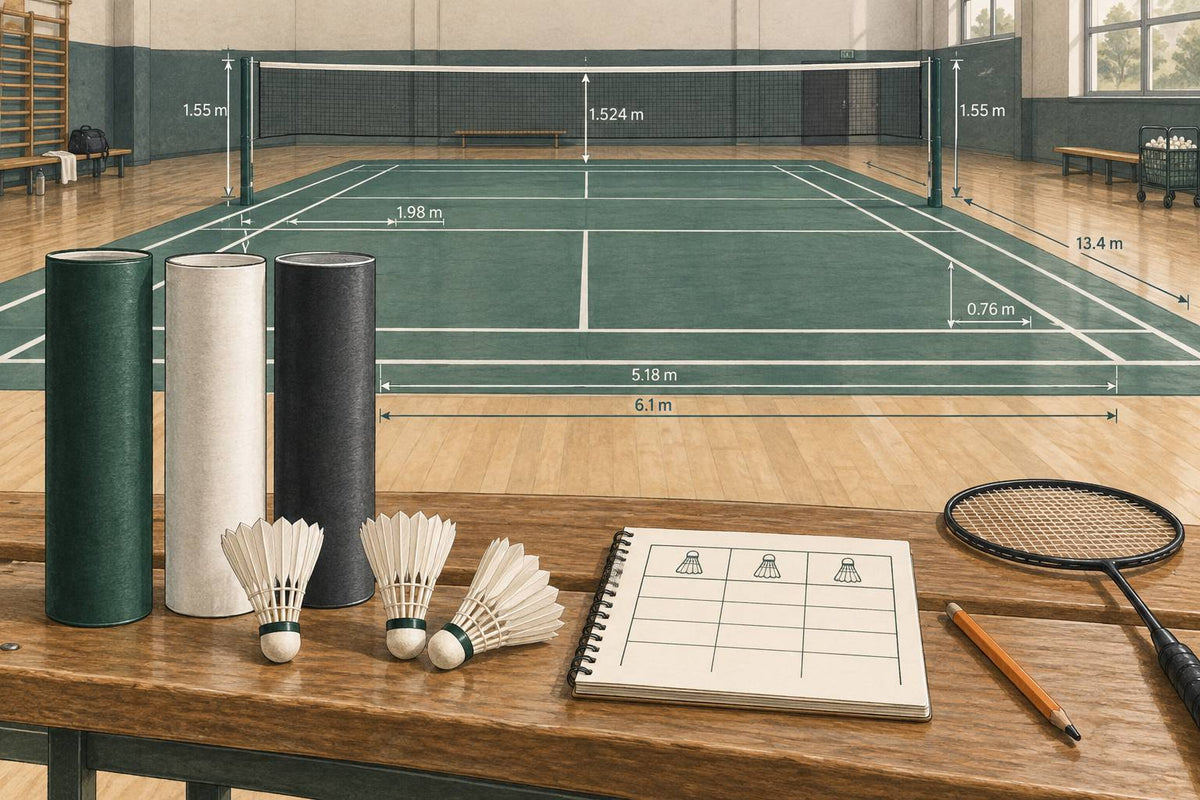
Do not start with a brand argument. Start with a test plan. Under the BWF Laws, a shuttle of correct speed, hit with a full underhand stroke from over the back boundary line, lands between 530 mm and 990 mm short of the opposite back boundary line. Clubs can adapt that test during warm-up to see whether a speed works in their hall. The official law is available in the BWF Laws of Badminton.
| Step | What to Do | Decision |
|---|---|---|
| 1. Define use | Separate league matches, open club nights, drills, and tournaments. | One club may need two grades, not one universal tube. |
| 2. Test speed | Try likely speeds on your actual courts with your players. | Choose the speed that lands deep without flying long. |
| 3. Compare grade | Track how many playable games each tube produces. | Buy based on cost per usable game, not cost per tube. |
| 4. Store properly | Keep tubes in a stable indoor space away from heat and extreme dryness. | Reduce brittleness before blaming the shuttle. |
Need club shuttles in Canada? Browse Badminton House shuttlecocks or contact us for help matching speed and grade to your courts.
What Specs Matter Most: Speed, Grade, and Cork?

For club buyers, three specs matter most: speed, feather grade, and cork feel. Speed decides whether the shuttle plays long or short. Grade affects consistency and durability. Cork affects contact feel and how the shuttle behaves on hard hits.
| Spec | What It Changes | Club Buying Note |
|---|---|---|
| Speed | How far the shuttle travels at your hall temperature and altitude. | Use the Canada shuttle speed guide as a starting point, then test locally. |
| Feather grade | Flight consistency, feather strength, and tube-to-tube reliability. | League players notice poor consistency faster than beginner groups. |
| Cork | Impact feel, rebound, and durability under smashes. | Full cork usually feels better; composite can be fine for budget training. |
| Storage | Feather brittleness and breakage rate. | Do not judge a shuttle after it sat in a freezing car or dry furnace room. |
Club buyers should avoid the trap of "tournament grade for everything." Use premium feather when the session requires it; use durable club-grade feather or nylon when the goal is volume, drills, or new-player access.
Free shipping on $200+ · Fast Canadian shipping
What Should You Check Before a Bulk Order?
- Run one normal club night with sample tubes. Do not test only with your strongest players or only during warm-up.
- Record the hall conditions. Temperature, humidity, and ventilation affect flight.
- Ask players about feel, not brand preference. "Too fast," "wobbles," and "breaks early" are useful notes.
- Track playable games per tube. A stronger shuttle can be cheaper if it lasts longer.
- Store the winning tube correctly. Bad storage can undo a good buying decision.
Once you choose a shuttle, create a reorder rule. For example: reorder when the club reaches four unopened tubes, or when a league block has three weeks left. Running out usually costs more than ordering one week early.
Club Feather Shuttlecock FAQ
What speed feather shuttlecock should a Canadian club buy?
Use local testing. Many Canadian halls land around common mid speeds, but altitude, heat, humidity, and ventilation can change the right choice. Calgary is not the same as Halifax.
Should clubs use one shuttle grade for every session?
Usually no. League matches may justify better feather, while beginner nights and feeding drills can use more durable or lower-cost options.
How should clubs store feather shuttles?
Keep tubes in a stable indoor space away from heat, freezing temperatures, and extreme dryness. Avoid leaving cases in cars or unheated storage rooms.
"The right club shuttle is the one that flies correctly in your hall and survives your level of play."
— Badminton House, Canada
Get Club Buying HelpCanadian badminton specialty shop · Club and team support · Free shipping on $200+

Leave a comment
This site is protected by hCaptcha and the hCaptcha Privacy Policy and Terms of Service apply.