
Last updated: July 2026 · Written by the team at Badminton House
Quick Answer: The Hourglass Badminton Court
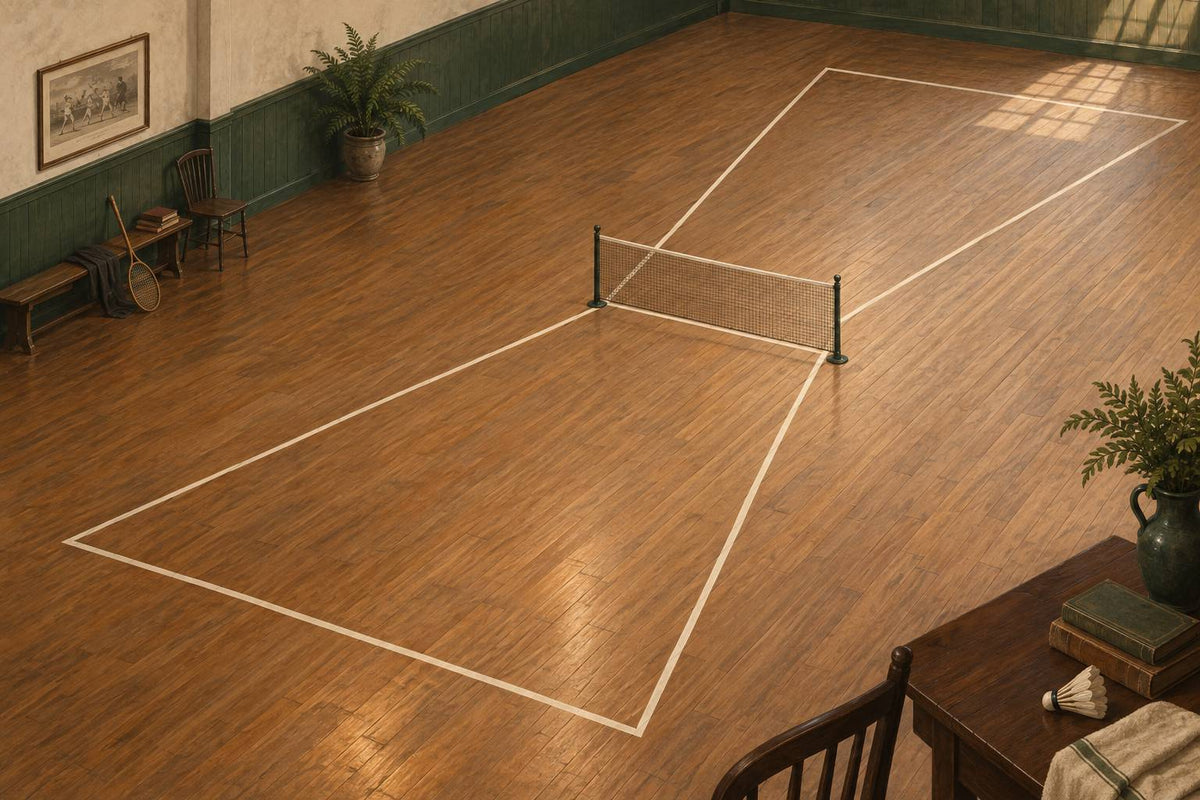
The clearest reading is a full-length court whose 20-foot width narrowed to a 16-foot net, then gave way to the rectangle.
Main account
The waist took a two-foot bite from each side; the North Hall at Badminton House offers the strongest venue explanation.
Counter-view
The 1873 Murree rules set posts 2½ feet inside for guy ropes; Jacobs doubts tapered side lines existed.
Transition
The law changed in 1901, with championship play moving to rectangular courts around 1901–02.
If you come across an old badminton diagram, do not mistake its pinched middle for a badly drawn modern court or an early singles layout. The hourglass badminton court was a recognized historical arrangement, although the narrowing was slighter than its dramatic name suggests.
The real interest is not simply that badminton once used a different outline. The court shows how a game shaped by individual rooms, improvised equipment, and varying local rules gradually acquired a uniform code. It also comes with a historical wrinkle: the familiar explanation for the waist is persuasive, but early rule diagrams leave room for a competing interpretation. Following that evidence explains both why the shape vanished and why the rectangular court that replaced it still contains lines and post positions that can look oddly arranged to modern players.
In This Guide
What the Hourglass Badminton Court Looked Like
The hourglass badminton court kept the familiar 20-by-44-foot overall footprint but narrowed to a 16-foot net at the centre. That difference pulled each side boundary inward by only 2 feet, creating a modest waist rather than the dramatically curved silhouette its name might suggest.

The outline is not merely a later reconstruction. A surviving photograph of Muriel Lucas’s home court is dated as probably pre-1901 because it shows the waisted court, while the first All England tournament in 1899 used hourglass courts with 16-foot nets and lines chalked onto the floor.
Today’s court retains the 44-by-20-foot doubles outline but carries the net across the full width; see Badminton Court Dimensions: Lines & Net Height for the modern layout.
Why the Court Narrowed at the Net
The traditional explanation begins in the North Hall at Badminton House. Two large doors opened inward at the middle of one wall, with projecting pillars beside them; a fireplace and more projecting pillars stood opposite. Narrowing the playing area through the middle kept play clear of those obstacles while people could still use the doors.
Around 1863, the earliest setup there was simply a string stretched from a front-door handle to the fireplace. As the improvised game developed, upright posts eventually replaced it, standing 16 feet apart and carrying the net. That room-based story offers a practical route from architecture to the court’s distinctive waist.
Surviving rules make the picture less certain, however. The 1873 Murree rules specified a rectangular 39-by-20-foot court, but placed each post 2½ feet inside the sidelines so guy ropes could reach the lines. This created central “nicks” without formally tapered boundaries. Historians therefore dispute whether every court described later as hourglass-shaped actually had sloping sidelines; some may simply have been rectangular courts pinched by inward-set posts.
Why the Hourglass Court Disappeared
The hourglass badminton court did not disappear simply because players preferred a rectangle. It was replaced as part of a larger effort to end inconsistent club rules. The Bath Badminton Club issued written rules in 1877, but court size, net height and other essentials still varied between clubs and locations.
In 1893, the national Badminton Association formed to bring uniformity to the game. Its laws changed to rectangular courts in 1901, and championship play followed at the turn of 1901–02. Standardization gave clubs and competitions one reproducible layout instead of a court adapted to each available room.
The transition was not instantaneous: waisted court diagrams remained in print as late as 1914. That overlap explains why old rulebooks can appear to contradict the official timeline. For the wider story of how competing local codes became a common rulebook, read The First Badminton Rules.
What the Rectangular Court Inherited
Standardisation left a rectangle with several inside-out-looking features. They belong to the geometry that followed the hourglass era, although none should be treated as a proven direct consequence of the old waist.
Old pinch → modern checklist
- Net: once narrower at the centre; now full court width.
- Posts: fixed on the doubles sidelines, even during singles.
- Singles: uses inner sidelines rather than moving the posts inward.
- Doubles: brings the outer tramlines into play.
- Serving: uses an inside rear line that applies only to doubles service.
The service markings were not created simply to make a serve clear the hourglass pinch. An early rectangular Nagpore court already had four service areas before the waisted layout, so service division predates that geometry rather than being explained by it.
For the complete modern layout, see the court dimensions and lines guide.
To connect the game’s changing courts with its most distinctive equipment, check live shuttlecock availability.
Which Court Should You Choose?
For actual play, the choice is straightforward: use the rectangular court. Choose the hourglass court only when recreating or interpreting an early version of badminton.
| Choice | Choose it when… |
|---|---|
| Rectangular court | You are playing, coaching, marking a floor or applying current rules. The net spans the full court width, and the posts sit on the doubles side lines for both singles and doubles. |
| Hourglass court | You are staging a historical demonstration or interpreting an old diagram, photograph or surviving floor marking. Its 20-foot width narrowed to a 16-foot net, unlike the standardized court adopted in 1901. |
If your goal is to lay out today’s lines correctly, use the modern court dimensions and lines guide rather than adapting the historical outline.
Get 10% off your first order
Join the Badminton House list and we’ll email you a 10% welcome code — plus training guides, technique advice, and badminton updates.
By subscribing, you agree to receive Badminton House emails and can unsubscribe anytime.
We play badminton, and we know that understanding the game’s past can sharpen how you see its rules today. If you have a question about court setup, equipment, or choosing gear for your game, contact us for practical advice.
From barrelled shuttles on chalked hourglass courts to modern play, the shuttle remains at the centre of badminton.
Explore Shuttlecocks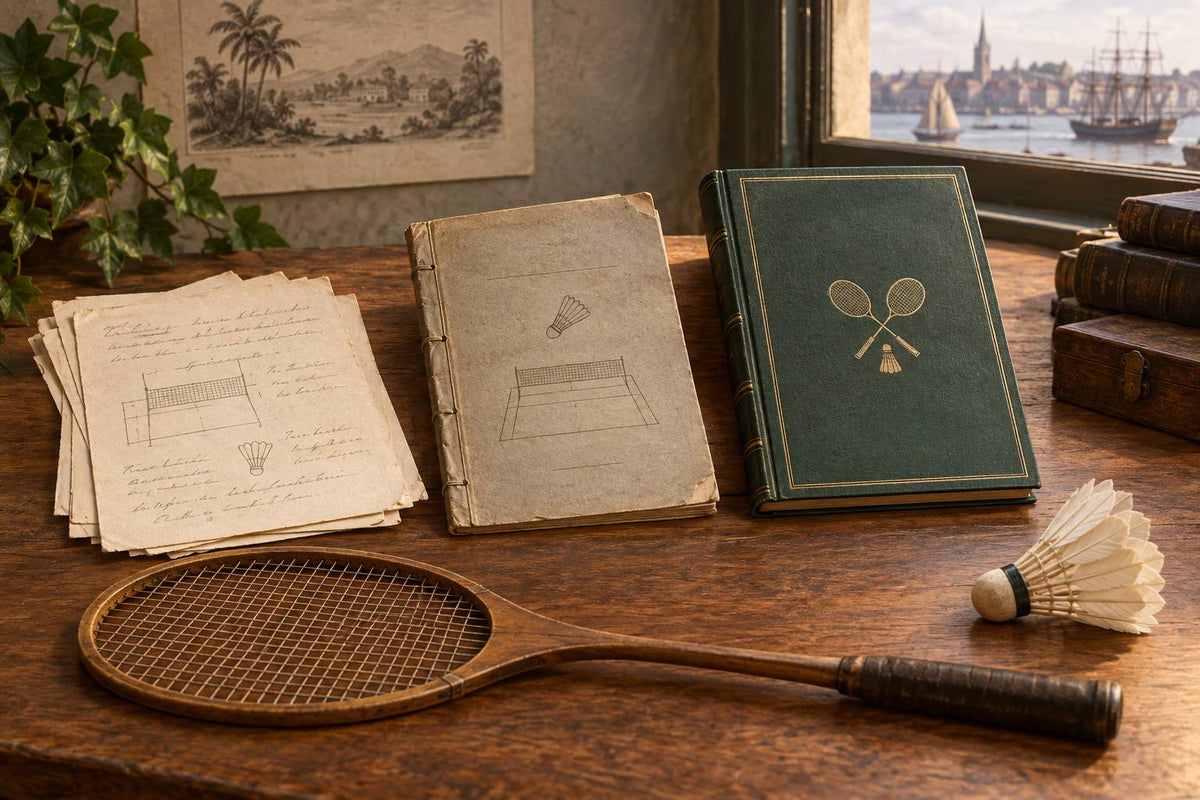

Leave a comment
This site is protected by hCaptcha and the hCaptcha Privacy Policy and Terms of Service apply.