
Last checked: August 2026 · Written by the player-led team at Badminton House
Quick answer
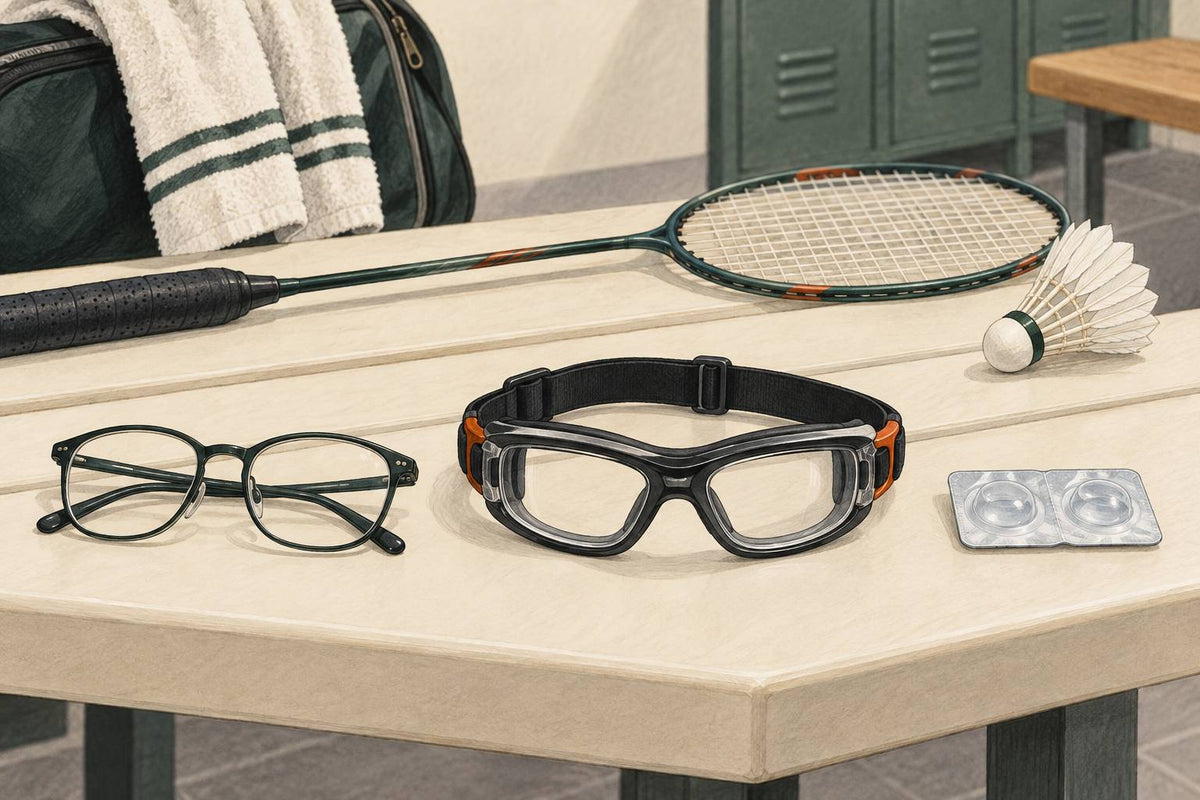
For most players who need vision correction, daily disposable soft contact lenses win on a badminton court: nothing fogs, nothing slips, and the shuttle stays inside a wide, undistorted field of view through every overhead exchange. Properly fitted sports frames with an anti-fog routine are the right choice when your eyes will not tolerate lenses. Everyday street glasses are the setup to move away from, and the routine below keeps them workable only until you sort out one of the other two options.
Related reading: Badminton Eye Injuries and Protective Eyewear — this guide is about seeing the shuttle well; that one covers injury risk and protection in depth.
Why everyday glasses struggle on court
Everyday glasses create three separate problems in badminton: they slide once you sweat, they fog between rallies, and their frame edge sits exactly where an overhead shuttle travels. They are fragile too: the American Academy of Ophthalmology warns that regular eyeglasses offer no proper protection and can make an injury worse if they shatter.
The slide is the problem you notice first. Office frames rest on the nose by gravity and friction, and both disappear when your face is wet and you are lunging, braking and jumping. By the second game most players are pushing their frames back up between points, and sports-vision guidance notes that glasses can come off the face entirely during dynamic movement. A frame that lands lens-down on a hard gym floor usually leaves the session scratched.
The vision problem is less obvious and matters more. A large share of badminton is played above your head: clears, drops and smashes all arrive from high positions, so your eyes spend rally after rally rotated upward while your chin points at the net. In that posture you are no longer looking through the middle of your lenses. You are looking through the top edge of the lens, or over the frame line itself, exactly where a spectacle lens corrects worst and where the frame blocks part of the flight path. Players describe losing the shuttle for a beat at the top of its arc; often the shuttle simply crossed the frame edge.
What proper sports frames fix
Sports frames solve retention and impact, and they reduce fogging without removing it. They carry shatter-resistant polycarbonate lenses, wrap closer to the head, and can be secured with an adjustable strap instead of temple arms, so a lunge or scissor jump does not move them. Anti-fog coatings and vented frames then manage the heat that builds up between rallies.
Certification is worth understanding before you buy. Racket-sport eye protectors are tested to the ASTM F3164 racket-sport standard, which took over the racket-sport requirements of the older F803 standard in 2019 and names racquetball, squash, tennis and pickleball in its scope. Badminton is not listed separately, so no badminton-specific certificate exists; the practical move is a prescription-ready protector tested to that racket-sport standard, with polycarbonate lenses, which the standard itself calls the most impact-resistant spectacle lens material.
Fogging still needs managing. Fog is condensation: warm, humid air from your face and breath meets the cooler lens surface and beads there. Sports frames attack this with anti-fog lens coatings, venting channels moulded into the frame, and fits that leave room for air to circulate behind the lens. All three help, and none is absolute. The moment you stop moving after a long rally, heat rises off your face and a hazy patch can still bloom in the lens while you prepare to receive serve.
The honest limit of sports frames is that they remain a frame. The lens sits further from your eye than a contact lens ever will, the edge of the carrier is still inside your visual field, and an overhead glance can still clip it. For players who cannot wear contacts they are a large upgrade over street glasses; they are still second best for pure shuttle tracking.
How contact lenses perform for shuttle tracking
Contact lenses remove the frame from the equation. The lens moves with your eye, so you always look through its optical centre, and the International Sports Vision Association credits contacts with roughly 15 percent more peripheral field than glasses. Nothing fogs when you sweat, and a soft lens stays put through jumps, lunges and overhead swings.
For badminton specifically, the overhead benefit is the decisive one. When your eyes rotate up to follow a high serve or a deep clear, the corrected zone travels with them. There is no frame line for the shuttle to cross, no edge distortion at the top of the arc, and no gap between where your head points and where your correction works. Doubles players also gain at the net, where a flat exchange happens at the edge of peripheral vision.
Lens type matters. Soft lenses are the sporting default because they cover more of the eye and dislodge far less readily than rigid gas-permeable lenses during hard changes of direction. Within soft lenses, daily disposables fit gym life best: ACUVUE's sports guidance points out that you open a fresh, clean pair for each session, there is no cleaning or storage routine afterwards, and a spare pair in the racket bag rescues the evening if a lens is lost or torn. Contacts also leave room for plain protective eyewear over the top if you want impact cover as well.
The trade-offs are real for some eyes. Long sessions in dry gym air can leave lenses feeling gritty, insertion takes practice and clean hands, and daily disposables carry a recurring cost that spectacles do not. If your eyes run dry or sensitive, book a fitting conversation with your optometrist before buying a season's supply; lens materials differ, and the right call is individual.
Glasses or contacts: the decision path
Choose by how often you play and how your eyes tolerate lenses. Daily disposable soft contacts suit most regular players; prescription sports frames suit players whose eyes reject lenses; everyday glasses deserve only a temporary, managed role. The comparison below covers the factors that actually decide rallies, followed by a short path you can act on this week.
| On-court factor | Everyday glasses | Sports frames | Soft contacts |
|---|---|---|---|
| Stability in lunges and jumps | Slide with sweat; can come off | Strap and close wrap hold firm | Move with the eye; stay put |
| Fogging between rallies | Fogs from sweat and breath | Coatings and vents reduce it | None |
| Overhead and peripheral view | Frame edge cuts the flight path | Bigger lens; frame still in view | Widest field; no frame at all |
| Behaviour on impact | Can shatter and worsen injury | Impact-rated polycarbonate | No barrier; add eyewear over top |
| Upkeep each session | Constant wiping and adjusting | Anti-fog top-ups; strap checks | Fresh daily pair; recurring cost |
- You play weekly or more and your eyes tolerate lenses: ask your optometrist about daily disposable soft lenses and trial them at one club night before committing to a supply.
- Your eyes run dry or sensitive, or lens handling is a hard no: order prescription sports frames with polycarbonate lenses and an anti-fog coating, and fit the strap before your first session.
- You want impact protection as well as clear vision: wear contacts under non-prescription protective eyewear, which combines the widest field of view with a rated barrier.
- You only own everyday glasses right now: treat them as a stopgap, use the routine in the next section, and start one of the paths above this month.
Playing in glasses anyway: a routine that works
Sometimes the fix has to wait, and plenty of adults arrive at a first drop-in wearing the glasses they wore to work. A short routine keeps them usable for a few weeks: anti-fog treatment before play, a strap to stop the slide, a frame that clears your brow, and a cloth within reach at every interval.
- Treat the lenses before the first rally. Wash them with mild soap so old skin oils do not smear, dry them fully, then apply an anti-fog spray or wipe on both sides.
- Add an eyewear strap and set the tension so the frame sits still on your nose without pressing at the temples. A snug strap reduces slipping, but does not turn ordinary glasses into certified sports eye protection.
- Prefer a frame that sits slightly off your face and clears your eyebrows. Air moving behind the lens slows fogging, and brow clearance opens up a sliver of the overhead view you otherwise lose.
- Build a wiping habit at intervals: towel your face first, then the lenses with a clean microfiber cloth. Wiping sweat before it reaches the lens beats polishing fog off it afterwards, the same logic that keeps your racket hand dry in our guide to grip slipping in sweaty gyms.
- Retire the arrangement once you are playing every week. The routine manages the symptoms; contacts or sports frames remove them.
Sort your setup before next session
Pick your lane now: book an optometrist visit to trial daily disposables, or order prescription sports frames with an anti-fog coating if lenses are out. Either path costs less than a season of lost rallies to fog and a frame edge. Then round out the rest of your bag with our starter equipment checklist so the only thing you think about on court is the shuttle.


Leave a comment
This site is protected by hCaptcha and the hCaptcha Privacy Policy and Terms of Service apply.