
Last checked: August 2026 · Written by the player-led team at Badminton House
Quick answer
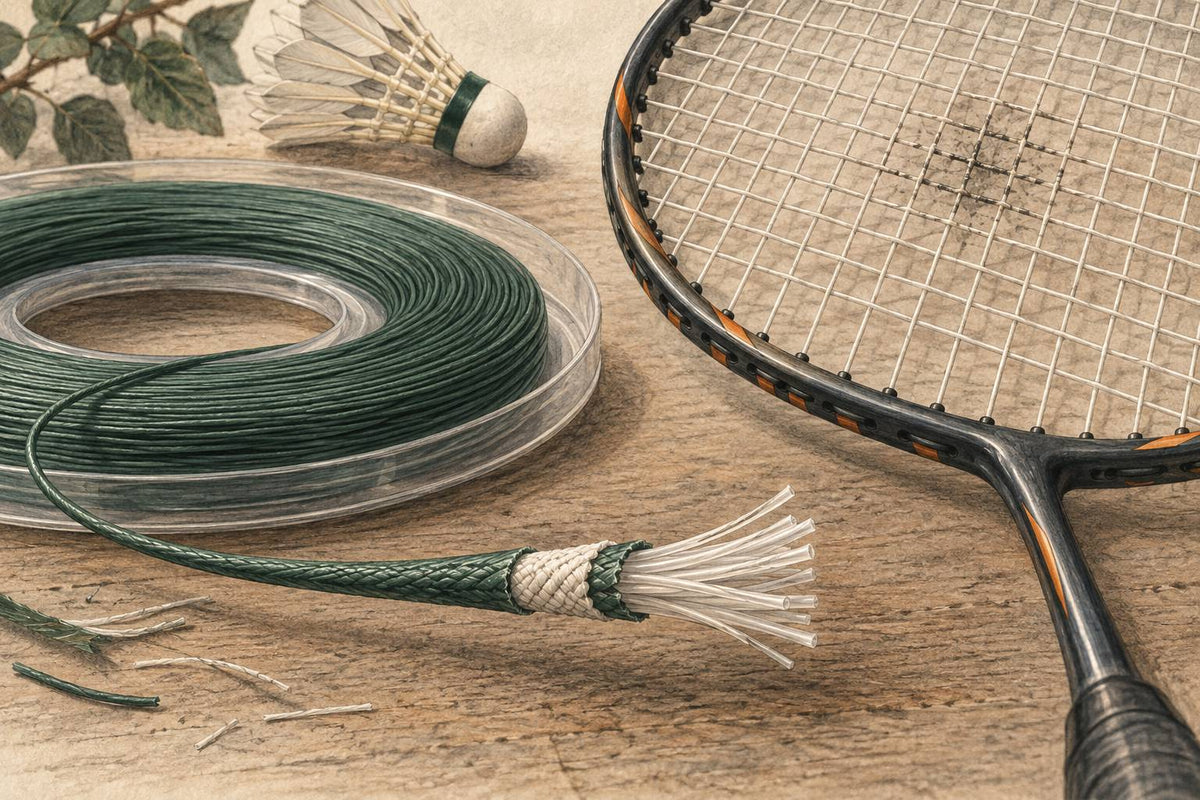
The coating is the thin outermost layer of a badminton string, sitting over a multifilament core and a braided wrap. Words like titanium and nano describe the compound in that layer. The attached promises cover feel, durability, and repulsion, and manufacturers almost never publish measurements behind them. The spec lines that predict your experience best are construction, gauge, and the maker's own category placement, and the coating is also the first layer to abrade where your strings cross.
Related reading: Badminton String Construction and Filament Types deals with what the core and filaments are made of; this guide focuses on the surface layer and its marketing.
What the coating layer actually is
The string examples below list three construction layers: a multifilament core, a braided outer wrap, and a surface coating. Manufacturers publish these as three spec lines. The coating is the thin outermost skin that touches the shuttle and the neighbouring strings, and it is the layer built to take abrasion first.
You can see this pattern on the following official spec pages. Yonex lists its BG65 Titanium as a high polymer nylon multifilament core, a special braided high polymer nylon outer, and a compound titanium hydride coating, at a gauge of 0.70 mm. Yonex BG65 Titanium spec page. Ashaway describes the same idea as a wear surface: its ZyMax TX is a polymer core encapsulated in a high-tenacity wear surface, then bonded with a textured coating on top.
The outer layers are also where durability design happens. Ashaway's stringing guidance notes that some strings carry two jackets or wear layers instead of the usual single one, and that a braided jacket outlasts a twisted one because the over-under weave locks fibres in place. A twisted jacket can begin unwinding as soon as the first fibre is breached, while a braided jacket stays intact for a while after a few fibres wear through.
The practical takeaway: when you pick up a string packet, find those three construction lines before you read any product name. They tell you what the string physically is. The name on the front mostly tells you what the coating compound is called this season.

What titanium and nano claims actually promise
Titanium and nano on a string packet name the coating compound rather than the whole string. Yonex lists a compound titanium hydride coating on BG65 Titanium and a compound cup-stack carbon nanotube coating on Nanogy 98. The attached promises are a sharper feel, better durability, tension retention, and quicker repulsion, and they are mostly unquantified.
Decoded claim by claim: the titanium compound is marketed for a sharp but comfortable feel at impact, with the string positioned for hard hitters and for durability with consistent tension. The nanotube coating sits on a string sold for quick repulsion and fast flat exchanges. Yonex Nanogy 98 spec page. Ashaway's textured coating claim is the most concrete of the group: the added surface texture is said to add stiffness and control on the shuttle.
Notice what is missing from all of these: numbers. No maker publishes coating thickness, coating mass, or a measured feel scale. Quantified claims do exist occasionally, and they show the other half of the problem. Yonex's launch note for its Forged Fiber string claims 24 percent better durability than conventional thin gauges and drives that land 7 cm deeper, but no test protocol or conditions appear alongside either number.
Sound sits in the same bucket. Marketing copy does promise acoustics, such as exhilarating impact sound in that same launch note, and many players genuinely enjoy a crisp hit. Treat sound and crispness as honest descriptions of preference, since no maker measures them as performance data. A string that sounds sharper is not documented anywhere as flying faster.
None of this makes coating claims fake. Coatings are real layers doing real work against abrasion, and the compounds differ between models. It means the words on the packet are positioning language, so the sensible reading is direction rather than magnitude: this model aims at feel, that one at durability.
How to read a string spec sheet
Read a string page in this order: construction lines, gauge, then the maker's category placement. Construction tells you where the marquee material actually sits. Gauge and category tell you the durability and feel tradeoff you will notice on court. The coating name comes last, because it is the least measurable part of the sheet.
The construction lines matter because the headline fibre is not always in the coating. Yonex BG80 lists Vectran blended into its multifilament core, under a braided oval nylon outer. A buyer who assumes every exotic material is a surface layer will misread sheets like that one. Two strings with the same coating story can be built very differently underneath.
Gauge and category are where manufacturers are most consistent. VICTOR's range runs from 0.63 mm, its thinnest string, up to 0.70 mm, and its own catalogue sorts them cleanly: the 0.70 and 0.69 mm models sit in the durability family, the 0.68 mm models are control-focused, and the 0.66 and 0.63 mm models sit in the high-resilience family. VICTOR LAB string guide. Yonex groups its lineup the same way into quick repulsion, control, and durability, with the durability shelf anchored by the 0.70 mm BG65 family.
That consistency is the useful signal. Whatever the coating is called, a thicker string is being sold to you as the durable option and a thinner one as the lively option, by every major maker at once. Coating chemistry adjusts feel at the margin; gauge and tension set the tradeoffs you can actually feel game to game. If you are still choosing a tension to pair with a new string, our string tension guide covers that decision separately.
Reading coating wear on your string bed
Coating wear shows first where strings cross. Every hit pounds the cross strings against the mains, and over time that string-on-string abrasion cuts through the outer jacket and into the core. Fuzz concentrated at the intersections indicates outer-fibre wear, but does not by itself show whether the core is exposed.
Ashaway's stringing guidance spells out the mechanism and the location: normal-wear breaks usually arrive on one of the central four main strings, within an inch or two of the racket head. Ashaway: why strings break. Mishits outside the sweet spot stress a less resilient section of string, which is why frame-edge breaks tell a different story about your timing than centre-bed breaks tell about wear.
What changes as the coating goes is not only breakage risk. An abraded string gradually loses resiliency, so an old bed feels duller and gives back less even before anything snaps. The manufacturer's own advice follows from that: restring before the degradation, because a newer string simply performs better than one you are nursing toward failure.
Reading your own bed takes thirty seconds under good light. Look across the bed at a shallow angle and check the intersections in front of the sweet spot. Surface gloss alone does not establish the condition of the coating. Whiskers of fuzz at the crossings indicate outer-fibre wear; they do not establish that the string is supported only by its core. On a braided jacket you get some grace after the first fuzz appears; on a twisted jacket the unwinding runs faster once it starts. If a string has already let go and you want to know what the break point says, see our guide to diagnosing string break locations.
Use this at the counter and at home
Buying: read the three construction lines, then the gauge, then the category shelf the maker puts the string on. Let the coating name break ties between two strings you already like, and treat feel and sound adjectives as flavour descriptions. A titanium or nano label on the packet is a description of the surface compound, and nothing about it changes the basic thickness tradeoff.
Maintaining: check the intersections in your hitting zone every few weeks. Fuzz at the crossings is a visible wear signal, though it does not measure coating loss or resiliency. Restringing on that signal, rather than after a mid-rally break, keeps the string bed behaving the way the spec sheet promised.
What manufacturers do not publish
- Coating thickness, coating mass, or per-layer wear rates for any model.
- A measurement method behind feel, crispness, or impact-sound claims.
- Test protocols for the occasional quantified claim, so treat those numbers as internal comparisons rather than lab results.


Leave a comment
This site is protected by hCaptcha and the hCaptcha Privacy Policy and Terms of Service apply.