
Last checked: August 2026 · Written by the player-led team at Badminton House
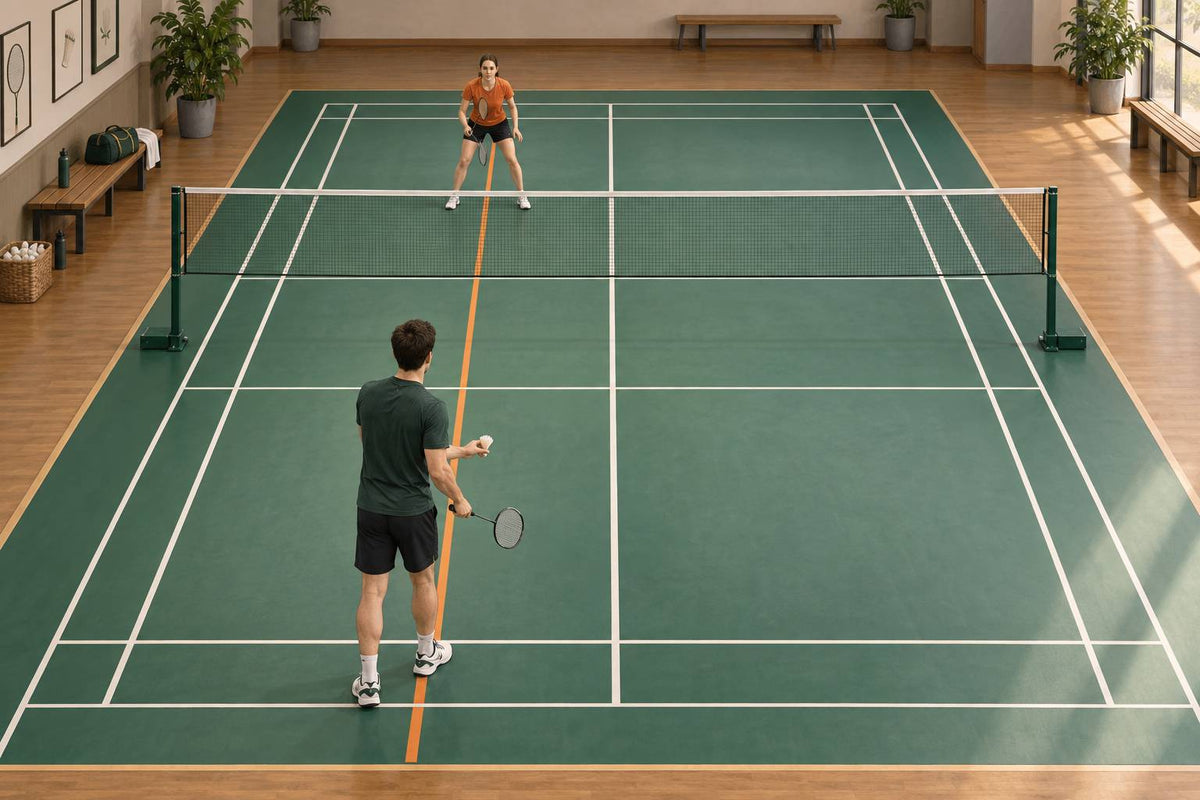
Half-court singles narrows a full court to one lengthways channel, from a side line to the centre line, so both players lose all their cross-court width. With no angle to escape into, a rally survives only on straight length, disguise and a shot that consistently clears or drops dead straight.
Related reading: Badminton practice session plan — use half-court singles as the game-like finish once your drill blocks are done.
Set the channel, then see which fault it exposes
Mark one lengthways channel from a side line to the centre line, using the full 13.40 m length of the court, and play normal singles scoring inside it. Anything that lands outside the channel, in the net, or on the far side of the centre line from your channel is out, so a weak straight shot gets attacked immediately.
Split a full doubles-width court lengthways at the centre line: under the BWF Laws of Badminton, a full court runs 13.40 m long and at least 6.1 m wide between the doubles side lines, so each channel comes out at roughly 3.05 m wide. Every line is part of the area it marks, so a shuttle that lands on the shared centre line or your outer side line counts as in, not out.
For this house game, agree a straight service into the opposite end of the channel, with one serve per turn and a point on every rally; first to the target score wins. This is a Badminton House training design, not an official format, built on a real coaching principle: restrict a shot or a court area while scoring continues as normal. BWF's own coach education material uses that method to isolate one return of serve at a time; half-court singles applies it to the whole channel. With no cross-court escape, a weak straight clear or a lazy straight drop gets found and punished within a few rallies instead of staying hidden in open play.

Run the three-step width progression
Progress the channel in three stages, and only widen once both players are sustaining controlled straight rallies: full half-court against half-court, then a handicap game with the stronger player kept in the half-court channel against a weaker player using the whole court, then a wider two-thirds-width channel for both.
- Step 1 — half-court vs half-court, to 11. Keep the full restriction from above. Stay here until both players hold a rally of ten shots or more without drifting wide; that is the bar before you widen anything.
- Step 2 — handicap game, to 7. The stronger player stays locked in the half-court channel; the weaker player gets the whole court. The stronger player builds every point on pace and placement alone, while the weaker player develops attacking width without being outgunned.
- Step 3 — two-thirds width, to 11. Widen both channels to roughly two-thirds of the court, easing the constraint enough to bridge back toward full singles while still cutting off the wide angles that let a weak length go unpunished.
Do not skip a step just because a session feels slow: BWF coach education guidance on progressive practices is to build from simple to complex and slow to fast, and not to advance players until they are reasonably competent at the level they are on. Games to 7 instead of 21 follow the same idea: BWF's own coach education material runs shortened games, as short as five points, to keep focus on one pattern rather than a full match.
Add variations, including the mid-court drive game
Once the width progression is solid, swap in a targeted variation for one game at a time rather than running all of them together: straight-line-only rallies, one permitted cross-court shot per rally, a single banned shot, clears-and-net-shots-only, or a flat mid-court drive game.
- Straight-line only: every shot must travel dead straight down the channel; any angle is out. Sharpens pure straight accuracy.
- One cross-court shot per rally: each player may go cross-court exactly once; every other shot stays straight. Trains disguise and shot selection over repetition.
- One shot type banned: remove the lift, the drop, or the clear for a game, and force players to solve the same problem with a narrower toolkit.
- Clears and net shots only: ban drives and smashes for a game, so every rally lives at the front or the back and nowhere in between.
For a mid-court variant, place the players around their short service lines and exchange continuous flat drives. Agree a landing target on each side before starting, keeping the shuttle near net height and inside the channel. The short service line is a real marked line under the Laws, even though this drive game, like the others above, is a Badminton House design rather than an official format.
Every variation here, and the progression before it, runs in the same channel as the three shot-restricted games in Half-Court Badminton Singles: The Placement Game. Alternate between the two articles' formats so the same court time keeps testing a different fault.
Fix failure modes and share one court
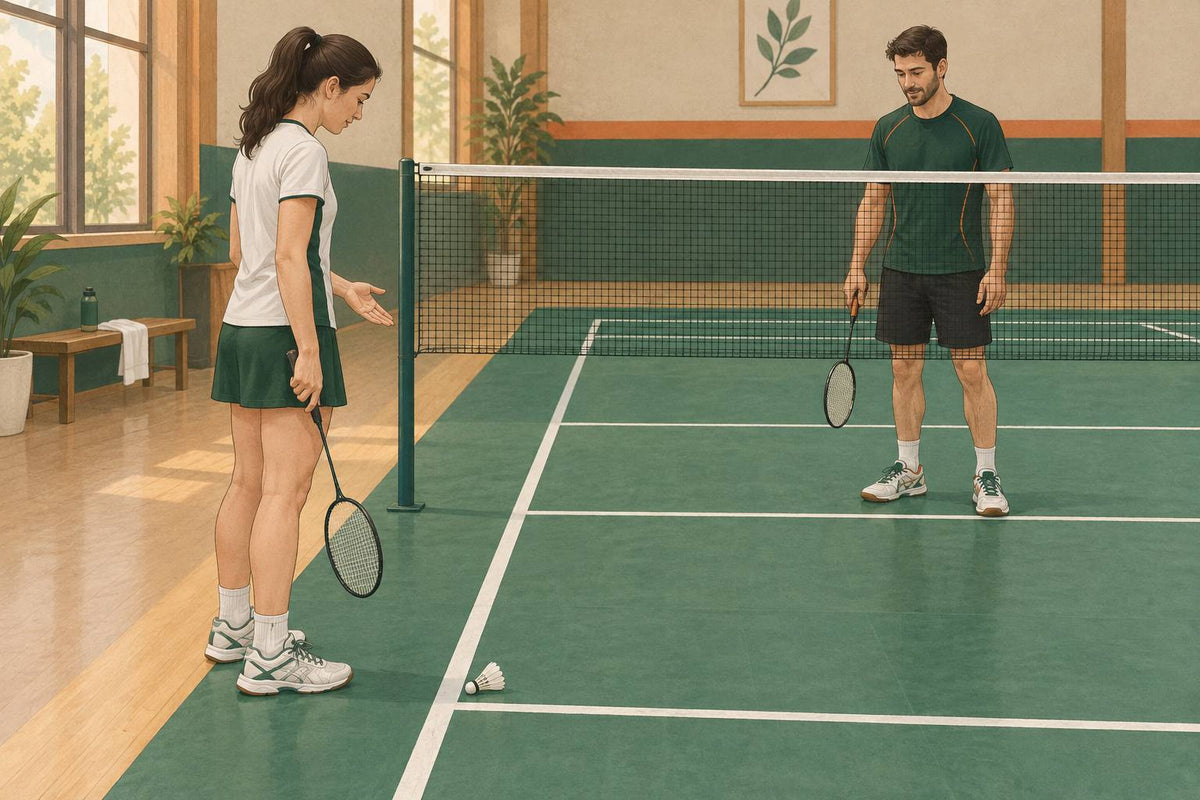
Three problems repeat in half-court singles: players drifting wide of the channel without noticing, rallies collapsing into safe lift-only exchanges, and arguments over exactly where the line sits. A cone on the channel edge, a ban on the lift, and treating every touched line as in solve all three.
Mark the channel with a cone or a strip of tape at the centre line and the outer side line before anyone serves; without a visible edge, players drift wide within a few rallies. Once both players can hold the base game cleanly, ban the lift for one round: it removes the easy defensive reset that turns half-court singles into a lift-only stalemate. For the shared centre line, apply the rule established above: any touch on the line counts as in, called for whichever game is rallying at the time, never as a fault.
Two half-court games run side by side on one full court, so a club with more players than courts gets four people playing at once instead of two waiting. That is the kind of game-like finish a structured session calls for once your drill blocks are done; see the badminton practice session plan for where this fits alongside your other blocks. Agree the shared-line call out loud before the first serve, and keep a half-step of space near the centre line between rallies, since a stray shuttle from the next game is the only real hazard of sharing a court this way.
Run it this session
- Tape or agree the channel boundary, then start with half-court vs half-court to 11.
- Add the handicap step (half-court vs full-court, to 7) once both players hold a straight rally.
- Widen to two-thirds width, then try one variation, such as the mid-court drive game, for a single game rather than a whole session.
- Agree the shared centre-line call and mark the channel edge out loud before the first serve.


Leave a comment
This site is protected by hCaptcha and the hCaptcha Privacy Policy and Terms of Service apply.