

Last checked: August 2026 · Written by the Badminton House player-led team.
Quick answer: how do you make a high school badminton team?
Show repeatable serves and returns, balanced movement, useful doubles communication, steady effort and an immediate response to feedback. Ask your school for the actual selection criteria.
A tryout is not a hardest-smash contest. In limited court time, a coach needs to see what you can repeat, how you move after the shot, whether a partner can play safely with you and what happens when an instruction changes.
The exact process belongs to your school: team size, grades, attendance, singles and doubles needs, equipment and selection dates can all differ. Confirm those details first. Then use the plan below to make your current game easy to evaluate.
What should you show during badminton tryouts?
Show the basics before the spectacular shots. A legal serve that starts the rally, a return with direction, a clear or lift that creates time and a recovery step after contact give the coach several useful observations. One winner cannot hide repeated late preparation.
| Area | Visible evidence | Avoid |
|---|---|---|
| Serve | Consistent legal start and chosen target | Changing technique after every miss |
| Rally | Controlled clear, lift, drive or net exchange | Trying to finish every second shot |
| Movement | Ready position, first step, balanced arrival and recovery | Watching the last shot while standing still |
| Doubles | Clear calls, safe racket spacing and rotation | Taking a partner's shuttle without warning |
| Coachability | Listen, restate the task and try the change | Explaining every error before trying again |
Treat every rotation as part of the evaluation. Collect shuttles when asked, keep them away from active feet, thank partners and move promptly to the next station. These habits do not replace playing skill, but they let the coach see that the group can train safely.
How should you prepare during the final seven days?
The final week is for making your current skills dependable, not rebuilding every stroke. Keep practice controlled enough that you arrive fresh. If your school has already given a format, rehearse that format rather than guessing from this example.
- Days 7–6: check ten short serves and ten high serves, then practise a simple return to each side.
- Days 5–4: use controlled clear, lift, net and drive exchanges. Count repeatable contacts, not winners.
- Day 3: play short singles and doubles games. Recover after every shot and use one clear partner call.
- Day 2: rehearse the warm up, shoes, racket and arrival routine. Keep hitting easy.
- Day 1: rest or move lightly, pack and confirm the time and gym entrance.
If you have no court, shadow one movement pattern at a time and finish balanced. Do not use the hallway for fast lunges or overhead swings. A club or lesson can provide structured preparation; see our Canadian junior badminton pathway for the broader route beyond one school tryout.
How can you stand out in doubles?
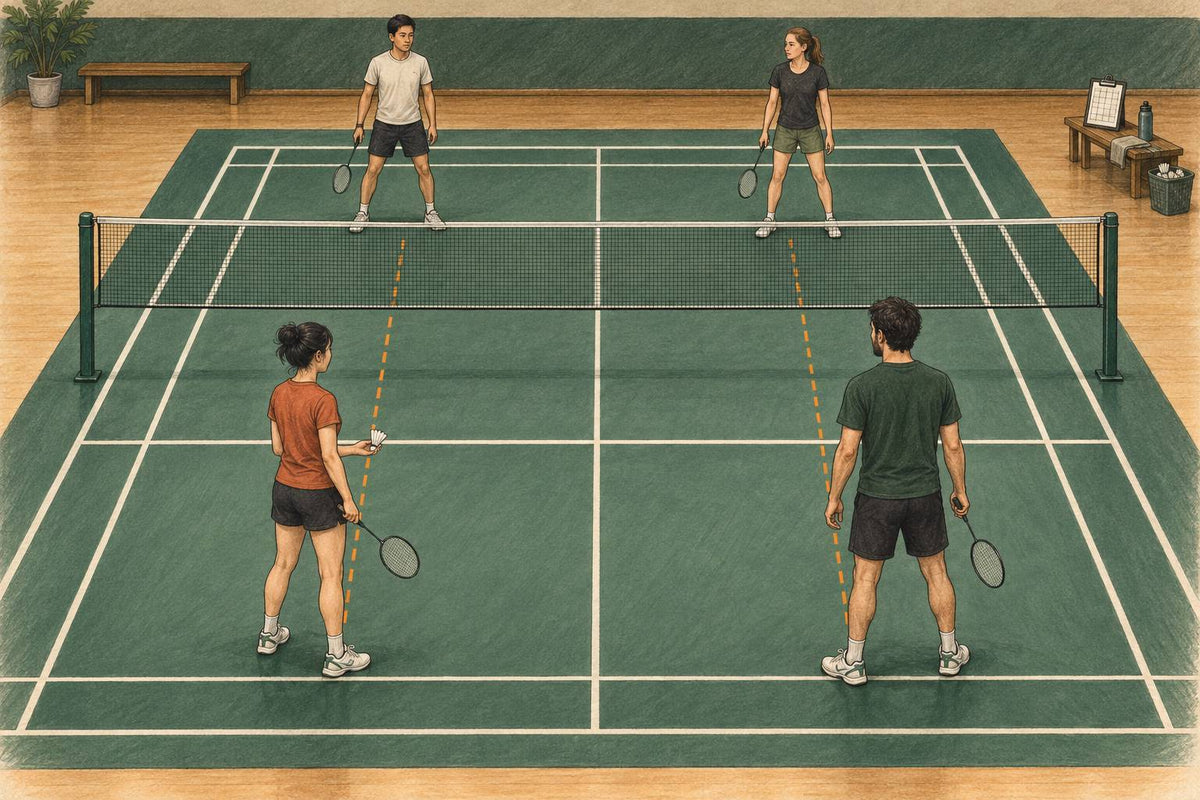
Make your partner more certain. Call “mine” early when the shuttle is clearly yours, yield when it is clearly theirs and avoid swinging through shared space after a late call. After serving, prepare for the next shot instead of admiring the serve. After lifting, recover with enough room for both players to see the shuttle.
Do not try to prove range by taking every shuttle. Useful doubles play includes leaving the right one, covering an open space and resetting after confusion. Between rallies, use one neutral sentence—“I’ll take the middle forehand” or “call earlier”—rather than assigning blame.
A coach may need a reliable partner for several combinations, not only the strongest singles scorer. Show that you can change roles, follow the stated service order and compete with the same effort beside different players.
Why do Canadian school requirements differ?
School Sport Canada identifies itself as the national body for school sport and describes member provincial and territorial federations and associations. From that structure, the practical inference is that eligibility and championship pathways must be checked through your own jurisdiction and school—not imported from a different province.
For example, the current OFSAA badminton regulations page publishes Ontario championship-specific information, including high-school and open singles classifications. The SHSAA badminton page separately provides Saskatchewan policy and championship material.
Neither source supplies a national coach’s tryout scorecard. Ask your athletic director which body governs the team, whether there are grade or eligibility rules, and what follows school selection. That question is more reliable than assuming a tournament classification determines who makes a local roster.
What should you do on tryout day?
Arrive early enough to find the gym, change and hear instructions. Bring clean non-marking indoor shoes, water and a safe racket. Tell the coach before play about any participation limit that needs accommodation; do not wait for a drill to expose it.
- Warm up progressively and keep maximum shots for the instructed activity.
- When a rule is unclear, ask one short question before the feed begins.
- After an error, recover position and show the next decision.
- Maintain effort through less-preferred partners and stations.
- Thank the coach and ask when and how results will be communicated.
If you are not selected, ask for one or two observable priorities and where you can keep playing. A cut is a roster decision for that team and date, not a permanent badminton level. Our school-team equipment guide for Canada can help with the practical setup once you know the next opportunity.
You cannot control the number of places or the coach’s needs. You can make your game legible: start rallies legally, move under control, communicate, accept feedback and repeat your best current skills when the court gets busy.


Leave a comment
This site is protected by hCaptcha and the hCaptcha Privacy Policy and Terms of Service apply.