
Last checked: August 2026 · Written by the Badminton House player-led team.
Quick answer: where did badminton come from?
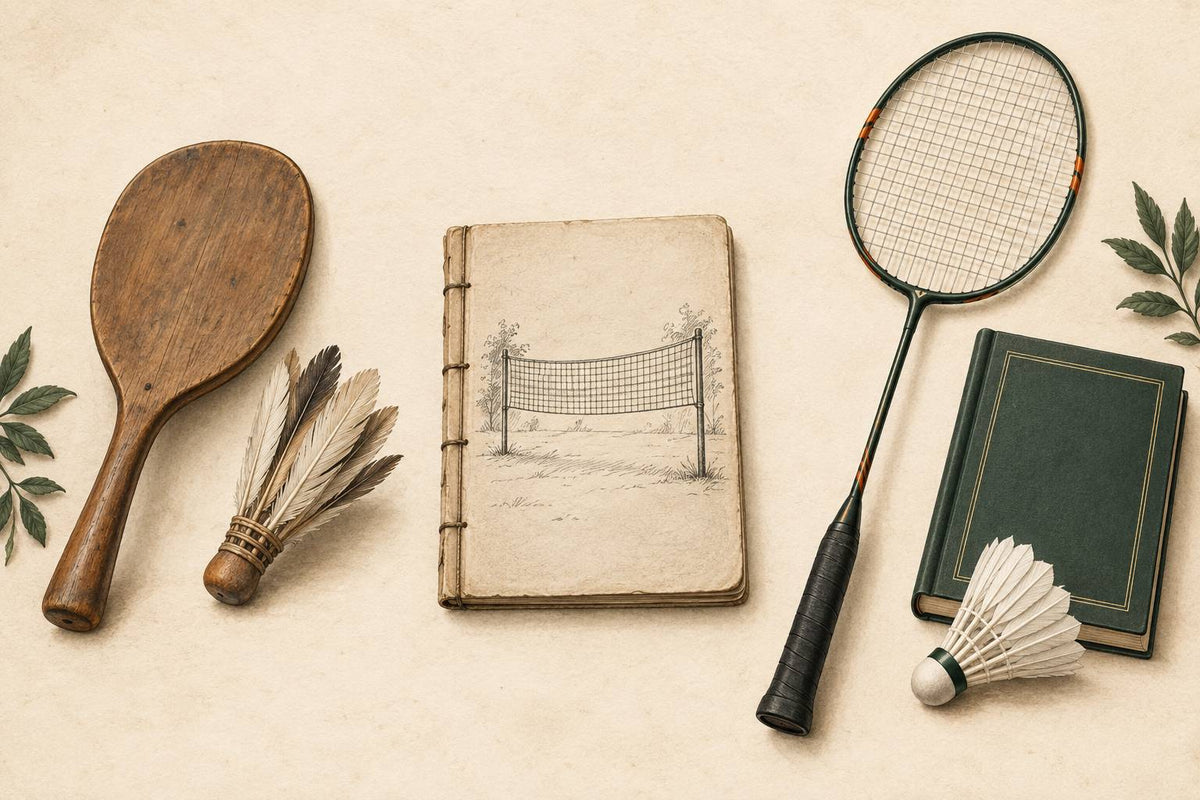
Badminton grew from the older cooperative game of battledore and shuttlecock. A competitive net game emerged during the nineteenth century, and clubs developed different local versions. In 1893, representatives of nine clubs formed the Badminton Association and agreed a common English rule code.
The clearest history of badminton separates three developments: the old bat-and-shuttle pastime, the competitive game played across a net, and the written rules that allowed clubs to meet on equal terms. Surviving evidence supports a gradual evolution. It does not establish one certain inventor, one first rally, or the familiar story of a single rainy afternoon.
| Date | What the evidence shows | Why it matters |
|---|---|---|
| 1830 | A battledore at Badminton House records a keep-up rally. | It proves the older pastime was played there. |
| 1860s–1870s | Net-based badminton appears in the historical record. | The pastime becomes a competitive game. |
| 1893 | Nine clubs form the Badminton Association. | A shared code replaces incompatible local rules. |
What was played before modern badminton?
Battledore and shuttlecock was generally a cooperative keep-up game. Players used small solid bats, called battledores, to return a feathered shuttle and count consecutive hits. The aim was to extend the exchange rather than force an opponent to miss. There was usually no net, marked court, or score based on winning rallies.
That older game supplied badminton with its central problem: control a light, high-drag projectile with a handheld implement. The Badminton Museum's battledore history describes players deliberately returning the shuttle toward one another and records counting feats that could last hundreds or thousands of strokes.
One surviving battledore connects that pastime to the Gloucestershire estate later associated with the sport's name. A handwritten note on the bat records a rally with Lady Somerset on January 12, 1830. This is valuable evidence that battledore and shuttlecock was played at Badminton House by that date. It is not evidence that the modern net game had already been invented there.
The distinction matters because the two activities reward opposite intentions. Battledore players cooperate to keep the shuttle up; badminton opponents use height, pace, direction and deception to make a legal return difficult. Adding a net and opposing sides changed a shared feat of control into a contest.
For a closer look at the older pastime, read our guide to battledore and shuttlecock.
When did the competitive net game appear?
The recognizable net game emerged during the nineteenth century rather than on one securely documented day. By placing a line, string or net between opposing sides, players created territory and a clear way to win an exchange. Written accounts and early rules from the 1870s show that this competitive form was developing, while the Badminton Museum documents the game being played in England by 1863.
A popular origin story places guests inside Badminton House during rain and says they stretched a string across a hall. It is memorable, but the surviving record cannot prove that scene was the single invention moment. Contemporary evidence instead points to related games, changing names and rules, and movement between British India and England.
The detailed World Badminton chronology of sources from 1873 to 1893 treats the legends cautiously. Its useful lesson is that reports closest to the period do not produce one simple inventor. They show people adapting an existing shuttle game into several net-game versions before one code became dominant.
The Badminton House association still mattered. It gave the developing game a memorable English name and became part of how it was described. A name, however, is not the same as a complete invention claim. The equipment had older roots, net games were played in more than one place, and the rules continued changing long after the name appeared.
Why is 1893 the key rules date?
The importance of 1893 is standardization, not invention. Clubs already played badminton, but they did not necessarily use the same court dimensions, net height or local laws. That made inter-club matches difficult: a visitor could arrive expecting a materially different game.
On September 13, 1893, representatives met at Dunbar in Southsea. According to the Badminton Museum's account of the first association, nine clubs were represented. They formed the Badminton Association, framed rules for the organization, and discussed and decided rules for the game.
A common code made comparison possible. Clubs could train for the same boundaries, net and scoring expectations, while organizers could build events around one published reference. Later administrators revised those laws many times, but the association meeting marks the point when regional variety gave way to coordinated governance in England.
This is also why an early rulebook matters more than a colourful invention tale. A sport becomes portable when strangers can reproduce it from shared instructions. Equipment dimensions, faults, service order and court lines turn a local custom into a game that can be taught and contested elsewhere.
Continue with our separate history of the first badminton rules for the path through Poona, Bath and Portsmouth.
How different was early badminton equipment?
One surviving example makes the difference concrete. A Badminton Museum shuttle from about the 1860s has a leather base, 28 feathers and a mass of 11.3 grams. The museum notes that it is just over twice the weight of a modern shuttle.
That object is evidence of one historical design, not a single prototype from which all later shuttlecocks descended.
For a separate explanation of shuttlecock flight, read our guide to shuttlecock aerodynamics and spin.
What is the evidence-led origin story?
Badminton is best understood as a chain of adaptations. Battledore and shuttlecock supplied a long-established bat-and-shuttle activity. Nineteenth-century players turned related games into competition across a net. Clubs experimented with different courts and laws. The 1893 association then supplied a shared code that made organized play more consistent.
- Keep what is documented: the 1830 Badminton House rally record, nineteenth-century net play, and the nine-club meeting in 1893.
- Qualify what is uncertain: no surviving evidence identifies one undisputed inventor or proves one dramatic invention scene.
- Separate milestones: an old pastime, a named competitive game and a common rulebook are related but not the same event.



Leave a comment
This site is protected by hCaptcha and the hCaptcha Privacy Policy and Terms of Service apply.