
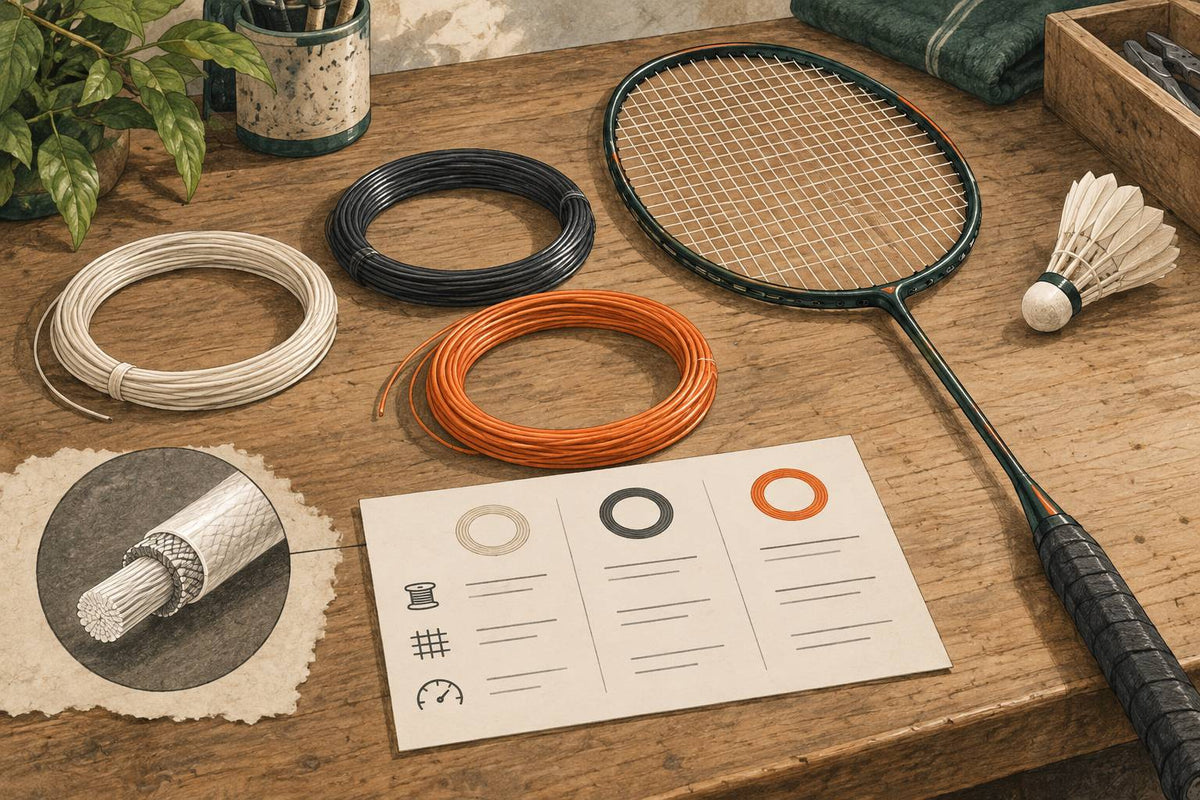
Last updated: August 2026 · Ratings taken from Yonex’s published string charts · Badminton House
Quick answer
Three starting options are BG65 for a durability-focused setup, Exbolt 65 for an all-round comparison, and BG80 Power for players who prefer its attacking response.
Gauge is not a durability ranking. Yonex gives Exbolt 68 at 0.68 mm a higher durability rating than BG65 at 0.70 mm; that rating is not a measured lifespan.
In this guide
Eight Common Yonex Strings in One Table
These eight strings use four selected ratings from Yonex’s 2026 catalogue, printed pages 64–65 and 68. Higher numbers indicate the manufacturer’s rating for that attribute, not a universal performance score or measured string life.
| String | Gauge | Repulsion | Durability | Sound | Control |
|---|---|---|---|---|---|
| BG65 | 0.70 | 7 | 10 | 6 | 6 |
| BG65 Titanium | 0.70 | 7 | 7 | 7 | 6 |
| BG80 | 0.68 | 8 | 6 | 7 | 6 |
| BG80 Power | 0.68 | 9 | 7 | 7 | 6 |
| Exbolt 63 | 0.63 | 11 | 7 | 10 | 10 |
| Exbolt 65 | 0.65 | 10 | 8 | 9 | 10 |
| Exbolt 68 | 0.68 | 9 | 11 | 8 | 10 |
| BG66 Ultimax | 0.65 | 10 | 6 | 10 | 10 |
The durability column does not follow gauge order: Exbolt 68 rates above BG65, and Exbolt 65 above BG80. Construction and coating also matter, while contact, tension, grommet condition and play affect actual breakage.
Head-to-Head Comparisons
BG65 vs Exbolt 65
Exbolt 65 is worth comparing for an all-round setup. It has lower rated durability than BG65 but higher repulsion, control and sound ratings. Those numbers do not establish how long either string will last for you or guarantee that you will prefer its feel.
BG65 vs BG65 Titanium
Titanium is a different option, not an automatic upgrade. Both are 0.70 mm and both have repulsion 7; Titanium has sound 7 rather than 6, and durability 7 rather than 10. The original table already shows this equal repulsion rating.
BG80 vs Exbolt 65
Exbolt 65 has higher ratings in all four columns shown. BG80 remains a distinct choice for players who prefer its firm, textured feel. A manufacturer’s control score cannot decide which response suits your strokes.
BG80 vs BG80 Power
BG80 Power has higher rated repulsion and durability than BG80. Both are 0.68 mm; Power rates 9 versus 8 for repulsion and 7 versus 6 for durability. This comparison does not guarantee longer string life.
Exbolt 68 vs BG65
Exbolt 68 has the highest durability rating in this table. Its 11 compares with BG65’s 10, alongside higher repulsion and control ratings. Compare the complete setup and the stringing quote before changing.
Exbolt 63 vs Exbolt 65
Exbolt 63 and 65 emphasize different attributes. The table gives 63 higher repulsion and sound, 65 higher durability, and both control 10. Use these ratings to choose a trial, rather than to predict exactly how either will play or last.
Is BG65 good for smashing?
You can smash effectively with BG65. Its repulsion rating is lower than the other options shown, but racket-head speed, contact and timing still matter. BG80 Power or Exbolt 63 are alternatives to compare if you want a different response.

What Gauge Actually Does
The eight strings above range from 0.63 to 0.70 mm; other products extend beyond this selection. Gauge affects the string’s dimensions, but construction and the complete setup also influence feel and durability.
| Gauge | Character | Suits |
|---|---|---|
| 0.58–0.63 mm | Fine-gauge options often emphasize response; actual feel and life depend on construction and setup. | Advanced players who restring often and want every bit of feel. |
| 0.65–0.66 mm | A common range for all-round comparisons; check the individual string. | Most competitive club players. Start here. |
| 0.68–0.70 mm | Thicker options often target durability, but compare construction and ratings too. | Beginners, string breakers, and anyone playing on nylon shuttles. |
If your club uses nylon shuttles, assess the string with those shuttles and stay within the exact frame’s guidance. A universal 2–3 lb reduction or claim that thin strings cannot survive nylon is not a reliable rule.
Victor and Li-Ning Strings
Victor and Li-Ning offer alternatives; compare their own specifications and the stringing quote.
| String | Gauge | Closest Yonex equivalent |
|---|---|---|
| Victor VBS-63 | 0.63 mm | Exbolt 63 — repulsion-first, short life |
| Victor VBS-66 Nano | 0.66 mm | BG66 Ultimax — the all-round performance choice |
| Victor VBS-70 | 0.70 mm | BG65 — the durable club default |
| Li-Ning No.1 | 0.65 mm | Exbolt 65 — balanced all-rounder |
| Li-Ning N65 | 0.65 mm | Exbolt 65 — high repulsion with decent durability |
| Li-Ning No.7 | 0.70 mm | BG65 — durability first |
Note that ratings are not comparable across brands — each publishes its own scale. Use these as a starting point, not an equivalence.
Pick by How You Play
| If this is you | String | Why |
|---|---|---|
| You break strings every few weeks | BG65, or Exbolt 68 | Both have high durability ratings; compare your actual breakage and preferred response. |
| You want one string for everything | Exbolt 65 | The most balanced ratings in the range. |
| You want the biggest smash | BG80 Power or Exbolt 63 | Higher-repulsion options with different feel and durability ratings. |
| You play front court and slice a lot | Aerobite | Coated mains grip the shuttle on cuts and tight net shots. |
| You are new and unsure | BG65 at a suitable starting tension | Cheap, durable, and a fair reference point to judge everything else against. |
| Your club uses nylon shuttles | BG65 or Exbolt 68 | Assess durability with your club’s shuttles and stay within the frame’s guidance. |
Common Questions
What is the most durable badminton string?
Exbolt 68 has durability 11 in the cited Yonex catalogue; BG65 has 10. These manufacturer ratings do not establish a fixed lifespan or account for every string on the market.
Is Exbolt 65 durable?
Reasonably. Yonex rates it 8 — better than BG80 (6) and BG66 Ultimax (6), below BG65 (10) and Exbolt 68 (11). For a 0.65 mm string that is a strong result.
Does a thicker string last longer?
Not reliably from gauge alone. The table’s durability ratings for Exbolt 68 and Exbolt 65 exceed those of thicker BG65 and BG80 respectively, but your actual string life depends on the setup and use.
Which string should a beginner use?
BG65 is a useful durable reference option. Choose a starting tension with the stringer that suits your contact and the exact frame’s guidance; no single tension fits every beginner.
How often should I change strings?
Inspect the stringbed regularly for notching, fraying and a response that no longer suits your play. A calendar rule based on weekly sessions is only a rough planning aid, not a replacement for condition checks.
Does the string matter more than the racket?
Changing string and tension can be a practical way to adjust a racket you already own. It does not always matter more than the frame; change one variable at a time so you can assess the difference.
Want a recommendation for your racket? Tell us your frame, level and whether you play feather or nylon through our stringing service, and we will suggest a string and a starting tension.
Next, pick the tension — see our string tension guide. For the three most-compared Yonex strings in detail, see BG65 vs BG66 Ultimax vs Aerobite.

Leave a comment
This site is protected by hCaptcha and the hCaptcha Privacy Policy and Terms of Service apply.