
Last updated: August 2026 · Ratings taken from Yonex’s published string charts · Badminton House
Quick answer
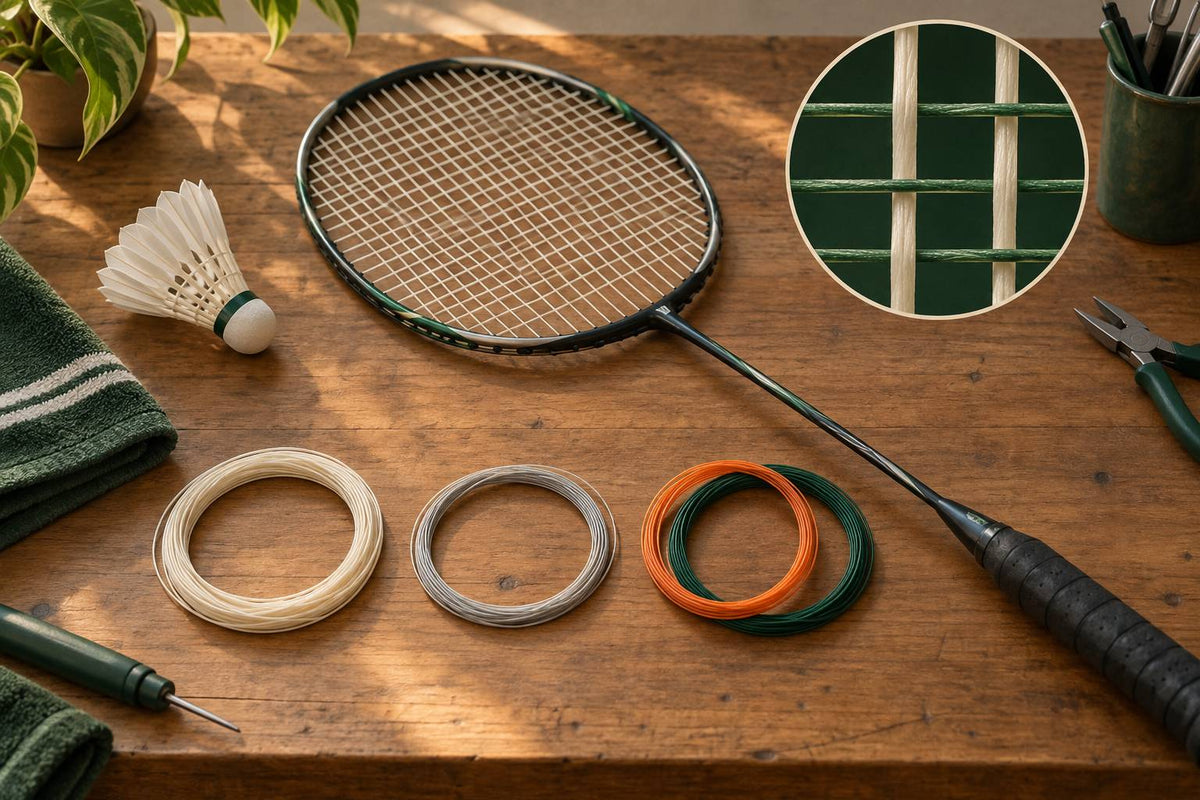
BG65 · 0.70 mm
You break strings. The most durable of the three by a wide margin.
BG66 Ultimax · 0.65 mm
You want repulsion, a crisp sound and sharp control, and accept restringing more often.
Aerobite · hybrid
You slice, cut and play tight at the net and want the shuttle to grip the bed.
First: There Is No Such Thing as “BG65 Ultimax”
This is the most common mix-up in Yonex strings, so it is worth clearing up before anything else. Yonex has never made a string called BG65 Ultimax. There are two separate products whose names get welded together:
| String | Gauge | Yonex family | Built for |
|---|---|---|---|
| BG65 | 0.70 mm | Durability | Lasting a long time |
| BG66 Ultimax | 0.65 mm | Quick Repulsion | Speed off the stringbed |
They sit at opposite ends of the range. If someone offered you “BG65 Ultimax”, ask which one they actually mean — the difference is 0.05 mm of gauge and a completely different playing character.
In this guide
Yonex’s Own Ratings, in One Table
Yonex publishes a five-attribute rating for every string it makes. Almost nobody puts them in one place, so here they are. Higher is more of that attribute.
| String | Repulsion | Durability | Sound | Shock abs. | Control |
|---|---|---|---|---|---|
| BG65 | 7 | 10 | 6 | 6 | 6 |
| BG65 Titanium | 7 | 7 | 7 | 6 | 6 |
| BG66 Ultimax | 10 | 6 | 10 | 8 | 10 |
| BG66 Force | 10 | 6 | 9 | 9 | 10 |
| Aerobite | 10 | 6 | 9 | 8 | 10 |
| Aerobite Boost | 8 | 7 | 7 | 6 | 10 |
| Exbolt 65 | 10 | 8 | 9 | 8 | 10 |
| Exbolt 68 | 9 | 11 | 8 | 6 | 10 |
Two things jump out. BG65 is the most durable of our three, but not the most durable Yonex makes — Exbolt 68 beats it. And Aerobite and BG66 Ultimax score identically on control, so the popular framing of Aerobite as “the control string” and Ultimax as “the power string” is not what Yonex says. The real difference between them is the hybrid gauge and the coated mains, which is about grip on the shuttle rather than control in general.
Notice also that gauge does not decide durability. Exbolt 68 at 0.68 mm outlasts BG65 at 0.70 mm, and Exbolt 65 at 0.65 mm outlasts BG66 Force at the same gauge. Construction beats thickness. If durability is your only criterion, our ranking of the most durable badminton strings covers the wider range and adds a break-diagnosis table.
Specs Side by Side
| BG65 | BG66 Ultimax | Aerobite | |
|---|---|---|---|
| Gauge | 0.70 mm | 0.65 mm | Mains 0.67 mm / crosses 0.61 mm |
| Yonex family | Durability | Quick Repulsion | Control |
| Construction | High-polymer nylon multifilament with a braided fibre outer for abrasion resistance | High-intensity nylon multifilament with a special braided outer | Hybrid set; PU coating on the mains only, for bite on the shuttle |
| Set length | 10 m (also 200 m and 500 m reels) | 10 m | 10.5 m, split 5.5 m mains and 5 m crosses |
| House tension advice | 20–24 lbs | 23–26 lbs | 24–26 lbs |
Those tension figures are our own recommendation, not a Yonex specification — Yonex publishes tension ranges for rackets, not for strings. Always stay inside your frame’s rated range.
BG65 and BG65 Titanium
BG65 is the string most people have played without knowing it — it is the default restring in club pro shops worldwide. At 0.70 mm with a braided outer, it is built to resist abrasion, and Yonex rates its durability 10. It is not exciting: repulsion sits at 7, while sound and control sit at 6. That is the trade you are making.

Choose it if you break strings inside a month, if you are still learning and mis-hitting often, or if you simply do not want to think about strings again for six months.
BG65 Titanium is a different string, and a widely misunderstood one. Same 0.70 mm gauge, with a compound titanium hydride coating. People assume it is “BG65 but tougher”. It is the opposite trade: Yonex rates its durability at 7, not 10, with the same repulsion rating and a livelier sound. If durability is why you use BG65, Titanium is a downgrade.
BG66 Ultimax vs BG66 Force
BG66 Ultimax is the enthusiast default: 0.65 mm, maximum repulsion, the crispest sound Yonex makes, and top-rated control. The shuttle leaves the bed fast and the feedback is sharp. The cost is durability at 6 — expect to restring noticeably more often, especially if you hit the frame.
BG66 Force is its close sibling and often the smarter pick. Identical repulsion and control, one point less sound, but noticeably better shock absorption (9 vs 8). If Ultimax feels harsh on your arm, Force is the same character with more cushioning.
If you want that responsive feel and durability, look at Exbolt 65 instead: it matches Ultimax on repulsion and control while rating 8 on durability rather than 6. On paper it is the best-balanced string in the range.
Aerobite and Aerobite Boost
Aerobite is a hybrid: thicker 0.67 mm mains with a polyurethane coating, thinner 0.61 mm crosses. The coated mains are the whole point — they grip the shuttle for a fraction longer, which is what you feel on slices, cuts, stick smashes and tight net shots.

It rates the same as BG66 Ultimax on repulsion and control, so do not choose it expecting more control in general. Choose it if your game is built on shaping shots rather than hitting through them. The textured mains do wear faster than a round string.
Aerobite Boost takes the idea further with 0.72 mm mains. It trades repulsion down to 8 for a slightly tougher, more planted feel, and keeps control at 10. It suits players who want maximum bite and are not chasing speed off the bed.
Your Shuttles Decide This More Than You Think
Here is the variable that settles most string arguments, and it is rarely mentioned: what you hit with matters more than what you string with.
Nylon and plastic shuttles have a harder, more abrasive skirt and a heavier plastic base than feathers. They chew through thin strings. If your club plays exclusively on nylon shuttles, a 0.65 mm string like BG66 Ultimax will not last, no matter how well it is strung — and that is not a fault in the string.
| You mostly play with | Sensible string |
|---|---|
| Nylon or plastic shuttles | BG65, or Exbolt 68 if you want more feel. String 2–3 lbs lower than you would for feathers. |
| Feather shuttles | Anything. This is where BG66 Ultimax and Aerobite make sense. |
| A mix | Exbolt 65 — responsive enough for feathers, durable enough for nylon. |
For the shuttle side of that decision, see our feather vs nylon shuttlecock guide.
Strings You Will See Recommended That Yonex No Longer Makes
A lot of string advice online is years out of date. These no longer appear in Yonex’s current catalogue, so if a guide recommends one, treat the rest of that guide with caution:
- BG66 (the plain version, 0.66 mm) — superseded by BG66 Ultimax, which is a different string at 0.65 mm
- BG66 Brilliant
- Nanogy 95, 98 and 99
- BG68 Titanium, BG70 Pro, BG85
You can still find stock of some of these. There is nothing wrong with using them — just do not expect your stringer to have them on the shelf.
Common Questions
Is there a Yonex BG65 Ultimax?
No. BG65 (0.70 mm, durability) and BG66 Ultimax (0.65 mm, quick repulsion) are two different strings at opposite ends of the range. The combined name is a mix-up, not a product.
Which is better, BG65 or BG66 Ultimax?
Neither — they do opposite jobs. BG65 lasts far longer (durability 10 vs 6). BG66 Ultimax is much livelier (repulsion 10 vs 7, control 10 vs 6). Pick based on whether you break strings or want performance.
Is BG65 Titanium more durable than BG65?
No, it is less durable. Yonex rates BG65 at 10 and BG65 Titanium at 7. Titanium trades durability for a livelier sound at the same 0.70 mm gauge, with the same repulsion rating.
What is the most durable Yonex string?
Exbolt 68, rated 11 — the highest durability figure Yonex publishes on any of its strings. BG65 is second at 10.
Is Aerobite worth it over BG66 Ultimax?
Only if you slice and cut a lot. Yonex rates them identically for repulsion and control; what Aerobite adds is the coated, thicker mains that grip the shuttle. If you hit mostly flat and hard, Ultimax gives you the same numbers with a more consistent bed.
Does a thicker string always last longer?
No. Exbolt 68 at 0.68 mm outlasts BG65 at 0.70 mm, and Exbolt 65 at 0.65 mm outlasts BG66 Force at 0.65 mm. Construction and coating matter more than gauge.
Which Should You Choose?
| If this is you | String |
|---|---|
| You break strings every few weeks | BG65, or Exbolt 68 if you want feel with it |
| You want the liveliest, crispest response | BG66 Ultimax |
| Ultimax feels harsh on your arm | BG66 Force — same numbers, more shock absorption |
| You slice, cut and play tight at the net | Aerobite, or Aerobite Boost for more bite |
| You want one string that does everything | Exbolt 65 — the most balanced ratings in the range |
| Your club uses nylon shuttles | BG65, strung 2–3 lbs lower than you would for feathers |
Want a recommendation for your racket? Tell us your frame, level and whether you play feathers or nylon through our stringing service, and we will give you a string and a starting tension.
Once you have picked a string, the tension matters just as much — see our string tension guide, or the wider string selection guide for Victor and Li-Ning options.



Leave a comment
This site is protected by hCaptcha and the hCaptcha Privacy Policy and Terms of Service apply.