
Last updated: July 2026 · Written by the team at Badminton House
Quick Answer: Badminton Elbow Pain
If your badminton elbow pain flares during hits, start by lowering arm load: check string tension, grip size, racket stiffness/weight, and stop playing if symptoms persist or include red flags.
Default
Audit tension first: review the exact racket, string and tension with suitable advice; there is no universal 22–24 lb treatment range or 26 lb injury threshold. Greater Moncton players can use our racket stringing service for tension advice.
Grip
If the handle feels skinny or twists in your hand, you may be squeezing too hard; a too-small grip can increase tendon stress, while an oversized grip can make wrist snap and grip changes harder.
Stop
Do not play through pain that lasts more than two weeks despite rest, numbness or tingling, hand weakness, trouble lifting light objects, night pain, painful handshakes, or elbow locking; get assessed by a qualified health professional.
That ache on the outside or inside of your elbow after club night is frustrating: you rest for a few days, feel fine, then one late backhand or defensive flick brings it right back. Badminton elbow pain is often tied to technique, gripping, repetition, and conditioning, but your racket setup can also make the arm work harder than it needs to.
The big equipment suspects are usually string tension, shaft stiffness, racket weight or balance, and grip size. String response, frame handling and grip fit can affect how a setup feels and how much effort it requires, but those observations do not identify the cause of elbow pain.
This guide is a practical equipment audit for Canadian badminton players, not a diagnosis. If the pain is persistent, worsening, or affecting normal daily tasks, get assessed by a qualified health professional. But if your elbow mostly flares after badminton, your current setup is worth checking before you simply keep playing through it.
Start with the most adjustable variable: strings. If you are near Greater Moncton, our racket stringing service can match string and tension to your game, with walk-in service and a typical 2–3 day turnaround.
In This Guide
- Badminton elbow pain: is it tennis elbow or golfer’s elbow?
- Why does badminton overload the elbow and wrist?
- Equipment audit #1: is your string tension too high?
- Equipment audit #2: is your racket too stiff or too heavy?
- Equipment audit #3: is your grip too small?
- When should you stop playing and get help?
- Which Fix Should You Try First?
Badminton elbow pain: is it tennis elbow or golfer’s elbow?

Badminton elbow pain is not always the same injury. The first clue is usually where the pain sits: the outside of the elbow points more toward tennis elbow, while the inner side of the elbow points more toward golfer’s elbow. That location is a useful starting point, but it is not a diagnosis.
Tennis elbow, medically called lateral epicondylitis, involves irritation of the tendons on the outside of the elbow. It is linked to overuse of the wrist extensors, the muscles on the back of the forearm that help control the wrist. One key muscle often involved is the extensor carpi radialis brevis, or ECRB, which can be overloaded by repeated wrist movement and gripping.
Golfer’s elbow, medically called medial epicondylitis, causes pain on the inner side of the elbow. It is linked more to the wrist flexors, the forearm muscles involved in wrist flexion and gripping. In badminton, it can show up when a player grips the racket too tightly, especially during forehand shots.
| Pain pattern | Where it hurts | Main tissues involved | Badminton movements that may irritate it |
|---|---|---|---|
|
Tennis elbow Lateral epicondylitis |
Outside of the elbow | Wrist extensors, including the ECRB | Repeated backhands, tight grip pressure, and excessive wrist flicking during clears or defensive shots |
|
Golfer’s elbow Medial epicondylitis |
Inner side of the elbow | Wrist flexors | Repetitive gripping, wrist flexion, and squeezing too tightly on forehand shots |
For Canadian club players, the confusing part is that both can come from the same session: fast rallies, late contact, hard clears, repeated smashes, and a grip that gets tighter as you get tired. If your arm only feels sore after long nights at drop-in, start by noticing whether the pain is on the outside or inside of the elbow, then look at the patterns in your technique and equipment.
Simple court-side check
- Outside elbow pain after backhands or defensive blocks? Think tennis-elbow pattern.
- Inner elbow pain after forehands or hard gripping? Think golfer’s-elbow pattern.
- Pain that changes your grip, swing, or sleep? Treat it seriously instead of trying to play through it.
The rest of this guide looks at why badminton overloads these tendons, then walks through the fixable gear factors: string tension, racket stiffness and weight, and grip size. If your pain started after a new string job or racket change, that equipment audit is worth doing before your next match.
Why does badminton overload the elbow and wrist?
When badminton elbow pain starts, it is rarely because of one single swing. Badminton asks your forearm to grip, rotate, brake, and accelerate the racket over and over — often in very small time windows. That combination can overload the forearm muscles and the tendon insertions around the elbow, especially if your technique makes the arm do work that should be shared by the shoulder, hips, and torso.
The biggest technique pattern to watch is relying on a hard, late wrist flick for power. Quick wrist action is part of badminton, but if every clear, lift, drive, defensive block, and backhand is produced mainly from the wrist and forearm, the elbow becomes the shock absorber.
| Stress pattern | Why it can irritate the elbow | Better cue |
|---|---|---|
| Rapid wrist flicks on most shots | Repetitive wrist movement and gripping can overload the forearm muscles that attach around the elbow. | Keep the wrist action light and controlled instead of forcing every shot from the forearm. |
| Repeated backhands and defensive shots | Backhands, clears, and defensive reactions are common badminton triggers when they are paired with tight grip pressure and excessive wrist flicking. | Relax the fingers between shots and avoid muscling the shuttle when you are late. |
| Repetitive smashing | Power shots can become elbow-heavy if the swing stops abruptly or if the player tries to create power mostly from the wrist. | Let the shoulder and torso contribute, then finish with a smooth follow-through. |
| Late wrist action | When contact is late, the forearm often compensates with a rushed snap or squeeze. | Move earlier, prepare the racket sooner, and reduce the need for a last-second rescue flick. |
| Leading with the elbow | Poor technique that leads from the elbow instead of the shoulder and hips can amplify stress at the tendon attachments. | Think shoulder, torso, hips, then racket — not elbow first. |
| Gripping too tightly | A constant squeeze increases forearm demand and can contribute to both outside-elbow and inside-elbow irritation. | Use a relaxed hold, then tighten briefly at impact instead of white-knuckling the racket through the rally. |
There is also a strength-and-mobility piece. Weak shoulders or rotator cuffs, combined with tight forearms, can make the elbow compensate. In other words, the painful spot may be the elbow, but the workload problem may start higher up the chain.
Warm up before you blame the racket. Skipping warm-ups and cooldowns is a common mistake because cold, stiff muscles are more prone to tendon overload. If your first hard shots happen five minutes into a cold Canadian gym session, use our badminton warm-up exercises before you start hitting full speed.
The practical takeaway: reduce the “all wrist, all the time” habit. Use your legs, hips, torso, and shoulder to share the load; keep the racket grip relaxed between shots; and avoid abrupt, forced swings when you are late. If the same elbow pain returns every session, your next audit should be both technical and equipment-related.
Equipment audit #1: is your string tension too high?
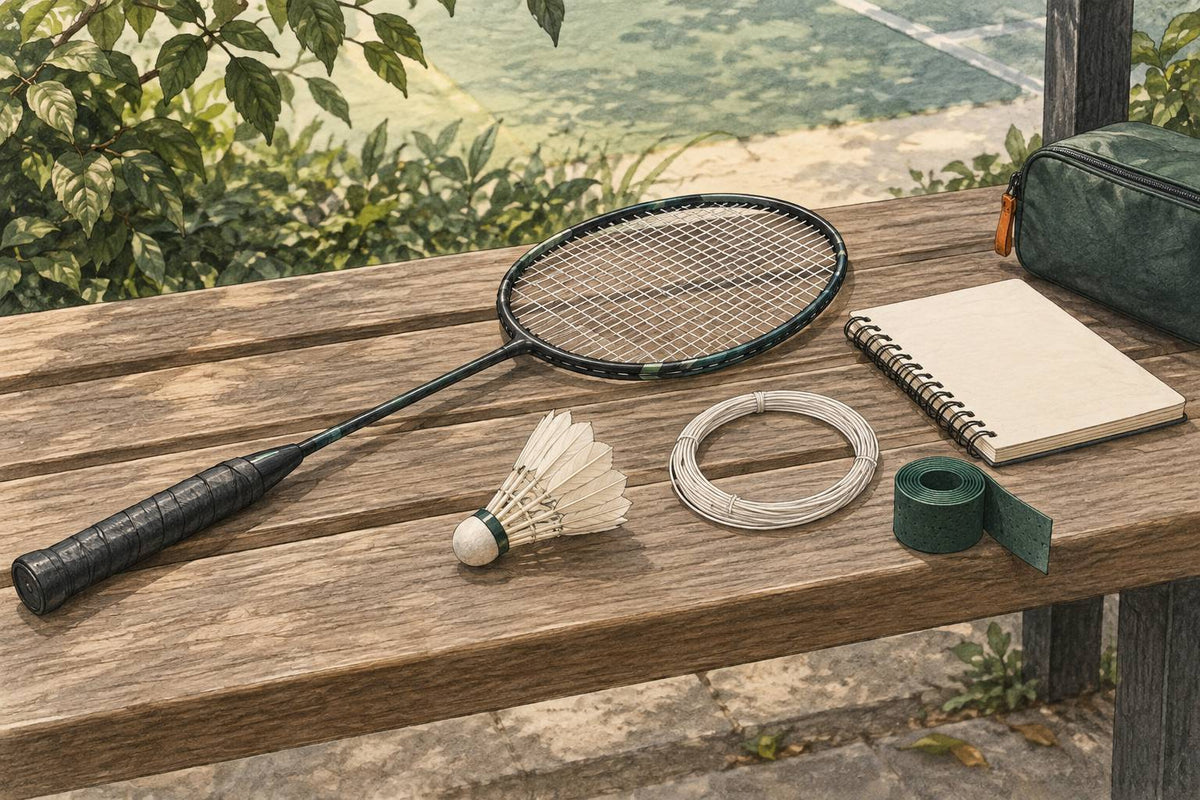
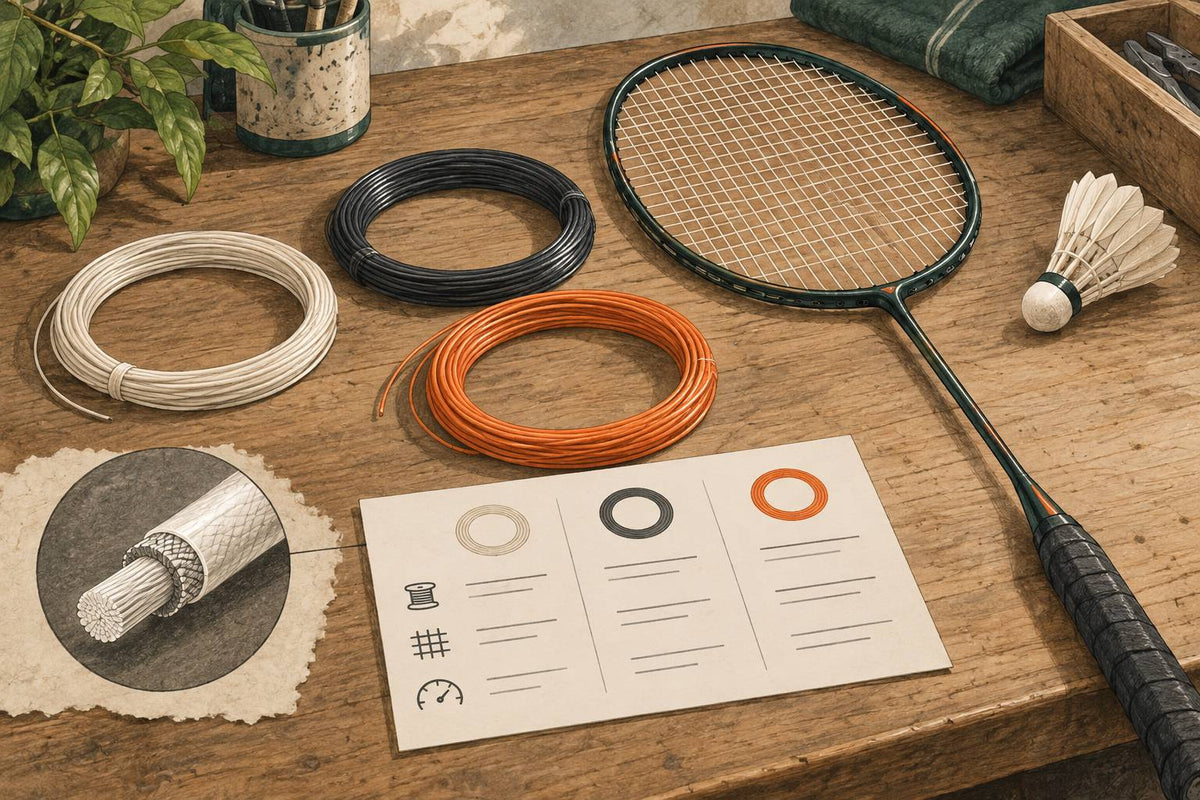
If your badminton elbow pain flares after mishits, late defensive blocks, or hard backhand clears, start with the strings. Equipment choices such as a heavy racquet, an overly stiff frame, or excessively tight strings can increase vibration and tendon load, and string tension is often the easiest variable to change first.
Stringbed feel and comfort depend on the complete racket, string and contact. A firmer response is not a clinical measure of tendon loading. An AAOS equipment check is framed within individual assessment; its racquet-sport guidance does not establish a badminton-specific tension threshold.
Local restring help in Moncton, NB. Badminton House offers a walk-in racket stringing service with 2–3 day turnaround, and our staff match string and tension to your game. If you want to understand the numbers first, see our badminton string tension guide.
A practical tension check for sore elbows
There is no single tension that treats sore elbows. Record your current frame, string and tension, and discuss whether a different setup is appropriate alongside the clinical advice below. The numbers in equipment discussions are not medical boundaries.
| Current setup | Why it can matter for elbow pain | Practical adjustment |
|---|---|---|
| 22–24 lbs | An equipment range sometimes discussed, not a clinical target. | Confirm the frame’s guidance and assess your own response with appropriate advice. |
| Above 26 lbs | This number does not mark a universal injury threshold. | Review the setup and symptoms rather than treating the number as a diagnosis. |
| Pro-level tension copied from another player | High tension rewards clean timing but gives less margin for error. | Choose tension based on your technique, strength, and weekly playing load, not someone else’s setup. |
Our stringer’s practical advice for a player with a sore arm is simple: if you love your racket but the impact feels sharp, try dropping about 2 lbs at the next restring. That is not a medical rule; it is a sensible equipment test. If your clears still travel, your control remains acceptable, and your elbow feels less beaten up after club night, you have learned something useful about your setup.
Also check the manufacturer’s printed tension range on your frame. Staying inside that range is part of using the racket as intended, and it keeps the conversation grounded in the racket’s actual safe-use envelope rather than chasing a number because it sounds advanced.
Equipment audit #2: is your racket too stiff or too heavy?

If your badminton elbow pain flares up most during clears, smashes, late backhands, or fast defensive blocks, look beyond string tension and check the racket itself. Shaft stiffness, total weight, and balance all affect how much work your wrist, elbow, and shoulder have to do on every swing.
A stiff shaft does not bend as easily. For players with compact timing, strong technique, and a fit hitting arm, that can feel precise. But many recreational and intermediate players find stiffer rackets more strenuous on the arm joints than more flexible shafts, especially when timing is late or contact is off-centre.
"If your arm is already irritated, a racket that demands perfect timing is usually the wrong direction."
Why flex matters for sore elbows
A shaft bends and recovers during a swing, but flex alone does not establish how a particular racket will load the arm or affect symptoms. Compare handling as part of the equipment review rather than treating a flexible shaft as a pain fix.
The important part is matching the racket to your current swing speed and control, not copying the stiffest pro-style frame you can find. If a racket feels powerful only when you swing harder, your elbow may be paying for that extra effort.
| Spec to audit | What can happen | Arm-friendlier direction |
|---|---|---|
| Shaft flex | A very stiff shaft can make the wrist, elbow, and shoulder work harder if your timing or swing speed is not ready for it. | Compare the complete setup with appropriate advice; a flexibility label is not a pain treatment. |
| Weight | Heavier rackets can increase fatigue, which often leads to late contact and extra gripping. | Compare manageable mass and balance; 83 g is not a clinical protection threshold. |
| Balance | Head-heavy rackets can feel demanding in fast exchanges or late overhead shots. | Balanced or head-light rackets are often easier to manoeuvre when the arm is sensitive. |
A quick home-court test
- Shadow swing slowly. If the racket feels like it lags behind your hand unless you force it, the shaft or balance may be too demanding for your current timing.
- Notice where fatigue starts. Forearm burn, elbow ache, or shoulder tightness after short rallies can be a sign the racket is asking for more effort than your arm wants to give right now.
- Compare with a lighter or more flexible clubmate’s racket. Do a few relaxed clears and drives. If the motion feels easier immediately, your current frame deserves a closer look.
For a deeper breakdown of how these specs work together, read our badminton racket choosing guide. If you are unsure whether your current frame is 3U, 4U, or 5U, start with our 3U vs 4U vs 5U weight guide.
Honest note: compare the model specifications in our badminton racket collection. The Astrox 100 ZZ in particular is a stiff, head-heavy frame, so we would not present it as the sore-elbow solution. If you want help reviewing the equipment variables, contact us and we’ll give practical Canadian buying advice based on your level, swing, and current racket.
Equipment audit #3: is your grip too small?

Grip size is easy to overlook because it feels less technical than string tension or racket flex. But if your handle is too small, your hand has to squeeze harder to stop the racket twisting on off-centre hits. That extra gripping effort can increase stress through the forearm muscles and the tendons around the elbow.
This matters even more in badminton because your grip is constantly changing: relaxed in preparation, tighter at contact, then relaxed again for the next shot. If the handle feels skinny, many players stay clenched the whole rally (especially on backhands, drives, defensive blocks, and late forecourt pickups).
Not sure how thick your grip should be? Read our badminton grip guide, or contact us with your racket model, current grip setup, and where your elbow hurts. We can help you think through an arm-friendlier setup before you buy more gear.
Too small vs too large: both can cause problems
| Grip issue | What you may feel | Why it can bother the elbow |
|---|---|---|
| Too small | You squeeze hard, the racket twists on mishits, or your forearm feels tight after games. | A smaller handle can require more muscle strength to stabilize the racket, increasing load through the gripping muscles and elbow tendons. |
| Too large | Your wrist feels restricted, grip changes feel slow, or you struggle to relax between shots. | A handle that is too large can inhibit wrist snap and make quick grip changes harder, which can lead to tension and compensation. |
How badminton grip sizing works: G1 to G5
Badminton grip sizing can feel backwards at first: in the G1–G5 convention, smaller numbers mean a larger grip diameter. So G1 is larger than G5. Many rackets sold in Canada commonly appear in smaller-handle sizes such as G5 or G6, then players customize the feel with replacement grips, overgrips, or towel grips.
If you are between two grip sizes, the safer customization route is usually to choose the smaller handle and build it up gradually with an overgrip. You can always add thickness; it is much harder to make a handle smaller without changing the base grip or altering the racket.
A quick self-check before your next session
- Hold the racket naturally. Use your normal forehand grip, not a death grip.
- Look for space. Check whether you can hold the racket securely, relax the fingers and change grips comfortably; a little-finger gap is only a rough fit heuristic.
- If there is no space, that alone does not establish that the grip is too small; assess the hold and grip changes.
- If the handle fills your hand completely, it may be too large and could make fast grip changes harder.
- Test under rally pressure. The real clue is whether you can stay relaxed during drives, backhands, net kills, and defensive lifts.
Simple elbow-friendly grip rule
Your grip should be thick enough that the racket does not twist easily, but not so thick that your wrist snap and grip changes feel blocked. If elbow pain shows up after tight, forearm-heavy sessions, check your grip size before assuming the racket frame is the only problem.
When should you stop playing and get help?
Equipment changes can reduce load, but they are not a substitute for medical assessment. If your badminton elbow pain is getting sharper, spreading, or affecting normal hand function, stop treating it like a racket problem and get help from a qualified healthcare professional.
Stop playing and get checked if: the pain lasts more than two weeks despite rest, or if you notice numbness, tingling, hand weakness, difficulty lifting light objects, pain during handshakes, night pain, or elbow locking.
Red flags to take seriously
- Pain lasting more than two weeks despite rest, especially if it returns as soon as you grip the racket again.
- Numbness or tingling, which is different from normal muscle soreness and should not be ignored.
- Weakness in the hand or difficulty lifting light objects.
- Pain during handshakes, gripping, or daily tasks.
- Night pain that wakes you or makes it hard to rest.
- Elbow locking or a feeling that the joint is not moving normally.
Treatment for tennis elbow and golfer’s elbow can include rest, physical therapy, bracing, and anti-inflammatory medications. Surgery is rarely needed, but persistent symptoms should be assessed rather than pushed through.
Rehab exercise menu to discuss with a professional
These are common exercise categories used around badminton-related elbow pain. Use them as a conversation starter with a physio or clinician, not as a prescription to keep playing through symptoms.
- Wrist extensor stretch: 30 seconds × 3
- Wrist flexor stretch: 30 seconds × 3
- Forearm pronation/supination: 10–15 reps
- Isometric wrist extension
- Eccentric wrist extension
Once you are cleared to return, revisit the string-tension audit above before jumping back into the same setup that irritated your elbow in the first place.
Which Fix Should You Try First?
Use this as a quick decision helper. Badminton elbow pain is rarely solved by one change, but the order matters: rule out warning signs first, then check tension, grip, and racket demands before buying anything new.
| Choose this first | If this sounds like you | Best next step |
|---|---|---|
| Stop and get checked | You have any of the red flags listed in the section above, or pain that is not settling with rest. | Pause badminton and speak with a qualified health professional before changing gear or training through it. |
| Lower the string demand | You are using a high tension, copying pro tensions, or feeling sharp shock on off-centre hits. | Review the current setup within the frame’s guidance; no fixed pound range is an elbow treatment or injury threshold. |
| Book a restring | You are in Greater Moncton and want someone to match string and tension to your game instead of guessing. | Badminton House racket stringing is available in Moncton, NB with 2–3 day turnaround and no appointment needed. |
| Build the grip up | You feel like you must squeeze hard to stop the racket twisting, or your grip feels undersized. | Use the grip-size self-test above, then adjust gradually with overgrip or replacement grip. Avoid going so large that wrist snap and grip changes become difficult. |
| Reconsider the racket | Your elbow flares up with a demanding setup and you are thinking of buying a stiffer or heavier frame as the solution. | Do not use a pro-spec frame as a pain fix. Re-read the stiff/heavy racket audit, then ask for help before changing rackets. |
| Ask for gear advice | You are outside Moncton, none of our current rackets fit your setup, or you want a second opinion before purchasing from a Canadian badminton source. | Send your current racket, tension, grip setup, and symptoms through the contact page. We will help you narrow the equipment variables without pretending a new racket is always the answer. |
Get 10% off your first order
Join the Badminton House list and we’ll email you a 10% welcome code — plus subscriber-only restock alerts, giveaways, and honest gear advice from players.
By subscribing, you agree to receive Badminton House emails and can unsubscribe anytime.
If your elbow pain started around a racket, string, or grip change, do not guess your way through the next restring. We play badminton ourselves, and we are happy to look at your current setup, tension, grip size, and playing level before you buy or restring. Send us a note through Contact Us and we will help you think through a more sensible next step.
Shop carefully if your arm is already sore.
Our racket and accessory stock changes over time, so check the current collections first, and if you are shopping because of badminton elbow pain, ask us before choosing a stiff frame, high tension, or smaller grip setup.
Browse Current Badminton CollectionsShips across Canada · 14-day returns · Canadian badminton specialty shop

Leave a comment
This site is protected by hCaptcha and the hCaptcha Privacy Policy and Terms of Service apply.