
Last checked: August 2026 · Written by the player-led team at Badminton House
Quick answer
To make a badminton drill harder or easier, turn one of six dials: body, time, space, people, equipment or rules. Change one dial, keep the learning goal fixed, and watch whether the intended movement, decision or stroke survives. If speed or complexity replaces that skill with rushed compensation, turn the dial back.
Easier: more time, less travel, a predictable feed or a larger target.
Harder: less time, more travel, a later choice or a tighter target.
Too far: the drill’s target skill disappears, even if effort rises.
A club court often pairs a first-season adult with a former competitive junior. Giving them different drills creates queues and extra explanation. Giving them the same drill at the same setting usually leaves one overwhelmed and the other under-challenged. Six adjustable dials let both players keep the same court, pattern and purpose.
This is a practical expansion of constraint-based coaching. Dansk Skoleidræt’s activity wheel names body, time, space, relationships, equipment and rules. Badminton Danmark applies the wheel to movement training. The framework organizes choices; it does not prove that one version is universally harder.
The source frameworks support adjusting constraints, but changing exactly one dial at a time is a Badminton House diagnostic method, not a federation rule or proven universal prescription. The adult club examples below adapt youth- and school-focused guidance.
Set the baseline before changing a drill
Start with one goal you can observe. “Work hard” is not a useful goal. “Recover toward base before the next feed,” “contact the rear shot above shoulder height,” or “choose clear versus drop after the cue” gives the drill a job.
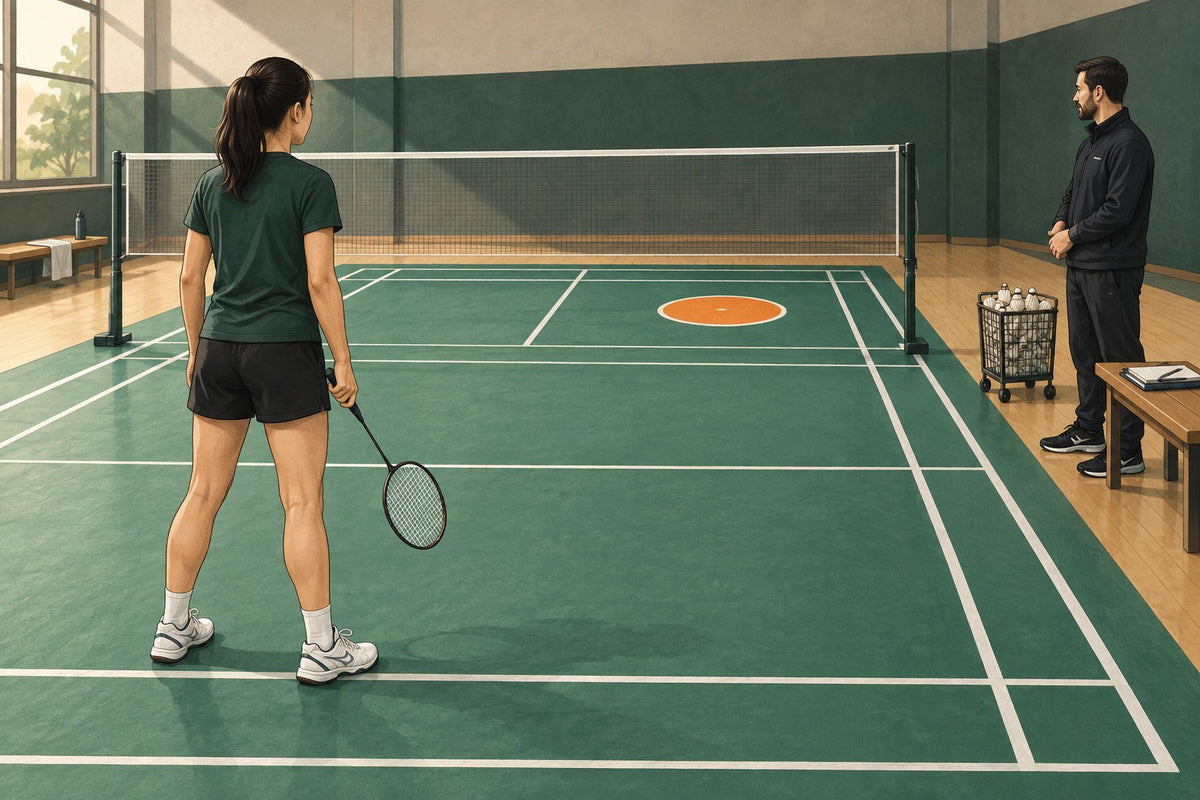
Use a simple front-and-back pattern as the baseline: one player works in a straight half-court lane, moving from a net shot to a rear-court drop and recovering between feeds. The partner feeds predictably. Begin at a pace that allows balanced stopping, an organized racket preparation and a clear return toward base. Our front-and-back badminton drill guide gives the full setup and progression; here, the pattern stays fixed while each dial changes.
Write this before the set: goal, baseline version, dial changed and the observable reason you will simplify it again. Without that record, two changes at once can hide which one helped.
What are the six dials for badminton drills?
| Dial | Make the front-and-back drill easier | Make it harder | Watch |
|---|---|---|---|
| Body | Walk the shadow pattern and pause in each balanced position. | Add the split step, lunge recovery and full rear-court turn. | Posture and braking |
| Time | Wait until the player has recovered before the next feed. | Shorten the reset slightly or extend the work block. | Late contact and rushed feet |
| Space | Feed to midcourt and use a generous landing zone. | Use full front-to-rear travel or a smaller target. | Reaching instead of stepping |
| People | Use one cooperative feeder and announce every destination. | Give a late front-or-rear cue or allow one live reply. | Guessing before the cue |
| Equipment | Add one large, high-contrast floor marker without changing the existing target area. | Remove that visual marker while keeping the same target area, feed and shuttle. | Looking down at the marker or stepping onto it |
| Rules | Fix the shot sequence and remove scoring. | Add one choice or award a point for the stated outcome. | Winning the score by abandoning the goal |
The columns are examples, not permanent directions. UK Coaching’s STEP guidance makes the important point that a smaller area may increase pressure while also reducing the distance a participant must move. Ask “harder for what?” A tighter target challenges precision; a longer travel distance challenges movement capacity. They are different loads.
Avoid weighted rackets, pre-fatigue and forced non-dominant-hand work as generic upgrades. They change the physical task substantially and can obscure the stroke or movement you wanted to improve. A progression should make the intended problem clearer, not merely make the player tired.

Use the technique-collapse test
Badminton Danmark describes a tempo–technique boundary: when pace is too high, players may compensate with extra small steps or carry the centre of mass too high. That does not diagnose an injury and it is not a universal performance threshold. It is a useful coaching observation—added pace has stopped training the intended solution.
Compare the first clean repetitions with the final ones. Turn the dial back when one of these changes repeatedly:
- Movement: the player reaches, crosses feet unintentionally or cannot control the stop.
- Contact: preparation becomes late, contact drops or the intended stroke disappears.
- Recovery: the player watches the shuttle and never reorganizes before the next cue.
- Decision: the player guesses early instead of reading the feeder.
- Safety: spacing shrinks, loose shuttles remain in the lane or partners move into the same striking zone.
One imperfect repetition is feedback. A repeated loss of the target skill means the current setting is no longer productive. Simplify one dial, recover the pattern, then decide whether to rebuild.
How do you scale one court for mixed abilities?
Keep the shared goal but give each player a different dial setting. The newer player might receive predictable feeds to midcourt with a visible landing zone. The advanced player might cover the full lane and read a late clear-or-drop cue. Both still practise organized recovery and early preparation; neither needs a separate activity.
Rotate roles after each block and ask one question: “Which setting let you solve the goal without making it automatic?” Adjust from the answer and the observed repetitions, not from status. A stronger player may need more decision uncertainty, while a fast but inconsistent player may need more time and a tighter precision target.
The BWF Shuttle Time manual supports easier and harder versions within one group and stresses court spacing and loose-shuttle control. Those safety basics matter even more when neighbouring pairs use different tempos.
Pocket session card
- Name one observable learning goal.
- Run a clean baseline version.
- Change one dial in one direction.
- Compare movement, contact, recovery and decisions.
- Keep, reverse or refine that change before touching another dial.
Use our STEP model guide when inclusion and four broad practice dimensions are the main job. Use the drill-progression guide to plan a longer sequence of practices. The six-dial method is the quick court-side tool: one drill, one goal and one visible change at a time.


Leave a comment
This site is protected by hCaptcha and the hCaptcha Privacy Policy and Terms of Service apply.