
Last checked: August 2026 · Written by the player-led team at Badminton House
Quick answer: can the shuttle be saved?
Badminton House uses one conservative exception: only superficial feather-vane damage receives a cautious cosmetic trial. Damage to a shaft, feather base, cork or binding is structural and should not be repaired for play.
Try once
Cosmetic bend only: the soft vane tip is bent, but the shaft is straight and the base and binding remain firm.
Drill bin
Use only after the shuttle flies consistently beside a fresh control, and only where precision is not important.
Retire
A cracked shaft, loose base, damaged cork, broken binding or repeatable flight fault is the end of useful court life.
Simple rule: if the damage changes how a feather is anchored, how the cork presents to the racket or how the skirt holds its shape, retire the shuttle rather than attempting a structural repair.
Which shuttlecock damage is repairable?
In this Badminton House policy, only a superficial bend in the soft feather vane receives one gentle correction and a flight comparison. A crack in the stiff shaft, movement at the feather base, a damaged cork or a failed binding changes the structure that holds the shuttle together. Those faults receive a retire ruling.
The current BWF Laws of Badminton specify 16 feathers of uniform length, arranged in a defined tip circle and firmly fastened with thread or another suitable material. Those dimensions are match specifications rather than repair instructions, but they show why symmetry and secure fastening matter.
| Damage | Ruling | Why |
|---|---|---|
| Bent feather tip | One cosmetic trial | If only the soft vane is bent and the shaft remains straight, gently align it once with your fingers. Keep it only if the comparison test is stable. |
| Cracked quill or shaft | Retire | The stiff supporting structure has failed. It cannot be reliably straightened or replaced in an ordinary shuttle. |
| Feather loose at the base | Retire | Movement where the shaft enters the base means the factory anchoring has been compromised. Do not treat surface glue as a dependable repair. |
| Split or badly dented cork | Retire | The impact surface and base shape are damaged. A patch cannot restore a known weight, shape or response. |
| Broken or slack thread ring | Retire | The skirt is no longer securely bound. Do not rethread it for court use. |
Engineering sources describe the cork, adhesive, aligned feathers, binding and lacquer as a constructed assembly. A doctoral study of shuttlecock flight and failure documents vane wear and feather-shaft breakage as shuttle failure modes. A separate shuttle aerodynamics study explains how the porous conical skirt and feather gaps contribute to flight.
Repeated racket impacts can also damage feather structures, as documented by a 2024 shuttle-feather compression study. None of these sources validates household regluing, rethreading, shaft replacement or cork patching as a dependable repair.
If the feather is moving where it enters the base, use our loose shuttlecock feather inspection guide for a closer look. The practical ruling remains conservative: movement at the base is not cosmetic damage.

How do you test a cosmetically corrected shuttle?
Do not approve a shuttle because the feather looks straight on the table. Compare it with a fresh shuttle under the same conditions. The purpose is to find a repeatable difference in wobble, sideways movement or descent while limiting changes in contact, airflow and direction.
- Inspect first: confirm that every shaft is uncracked, every feather remains firm at the base, the binding is tight and the cork is intact.
- Choose a fresh control: use a new shuttle of the same type and speed from the same end of the same court.
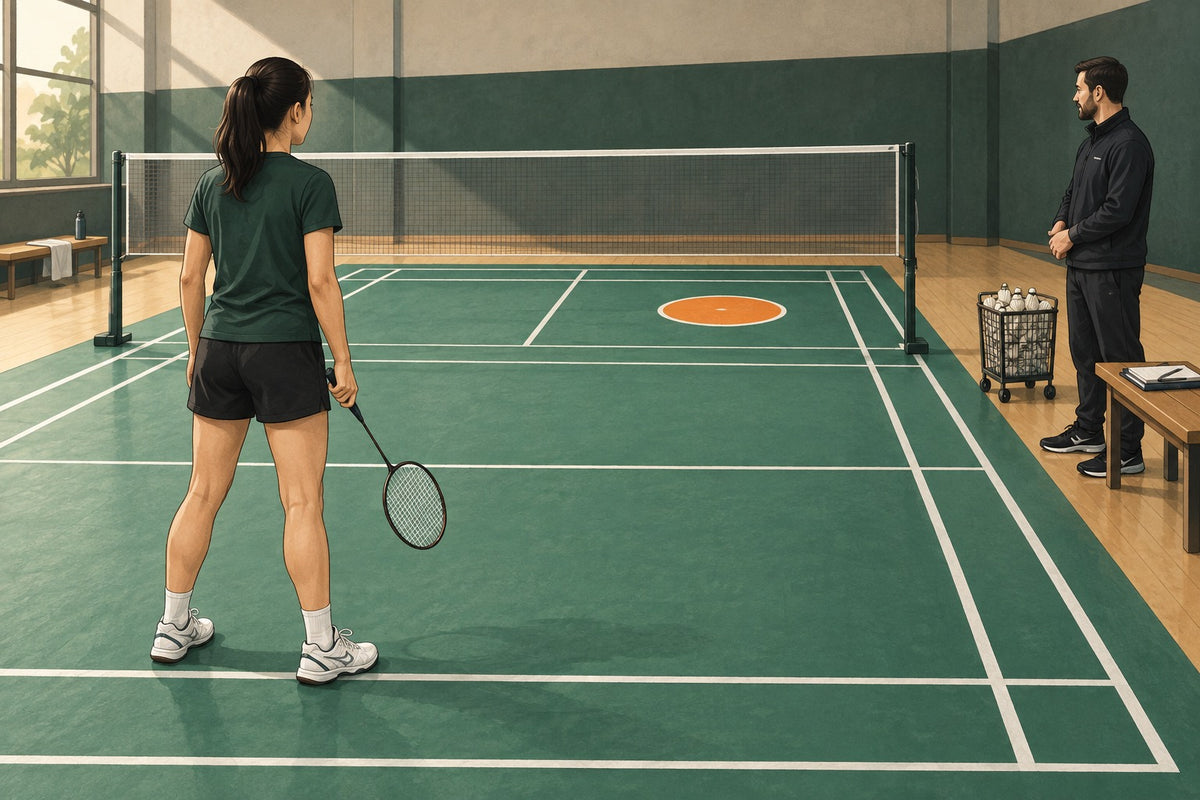
- Use one repeatable stroke: have the same player hit three high serves with the suspect shuttle and three with the fresh control. Keep contact and effort as consistent as practical.
- Watch the full flight: look for repeated skirt wobble, sideways deviation or noticeably earlier descent. One mishit is not a ruling; a pattern is.
- Make the conservative call: if the suspect shuttle behaves differently more than once, retire it. If it tracks the control consistently and has only cosmetic vane damage, place it in the controlled-drill bin.
This is a Badminton House comparison method, not the official BWF speed test. The official test uses a full underhand upward stroke from the back boundary, parallel to the side lines, and a defined landing zone near the opposite back boundary. Use the on-court shuttle speed test when speed is the question; use the fresh-control comparison when visible damage is the question.
If both shuttles move sideways in the same direction, inspect the hall, airflow and contact before blaming the corrected feather. Our shuttle drift diagnosis guide separates environmental drift from a faulty shuttle.
Which shuttles belong in matches, drills or retirement?
Under this Badminton House sorting policy, reserve intact, unmodified and predictably flying shuttles for games. Reserve cosmetically worn but stable shuttles for controlled feeds where exact trajectory is not the lesson. Any structural fault or repeated flight defect belongs in the retirement box so it cannot quietly return to a movement or precision drill.
| Category | What belongs there | Suitable use |
|---|---|---|
| Match tube | Intact, unmodified, stable shuttles | Games, match simulation and precision practice |
| Controlled-drill tube | Cosmetic vane wear only, with stable comparison flight | Stationary feeds, contact practice and non-precision work |
| Retirement box | Shaft, base, cork or binding damage; repeated wobble, drift or early drop | No further court use |
Label each tube clearly and use the oldest suitable drill stock first. This is inventory discipline, not a claim that rotation repairs feathers or extends their physical life. For ideas that use predictable older shuttles without confusing the lesson, see our badminton training-shuttle guide.
In a tournament, players should leave shuttle changes to the umpire or responsible official. The BWF Instructions to Technical Officials place fair shuttle-change decisions with the umpire. The Laws also prohibit deliberately modifying a shuttle to affect its speed or flight. That is not the same as saying BWF categorically bans every shuttle that has ever had a bent vane.
The final repair rule
A cosmetic vane bend may earn one careful correction and one controlled comparison. Structural damage does not earn a home repair. When flight becomes unpredictable, retire the shuttle.
Read when to change a shuttle during play before wear begins changing the rally.


Leave a comment
This site is protected by hCaptcha and the hCaptcha Privacy Policy and Terms of Service apply.