
Last updated: July 2026 · Written by the team at Badminton House
Quick Answer: Badminton Racket Lead Tape Balance
For most Canadian club players, measure your racket first, add only 1–2 g at a time, and start on the upper sides of the frame instead of jumping straight to 12 o’clock.
Default
Start at 10 and 2: small strips near the upper sides add a more solid, forgiving feel without the biggest swingweight jump.
12 o’clock
Choose this only if you clearly want more punch, because weight at the very top increases swingweight the most and can make timing slower.
Handle
Add weight under the grip or use a thicker grip setup when the racket feels too head-heavy and you want a quicker, more manoeuvrable response.
Badminton racket lead tape balance tuning is for that frustrating middle ground: your racket is almost right, but not quite. Maybe your smashes lack punch, your drives feel late, or your defence feels slower than it should. Before you buy a new frame, a tiny amount of well-placed weight can change how the racket swings.
The key word is tiny. Roughly 1–2 g of lead tape near the top of the frame can move the balance point forward by a few millimetres and make the racket feel more head-heavy and powerful. Weight at the bottom of the handle, or a thicker grip build-up, moves the balance back and makes the racket feel quicker and more manoeuvrable. The same added weight feels completely different depending on where it goes.
This guide walks through how to measure your current setup, where to add weight for more power or speed, and how to test changes safely so you do not accidentally turn a good racket into a tiring one.
Tuning or replacing your racket? Compare current options in our badminton rackets collection. Prices are listed in CAD, and Canadian orders qualify for free shipping.
In This Guide
- What Do Balance Point and Swingweight Mean?
- How Do You Measure Your Racket Before Adding Tape?
- Where Should You Add Lead Tape for More Power?
- How Do You Make a Racket Feel Quicker?
- How Much Lead Tape Should You Add at a Time?
- Is Lead Tape Safe to Use on a Badminton Racket?
- Which Lead Tape Balance Change Should You Choose?
What Do Balance Point and Swingweight Mean?
When players talk about badminton racket lead tape balance, they are usually trying to change two related things: the racket’s balance point and its swingweight. They sound technical, but the on-court feel is simple: does the racket feel faster in defence, heavier through a smash, or more stable when you hit off-centre?
The balance point is the racket’s centre of mass: the spot where the racket balances on a pivot. In badminton, it is commonly measured in millimetres from the bottom of the handle, and most rackets sit in the region of 285–295 mm: a higher number plays more head-heavy, a lower number more head-light. A shift of only a few millimetres can noticeably change how the racket feels in fast exchanges.
That is why adding a small amount of tape can matter. Roughly 1–2 g of lead tape near the top of the frame can move the balance point forward by a few millimetres and make the racket feel more powerful and head-heavy. Adding weight at the bottom of the handle, or building the handle with a thicker overgrip or under-wrap, moves the balance point back and makes the racket feel quicker and more manoeuvrable.
| Term | What it means | Why it matters when adding tape |
|---|---|---|
| Balance point | The racket’s centre of mass, measured in millimetres from the bottom of the handle. | Shows whether your setup is moving more head-heavy, more head-light, or staying close to even. |
| Swingweight | How heavy the racket feels while moving through a stroke, not just what it weighs on a scale. | The farther you move added mass from your hand, the more the racket feels like it resists quick movement. |
Swingweight is the part many players feel before they can measure it. Two rackets can have the same static weight on a scale, but the one with more mass toward the head can feel heavier during a clear, smash, drive, or defensive block. Moving weight farther from your hand increases that moving feel; moving weight closer to the handle changes the balance with much less effect on how heavy the head feels in the swing.
A useful way to picture it is a hammer: hold it near the heavy head and it feels easy to move; hold it by the end of the handle and the same hammer feels much harder to swing. The total weight has not changed, but the weight is farther from your hand, so it feels heavier in motion.
Before you tune, know your starting point. If you are still deciding what balance suits your game, compare head-heavy vs head-light racket balance and review how 3U, 4U, and 5U racket weights affect feel before adding tape.
The key takeaway: balance point tells you where the racket’s mass is centred, while swingweight tells you how heavy it feels in motion. Lead tape changes both, but not equally. The same added weight can create a very different racket depending on whether it goes at 12 o’clock, the sides of the frame, the throat, or under the grip.
How Do You Measure Your Racket Before Adding Tape?

Before you change anything, find your current baseline. Lead tape tuning is only useful if you know where you started; otherwise, a racket that feels “better” one night can be hard to reproduce after a grip change, restring, or tape adjustment.
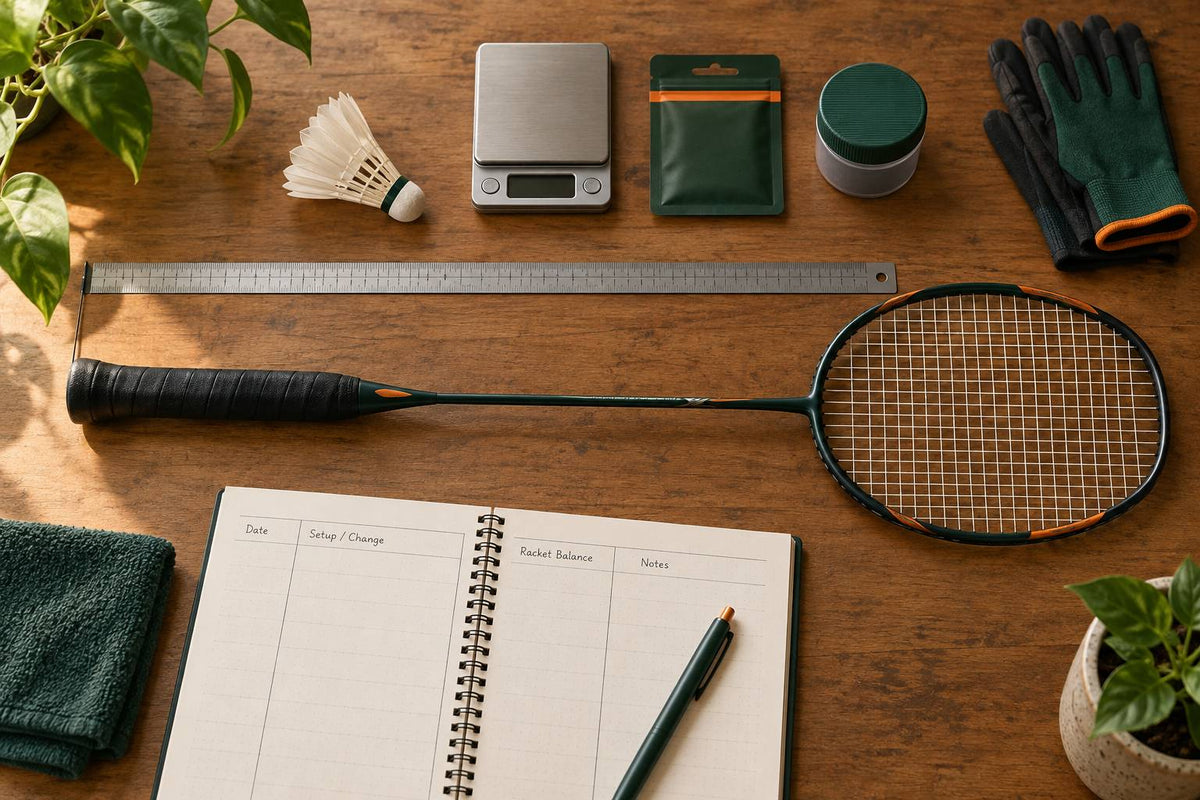
Write down your setup before tuning. Record your racket weight, balance point, and exact grip setup before adding tape. If you are comparing different balance styles, start with the badminton rackets collection as your category reference.
How to find your balance point at home
The balance point is the spot where the racket balances on a pivot. For badminton rackets, it is usually recorded as the distance from the bottom of the handle to that balance point.
- Place the racket horizontally across your index finger, with the handle on one side and the frame on the other.
- Slowly slide the racket left or right until it sits level without tipping toward the head or handle.
- Mark that balance spot lightly with a small piece of removable tape, or keep your finger in place.
- Measure from the very bottom of the butt cap to that point.
- Write the number down in millimetres, along with the date and current grip setup.
Do this with the racket in the same state you actually play with: strung, with your normal grip or overgrip installed, and without temporary accessories removed. Grips and strings can shift balance slightly, so measuring a bare frame tells you less about how the racket feels in a real rally.
Record three numbers before every change
A simple setup note is enough. You do not need a professional matching machine to make useful badminton racket lead tape balance changes; you just need consistent measurements.
| What to record | Why it matters |
|---|---|
| Total racket weight | Use a precision scale if you have one. Total weight helps you avoid accidentally turning a quick racket into something tiring over a full club night. |
| Balance point | Measure from the butt end to the balance point. A shift of only a few millimetres can noticeably change how head-heavy or head-light the racket feels. |
| Grip setup | Note whether you are using the original grip, an overgrip, towel grip, extra under-wrap, or a built-up handle. For grip terminology, see our overgrip vs replacement grip guide. |
This matters because static weight and playing feel are not the same thing. If two rackets weigh the same on a scale, the one with more mass farther from your hand can still feel heavier through the swing. That is why adding tape near the top of the frame changes the feel much more dramatically than adding the same amount near the handle.
Once your baseline is written down, make one change at a time. Add tape, measure again, test on court, and update your notes. If the setup feels right, your measurements give you a repeatable recipe instead of a one-off experiment.
Where Should You Add Lead Tape for More Power?

If your racket feels quick but a little light through clears, smashes, and rear-court drives, the simplest experiment is adding a very small amount of lead or tungsten tape near the top of the frame. Roughly 1–2 g near the upper hoop can move the balance point forward by a few millimetres, which makes the racket feel more head-heavy and more powerful through the shuttle.
The important part is placement. The same 1 g does not feel the same everywhere on the frame: the farther the added weight sits from your hand, the more it increases swingweight. That is why tape at 12 o'clock has the biggest effect, while tape around 10 and 2 o'clock is usually the better first test for most players.
| Frame position | What it changes | Best use |
|---|---|---|
| 12 o'clock | Adds the most swingweight for a given amount of tape and makes the racket feel more head-heavy. | Maximum power experiment for players who already know they like a heavier-feeling head. |
| 10 and 2 o'clock | Moves balance forward while making the head more resistant to twisting. | Best beginner-friendly starting point, especially if you want more forgiveness on off-centre hits. |
For a first test, cut the total added weight into two equal pieces and place them symmetrically at 10 and 2 o'clock. Symmetry matters: if you put all the weight on one side, the racket can feel uneven through fast drives and defensive blocks. Start with about 0.5 g per side for a 1 g total change, then test before adding more.
Power without overcommitting. If you are unsure whether you want a true head-heavy setup, start at 10 and 2 o'clock instead of 12 o'clock. You still get a stronger, more stable head feel, but the jump in swingweight is usually easier to control.
A 12 o'clock strip is the more aggressive version. It can help the racket carry more momentum through smashes and deep clears, but it also makes the head harder to start, stop, and redirect. In doubles, that can show up quickly on flat exchanges, late backhands, and body defence.
This type of tuning works best when you are fine-adjusting a racket you already like. If you are trying to turn a fast, head-light racket into a completely different power racket, you may be better served by comparing frame balance first. Our head-heavy vs head-light racket guide explains the playing-style trade-off, and you can check current options in our badminton rackets collection.
For tape and grip materials, check our accessories collection first; availability can change. If lead or tungsten tape is not listed, look for cut-to-length racket tape through Canadian badminton specialty retailers or your local club pro shop, then keep notes on the exact weight and position so you can undo or repeat the setup later.
How Do You Make a Racket Feel Quicker?
If your racket feels slow in fast drives, defence, or front-court interceptions, the easiest reversible change is usually at the handle end, not the frame. Adding weight at the bottom of the handle, or building up the handle with a thicker overgrip or under-wrap, moves the balance point back a few millimetres. The result is a more head-light, manoeuvrable feel.
This does not make the racket lighter on a scale. It adds total weight. But because the extra mass sits close to your hand, the racket can feel quicker to turn than the same amount of weight placed up near the top of the frame. That is why two rackets with similar total weight can feel very different once you start changing grip thickness, tape placement, and balance point.
Handle-side tuning options
- Thicker overgrip: adds weight near the hand and can make the racket feel a little more head-light while also increasing grip size.
- Under-wrap: builds up the handle underneath your grip, useful when you want a fuller handle shape and a slightly quicker-feeling head.
- Balancing tape under the grip: adds mass low on the handle without putting tape on the frame, making it a cleaner option for players who want to preserve the racket head’s original feel.
- Replacement grip changes: can shift balance too, so do not measure a racket with one grip setup and then compare it to another after changing the grip.
Treat your grip setup as part of the balance spec. A racket measured with the factory grip only is not the same setup as the same racket with a replacement grip, overgrip, and extra under-wrap. If you are trying to repeat a favourite setup, write down the grip stack along with total racket weight and balance point.
For a deeper breakdown of grip types, thickness, and when to use each one, read our badminton grip guide. You can also browse the accessories collection for badminton add-ons as availability changes.
A good practical test is simple: make one handle-side change, re-measure the balance point from the bottom of the handle, then play a short set of fast drives, blocks, and defence. If the racket turns faster without making your grip feel bulky or your timing late, you are moving in the right direction.
How Much Lead Tape Should You Add at a Time?
Lead tape tuning is not just about how many grams you add. The same total weight can feel completely different depending on whether it sits at 12 o’clock, the side of the hoop, the throat, or under the grip. Mass placed farther from your hand raises swingweight much more, so a tiny change near the top of the frame can feel bigger than the number on the scale suggests.

Work in small steps: add a little, measure, play, then decide. As a practical measuring reference, a four-inch (10 cm) strip of standard quarter-inch lead tape weighs about one gram. Use a precision scale for total weight, plus a ruler or balance board to record the balance point from the bottom of the handle.
Simple rule: change only one variable at a time. If you add tape to the frame and change your grip on the same day, you will not know which change made the racket feel better or worse.
A repeatable testing routine
- Start with your baseline: record total racket weight, balance point, string setup, and grip setup before adding anything.
- Add one small amount: begin around one gram on the frame, or a modest handle change if you are trying to make the racket feel quicker.
- Test the same shots: hit clears, smashes, fast drives, defensive blocks, net kills, and serve returns so you feel both power and recovery speed.
- Write down the result: note whether timing improved, whether the head feels late, and whether your shoulder, elbow, or wrist feels more loaded.
- Stop before it feels extreme: if the racket suddenly feels sluggish in defence or unstable on quick interceptions, remove some tape instead of forcing yourself to adapt.
What to record after each change
| Measurement | Why it matters |
|---|---|
| Total racket weight | Shows how much static weight you have added, even if the racket does not feel equally heavier in every setup. |
| Balance point | A few millimetres forward or backward can noticeably change whether the racket feels more head-heavy or head-light. |
| Tape location | One gram near the top of the hoop does not feel like one gram near the handle because the distance from your hand changes swingweight. |
| Grip setup | Overgrips, replacement grips, towel grips, and under-wrap can all shift the balance toward the handle. |
| On-court notes | The useful setup is the one that improves your timing, defence, and shot quality—not just the one that looks good on paper. |
If you are also changing grip thickness, read the badminton grip guide before finalizing your tape setup. A thicker handle build-up can make the racket feel more manoeuvrable by pulling the balance point back, even if the total weight increases.
Shop Badminton Rackets in Canada
Free shipping in Canada · 14-day returns
Is Lead Tape Safe to Use on a Badminton Racket?
Lead tape is useful because it lets you test balance changes without permanently modifying the racket, but treat it like a tuning material — not a casual sticker. If you use lead tape, wash your hands after applying or removing it. For uncovered lead tape, consider wearing gloves while cutting, pressing, and repositioning it.
Simple safety rule: cut cleanly, avoid loose scraps, wash your hands, and dispose of offcuts properly instead of leaving tiny pieces in your racket bag, on the floor, or around your stringing area.
The bigger performance risk is overloading the upper hoop. Weight near 12 o’clock has the strongest effect on swingweight, so a small strip can make the racket feel much heavier in motion than the scale weight suggests. On an already head-heavy racket, adding more tape high on the frame can push the setup into an excessively head-heavy, high-swingweight feel — powerful in theory, but slower through drives, defence, and recovery.
If the racket starts to feel late in fast exchanges, do not keep adding head weight to “make it stronger.” Remove some tape, move it lower on the frame, or counter-balance through the handle. For a refresher on how balance affects power and speed, see our head-heavy vs head-light badminton racket guide.
Remember what is reversible — and what is not
Balancing tape is removable. Overgrips, under-wrap, and handle build-up can also be changed. That is why they are good tools for experimenting in tiny increments.
The racket’s structural frame weight is different. If a racket is built to be head-heavy, most of that character comes from the frame construction itself, and that weight cannot be safely removed. Do not try to sand, drill, shave, or otherwise remove material from the frame to make it head-light. If you need a faster-feeling setup, use reversible handle weighting or choose a naturally lighter or more head-light racket next time.
Before you make a permanent-feeling change, record the racket’s total weight, balance point, grip setup, and tape position. If the setup feels wrong after one club night, you can peel the tape off and return to your baseline without damaging the racket. For broader frame-care habits, read our badminton racket care guide.
Which Lead Tape Balance Change Should You Choose?
Choose the placement based on the problem you are trying to solve, not just the balance number you want to reach. The same added weight can feel very different depending on whether it sits near the top of the hoop, on the sides, at the throat, or under the grip.
| Choose this setup | If your racket feels... | What it changes | Best caution |
|---|---|---|---|
| 10 and 2 o’clock on the frame | Unstable on off-centre hits, but you do not want the biggest possible swingweight jump. | Makes the racket more resistant to twisting and more forgiving, which is why it is a sensible first lead-tape position. | Start small, test, then adjust. A few millimetres of balance shift can be noticeable. |
| 12 o’clock on the frame | Too light through smashes and rear-court clears, and you are willing to trade some speed for power. | Adds the most swingweight for a given amount of added mass and pushes the feel toward head-heavy power. | Not the best first experiment. It can make the racket harder to control, especially if the racket is already head-heavy. |
| Bottom of the handle, overgrip, or under-wrap | Too sluggish at the net, slow in defence, or too head-heavy after frame weighting. | Moves the balance back toward the hand, making the racket feel more head-light and manoeuvrable. | Grip and string changes also shift balance, so record your grip setup when comparing results. |
| Throat area | A little too light overall, but the balance already feels right. | Adds overall mass with less effect on balance point than adding weight high on the hoop. | Still test gradually because any added material can change swingweight and playing feel. |
| No tape yet | You are trying to turn a naturally head-heavy racket into a genuinely head-light one. | Lead tape is better for fine tuning than completely changing a racket’s design; structural frame weight cannot be safely removed. | Consider choosing a different balance category instead of forcing a major conversion. |
Availability note for Canadian players: Badminton House does not currently list lead tape, grips, or overgrips in the accessories collection. For racket comparisons, the badminton rackets collection has included reference models such as the Yonex Astrox 100 ZZ Kurenai, Dark Navy, an extra-stiff head-heavy power example, and the Yonex Astrox 100VA Game Grayish Beige, a more forgiving medium-flex head-heavy example.
If you are unsure whether tape is the right fix, compare your current racket’s balance category against the trade-offs in our head-heavy vs head-light badminton racket guide before adding weight.
Get 10% off your first order
Join the Badminton House list and we’ll email you a 10% welcome code — plus subscriber-only restock alerts, giveaways, and honest gear advice from players.
By subscribing, you agree to receive Badminton House emails and can unsubscribe anytime.
Racket balance tuning is best treated like string tension: change one thing, test it on court, and keep notes. We play badminton ourselves, so if you are unsure whether lead tape, a grip change, or a different racket balance makes more sense for your game, contact us and tell us what you are using now, what feels slow or underpowered, and how you like to play.
Build a racket setup that feels right in your hand.
Start with the right racket category, then fine-tune balance, grip feel, and string setup from there.
Browse Badminton RacketsFree shipping in Canada · 14-day returns · Canadian badminton specialty shop

Leave a comment
This site is protected by hCaptcha and the hCaptcha Privacy Policy and Terms of Service apply.