
Last updated: July 2026 · Written by the team at Badminton House
Quick Answer: Steam Feather Shuttlecocks?
Condition and manufacturer guidance control the choice; steaming is not a universal routine.
Leave as-is
Best choice: Choose this when shuttles already fly correctly and the feathers are not brittle.
Control humidity
Use gradual, controlled humidity when a dry tube has brittle feathers, then rest and test one shuttle.
Stop treatment
Stop for visible dampness, distorted feathers, a soft cork, or flight that becomes heavy or inconsistent.
If feather shuttlecocks are snapping after only a few rallies, steaming can sound like the club-player shortcut: add moisture, soften dry vanes, and try to slow breakage. Moisture changes how a shuttle plays as well as how it lasts, so the right question is not “does steam work?” but “is this tube too dry for this room?”
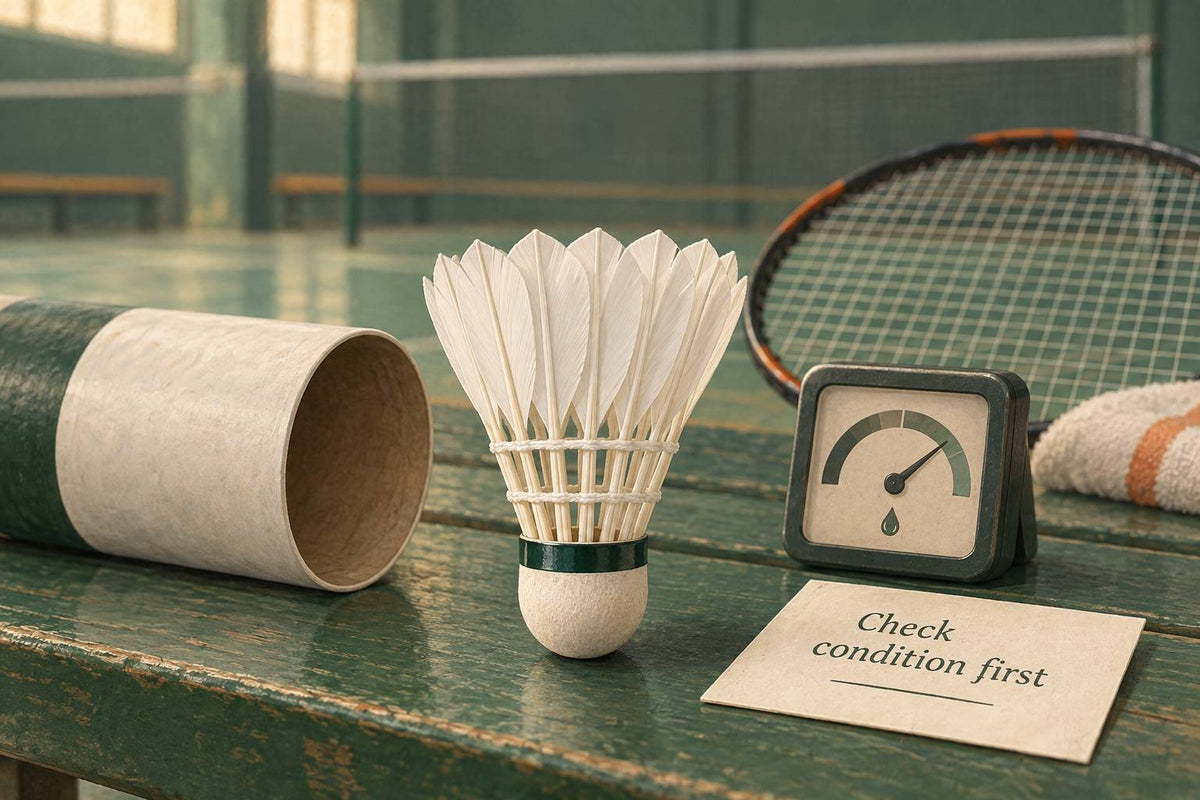
Before you steam feather shuttlecocks, treat it as a condition check, not a ritual. Look at feather brittleness, the current humidity, how the cork feels, and whether the shuttle still passes a normal baseline test flight.
In This Guide
Should You Steam Feather Shuttlecocks? What Steam Changes
Start with the inner skirt: the stems and quills are not decoration; they carry much of the shuttle’s structure while the outer vanes create drag and spin. A feather shuttlecock is built from 16 feathers set into a cork base, with the skirt held by glue and threads, so steam is not touching “just the feathers.” It can also affect the bound skirt and cork cap.
Feather shafts are keratin, and moisture can change how stiff or brittle that material feels. At the micro level, the rachis, barbs, and barbules can hold condensed water from humid air, which is why feather shuttle weight depends on humidity. In measured conditions at 20 °C, very dry air versus very humid air changed shuttle mass enough to alter range. Steam can therefore help a dry, brittle skirt, but it is not a guaranteed durability hack or a neutral treatment.
Why Results Vary by Climate, Feather Condition, Cork, and Glue
Steam affects feathers, cork, and the bonded skirt differently depending on how dry or worn the shuttle already is. A slightly dry feather may regain some flexibility; a cracked vane, softened cork, or weakened glue-and-thread support is not “fixed” by moisture. That is why one tube can feel better after a short treatment while another becomes heavy or inconsistent.
Climate is the other variable. Humidity changes feather mass because water vapour condenses on the feather’s fine structure, and temperature changes air density; both can alter range and trajectory. For the physics behind that cork-first flight behaviour, see why shuttlecocks always fly cork-first. Feather stiffness and recovery also vary by product and by goose versus duck feathers, so there is no universal steaming duration. If the feathers are already brittle or the cork feels suspect, replace the tube with fresh feather shuttlecocks instead of trying to rescue it.
Steam vs Controlled Humidity
Steaming exposes a tube to a short burst of moist air. One commonly described approach is brief steam exposure into the tube, followed by re-capping and resting before play. That can make sense when feathers have dried out, but it is still a moisture spike: too much can make the shuttle heavier, change flight, and risk the cork.
Controlled humidity is different. A humidity cabinet can keep shuttles in a set relative-humidity environment, but cabinets are costly, bulky, maintenance-heavy, and not practical to transport. A patent for one tube-insert design describes a roughly 60–80% relative-humidity range. That is a product-specific design claim, not a universal target or proof that every insert prevents condensation; follow the shuttle and insert makers’ instructions.
Do not confuse controlled inserts with any wet pad in a tube. The same patent describes humidity-control and microbial concerns with particular older disc designs; those claims do not establish that every humidifying pad performs the same way.

Test Flight and Stop Signs Before You Play
After any treatment, judge the shuttle in the room where it will be used, not by feel in the tube. Let shuttles sit at ambient conditions for several hours, then use the BWF test: hit one shuttle with a full underhand stroke over the back boundary line and check where it lands in the opposite back corridor. If the flight has become too long, too short, or inconsistent, the moisture change has not matched that room. Manufacturer guidance and the actual shuttle condition should override any routine.
Visible dampness, distorted feathers, a soft cork, signs of cork damage, or heavy flight in humid conditions all mean the treatment has gone far enough. Conditions above about 80% relative humidity also raise mould risk for feathers and cork.
Which Should You Choose?
| Choice | Choose this if... | Avoid it when... |
|---|---|---|
| Leave as-is | The shuttle passes the underhand test flight in the current room and the feathers are not brittle. | The feathers are snapping unusually early or the room is very dry. |
| Control humidity | The room is dry, feathers feel brittle, and you can let the tube rest before testing one shuttle. | The venue is already humid, the cork looks vulnerable, or the glue-and-thread binding looks disturbed. |
| Stop treatment | You see visible dampness, distorted feathers, a soft cork, or heavy or inconsistent flight. | Do not keep adding moisture to a damaged or over-treated tube. |
Get 10% off your first order
Join the Badminton House list and we’ll email you a 10% welcome code — plus training guides, technique advice, and badminton updates.
By subscribing, you agree to receive Badminton House emails and can unsubscribe anytime.
We play badminton too, so our default advice is practical: humidify gently only when the shuttle needs it, test flight before games, and stop if weight or trajectory changes. If you are unsure whether your tube is worth saving, contact us for gear advice and we will help you choose the sensible next step.
Brittle feathers and unpredictable flight? If careful humidity no longer restores feel, a fresh tube may beat another treatment.
Browse Feather ShuttlecocksBrowse feather shuttlecocks for practice, club nights, and match play.



Leave a comment
This site is protected by hCaptcha and the hCaptcha Privacy Policy and Terms of Service apply.